Tag: Clock Faces

  • The Rosenthorns

    The Rosenthorns

    Clock in Clock Tower
    Clock in Clock Tower

    Over New Years, my intentional friend likes us to sit in a big group and practice “Rose, Thorn and Rosebud.” We say the best thing that happened to us this past year, and the worst, and the thing that we’re looking forward to in the coming year. My rose took so much time that it’s been nearly absent from the blog, but it’s an easy pick: the completion of the Hampton Town Clock Tower. (This is me talking for me, Arron would surely have a harder time choosing. There’s the completion of the first phase of Wood Island, the East Derry undercarriage, Northwood Church and Jennison barn. There’s the installation of the trusses at Troy, and the commencement of undercarriage repairs in Readfield. There’s the long-awaited restoration of the windows in the converted barn that serves as our office, shop and home for Michelle and Arron. Scott Lewis returned to PTF to be our Project Manager, a top contender for blue ribbon). My thorn was losing Joe McAllister to the wilds of Minnesota; I hope his rose was one of projects that he’s since completed out that way.

    Hampton Town Clock Tower stands out because it wasn’t the typical repair fare. Instead of repairing a historic building, we re-interpreted one. In 1990, a catastrophic fire destroyed the Odd Fellows Building in Hampton, NH. The only artifact that could be saved was the Hampton Town Clock, and that had been warped by the intense heat. The clock was given to the town by John T. Brown in 1897, with a dial which spelled out “M E M O R I A L G I F T” in place of numerals so that every person who wonders why it’s half past “G” remembers his generosity. Since 2004, a dedicated group of Hamptonians have been working to restore the clock. They wanted the clockworks itself to be on display, in a housing that referenced its original home.

    Most people think of a clock as a round face with hands and numbers, but a tower clock is the size of a sideboard, with large bronze gears and a 9′ pendulum that swings below it. The round face is called a dial and might be the least interesting part of the whole contraption. Hampton’s clock is a Howard Round top, which means that the gears sit between two half-round carriages, about 4′ wide, 4′ high, and 2′ deep.

    Odd Fellowing Building, photo from Lane Memorial Library
    Odd Fellowing Building, photo from Lane Memorial Library

    The original tower, built in 1895, was too small for the clock, and was raised twelve feet and rebuilt in 1897. The roof was unique, with cross gable pitches topped by a spire reminiscent of a witch’s hat. The roof and dials perched above a belfry with large open arches on each face, and pilasters on each corner.  The committee wanted us to build a standalone clock tower that displayed the clockworks at eye level, referenced the original building, and fit into their budget of just under $100,000. We also learned that the clock would work best if the bell was located beneath it, so that the drive train could be relatively straight, and not be diverted around a large bell. This created our biggest design challenge. We wanted to display the clockworks at eye level, but the clock needed to be located above a bell that stands 5′ high in it’s carriage.

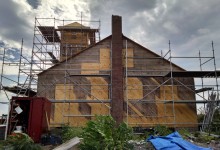
    Tower and staging
    Tower and staging

    At first we designed a building that nearly reproduced the belfry, with its open arches and fluted pilasters. We kept the original gables, but eliminated the witch’s hat. We presented the project at the Crit night of the Portland Society of Architects to get their input on the arrangement of clockworks and bell, and ended up getting better feedback about the roof and trim. They encouraged keeping the original roofline and accentuating the timber frame. We learned from the committee that the pilasters didn’t fit into the budget anyway. Ultimately, we arrived at a design that replicated the iconic roofline, over a much simpler box. We enlarged the arches, which echo the round top of the clock, but lost most of the Victorian trim, which took the focus away from the main object anyways. The timber framed floor hovers just above the bell, and is cut away at either window, so that the view of the clock is obscured as little as possible. The bottom of the clock is directly at eye level, so that visitors look up into its workings. One of the architects dismissed the design as looking like a ticket kiosk, which was OK by us, but I think of it as a building-sized display case for a desk-sized clock. The design process was incredibly rewarding, and the inputs from each stakeholder and committee member improved the design. Together we created a building that better fulfills its purpose than we could have on our own.

    Slated Roof
    Slated Roof

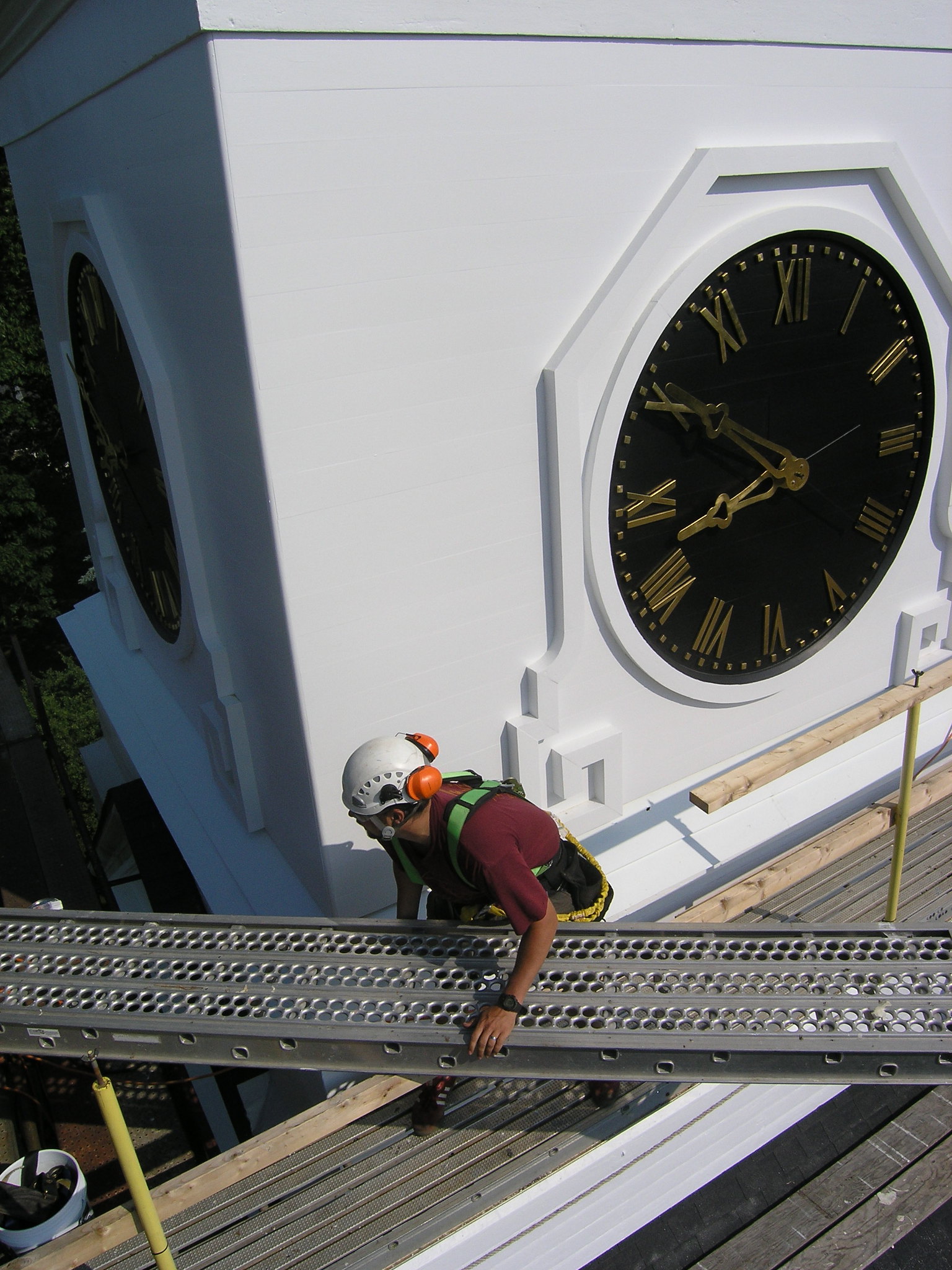
    Lee Hoagland, Jake Imlay and I cut and fit the frame at the shop. The new clocktower would be erected on the front lawn of the Centre School in Hampton, and we needed to complete as much offsite work as possible before we could work onsite during summer vacation. The foundation and site work was donated by Kenny Lessard by the end of the school year, and we erected the frame in early July. With Scott Lewis and Seth Rowell’s help, we sheathed the building and completed the trim. Portland Glass manufactured and installed the 10′ high arch-framed windows, many thanks to Paul Vermette and his crew. Skip Heal of Northeast Lantern donated a reproduction of the elaborate wind directional. The Heritage Company graciously accommodated our tight timeline and slated the eight peaks and eight valleys in August. In November, the clock was installed and running and we celebrated with the community, including many residents who fondly remembered the original tower and the clock’s tolling.

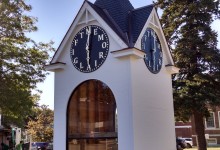
    Hampton Town Clock Tower
    Hampton Town Clock Tow

    While I certainly hope for more new design-build jobs in 2017, my “rosebud” for the coming year is the work we are doing with communities throughout Northern New England to preserve their historic landmarks, and that was the real pleasure of Hampton. We will be collaborating with local contractors in Troy, Readfield and Eastport in the Acworth Model to develop repair plans and share specialized skills. From the committee chair to the on-site carpenter, we are fortunate to work with folks who really care about their neighbors. We work with people who donate a lot of time, knowledge and money to a communal cause: saving the structures that serve as a reminder of our shared history and as meeting places that knit the community together.

    Hampton Town Clock Committee
    Hampton Town Clock Committee
  • Good Day, Bad Blog

    Good Day, Bad Blog


    Sub net pier from the top of the Wood Island staging
    Sub net pier from the top of the Wood Island staging

    This blog goes dark when it’s sunniest. Seems like every day this summer has been a good day to be working outside. We’re installing the last repairs to the undercarriage at East Derry First Parish Church, installing electricity for the clock at Hampton Town Clock Tower, waiting for the last of the ceiling to be removed at the Winter St Church in Bath and finally hanging exterior trim at Wood Island. They’re all big jobs, with little updates.

    ext-t1-wall-b-iso-w-church
    East Derry First Parish Church and steeple

    The First Parish Church is the biggest, heaviest building that we’ve ever lifted (thanks to Rick Geddes of Geddes Building Movers). The building was estimated at 188 tons, but actually weighs 288 tons. For the first time in PTF history, we bent a lifting bracket, as well as the shaft on a hydraulic jack (which is why we always use redundant rigging, and shim hard to ground).  “It’s been quite a challenge,” says job lead Brian Cox. A poorly conceived connecting ell was dumping water and moisture onto the historic meetinghouse, resulting in a nearly complete undercarriage replacement. Almost a year ago, we removed the steeple from the building and placed it on the front lawn to await repairs. In the early spring, the building was lifted, a new 4’ basement was excavated and concrete foundation poured. In May, the church was lowered onto its new foundation. Throughout the summer, Brian Cox, Dan Boyle, Seth Richard and Kirk Hennequin have been working diligently to replace any rotten girts and floor joists. Paul Lindemann on the restoration committee has kept a thorough blog to document their process and progress, and the building’s history. Read more here.

    Hampton Town Clock Tower
    Hampton Town Clock Tower

    The small Northern contingent of Lee, Jake, Scott, Seth and Jess built the Hampton Town Clock Tower this Spring and Summer. The standalone clock tower is building-sized display case for Hampton’s historic Howard round top tower clock. The 8-day clock, with dials that read “M E M O R I A L G I F T” instead of numerals, was given to the town in 1897 and ticking in the Odd Fellows Block until the building was destroyed by fire in 1990. The building is a design departure for PTF, as it references the Odd Fellows Tower, but does not replicate it. The four gable roof, topped with a “witch’s hat” spire, and four corner pent roofs was taken from the original building. Below, the body of the building is much simpler than the Odd Fellows tower. The 10’ arched windows reference the original arches, but the elaborate corner trim was eliminated, allowing the historic clockworks to take center stage. The clock will stand on a low lofted floor above the bell, making the clockworks accessible to its civic owners for the first time in history. Phil D’Avanza is completing repairs on the clock, and Skip Heal, of Northeast lantern, donated an enormous reproduction of the original weathervane. Read more about history of this clock, from installation, through destruction, disappearance and ultimate restoration.

    Sagadahoc elevated timber deck, partially erected
    Sagadahoc elevated timber deck, partially erected

    In August 2015, high winds shook loose nearly a third of the coved ceiling at the Winter Street Center in Bath, ME. Enormous swaths of plaster and lath crashed onto the pews, and hung loosely from the trusses. Remediating and repairing the 26’ high ceilings posed a unique challenge. The sanctuary needed to be cleaned of hazardous debris, and the rest of the dangling plaster needed to be removed. Following the removal, Sagadahoc Preservation will need to raise the funds to make necessary truss repairs and ultimately reinstall the ceiling. The process is expected to take years, and a lot of staging. Given the original timber framed floor framing, with large, widely spaced girts and joists, and the time-span of the project, it made more sense to build a timber-framed deck 13’ above the floor, and cantilevered over the balcony. The deck is perfectly flat, and allows EnviroVantage to safely remove the ceiling where it is 6’ above the deck at the eaves, and from rolling baker’s staging at the center of the room. The timber deck even allows Sagadahoc to continue to use and show the sanctuary as they fundraise for the next phase. Jake Imlay wrote a great post describing the building and our approach there. Coming soon.

    Wood Island Life Saving Station boathouse and tower
    Wood Island Life Saving Station boathouse and tower

    The restoration of the Wood Island Life Saving Station, in Kittery Harbor, has had Arron and his salty crew of Tom, Dave, Jake, Tim, Scott, Jess, Gail and Kendall up to their armpits in work. The life saving station was built in 1908 for the U.S. life saving service and became part of the coast guard in 1915. The U.S. Navy used the site to defend Portsmouth Naval Shipyard against U-Boats during World War II. Since the early 1950’s, the life saving station has been unused. Although the island is a popular destination for kayakers launching at Fort Foster, the building fell into dangerous disrepair, with radiators dropping through the floors. The Wood Island Life Saving Station Association applied for National Register status based on the building’s historic significance, and the integrity of the original interior trim and cabinetry. Over the summer, the intrepid crew rebuilt the boathouse, porches and dormers. As ever, sheathing repairs revealed more extensive rot than expected, but we’re finally finished with taking things away, and can focus on rebuilding. This week, we commenced with hanging reproduction trim milled right in our shop in Berwick. I’ve worked in wind like that on one other job-site: Mount Washington. We hope to have the building roofed by the end of September, which will mark the completion of phase one. And we’ve had some good press, from the Portland Press Herald to the Associated Press. Read more here.

    As much as we’ve enjoyed these projects, we’re looking forward to Fall, continuing repairs at the Abyssinian Meetinghouse and Troy Union Church and commencing work at the New Harbor Methodist Church, among others. When it rains, check back for more.

  • Unveiling York First Parish Church,  (we took the staging down).

    Unveiling York First Parish Church, (we took the staging down).

    Ed, doin’ the Pick Shuffle

    Last week, we dropped the staging from the front of the York First Parish Church.  After the 24 ft picks were lowered smoothly, we took apart the rest of the ledgers and standards like a rogue band of dismantling Doozers.  Staging takedowns like that don’t just happen, they are engineered, by people like Keith Trefethen.  Thanks, Keith!  When the staging was finally on the ground,  and we were sweeping up the last of the debris, we heard a rustle in the trees — the collective sigh of York’s most elegant wedding planners.

    For more photos of the takedown, explore our Flickr album.

  • Trim Time

    Geometrim
    Geometrim

    These past few weeks, with the inclement weather, the York Congregational trim has kept us busy in the shop. Using a steam box, we carefully scraped the lead paint from the trim pieces, made dutchman repairs, and filled nail holes with West System epoxy. We were able to repair 90% of the scroll-shaped trim that surrounds the clock-faces, and about half of the curved pieces that create the outline of the clock-faces. The pieces at the bottom of the curve collect the most rainwater, and all needed to be replaced.  In order to cut the bevel on the concave edge of the new circular trim, Keith tilted the table of the bandsaw, and made a circular track for the trim to ride in.

    Please click on the photos below for more information:

Think we can help? Get in touch.