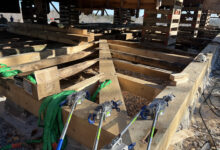
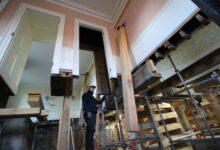
The Ox Barn at Sabbathday Lake Shaker Village and the Penhallow House at Strawberry Banke are two of our most historically significant projects. Both buildings were temporarily lifted by Geddes Building Movers so that they could receive completely new foundations and modern drainage systems. Jimmy and his crew are peaceful and professional and we could not recommend them more highly. We also appreciate all the news coverage these jobs have received recently. It is well deserved.
Ox Barn undercarriage diagonal floor girt
We’ve repaired the undercarriage at the Ox Barn and it was recently lowered onto its new foundation. NewsCenterMaine broadcast a nice piece about the day, and you get to see Arron being himself.
NH Chronicle broadcast a story about the ways that Strawberry Banke is adapting to increasing storm surges, groundwater levels, and climate change.
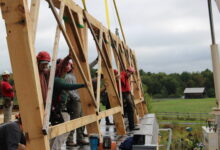
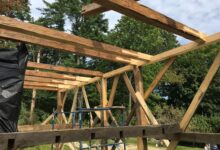
Last week, the entire crew came together to raise Arron and Michelle’s new barn. A lightning strike destroyed their home, our office, and workshop over two years ago. Last night, NewsCenterMaine published a lovely story about how the community has been helping to rebuild ever since. Arron and Michelle and all of us at PTF feel very fortunate to be surrounded by so much love and support. Thank you to all our dear friends, colleagues, and neighbors.
Thank you Alex Dykstra for taking all these great photos of the day:
Raising the front eave.Walking the eave into position.Installing the first tie beam and rafter pair.Fitting the braces.Fitting the posts.We sheathed it over the following week, and since then, the SIPs have been installed. It’s been a long wait, and we’re all relieved that it’s weather tight.Thank you everybody. We are very lucky.
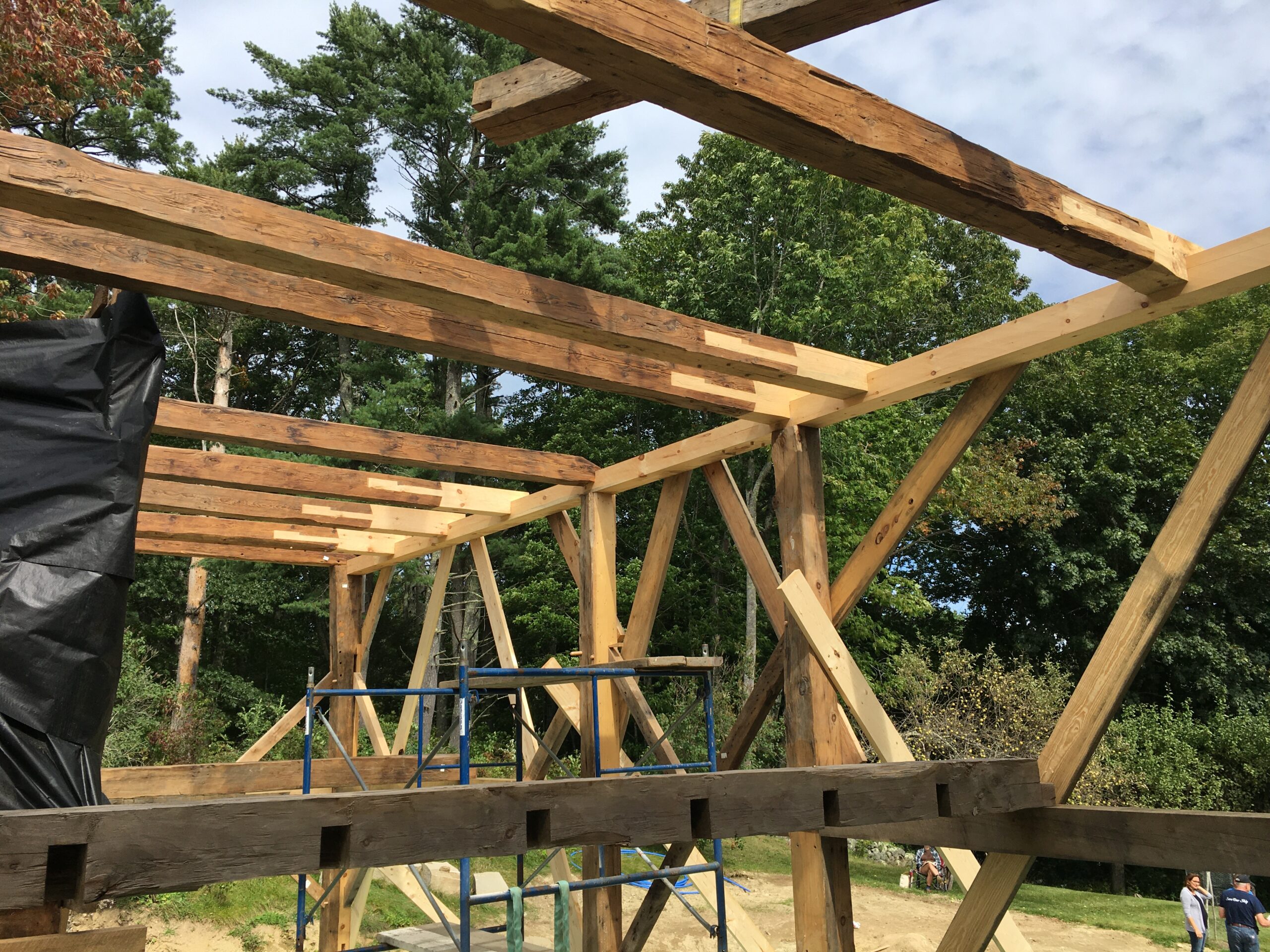
We raised the Kavanagh ell last week. The frame was in rough condition, but the owners have prioritized preserving original material as much as possible. All but one tie beam received two new ends, each joined by a timber scarf. Most of the posts received repairs as well. The undercarriage and roof system were beyond repair, and will not be seen within the finished space. The roof will be framed conventionally by Williamson Fine Homes.
Center Tenon Tie Repair, keyed, wedged, and under-squinted.
Dan Newman cut center tenon scarfs to repair the rotted ends of the tie beams. The shoulders of the scarf were under-squinted (angled) to prevent twist, and the center tenon was keyed and wedged to work in tension. The scarfs were cut with extremely tight tolerances because they will need to resist spread in the eave walls, and because they will be on display in the second story bedrooms.
Double-bladed post repair
Most of the posts required repairs as well, but Jake Imlay and Dan cut their scarf joints to preserve the maximum amount of original material. A double-bladed scarf joint attaches a new post base to an original post top, above. The length of the scarf is customized to cut out all rot and preserve the beautifully-hewn interior surfaces.
Eave wall raising with crane, and crew
The ell was relatively small, and was erected with an “eave-wall raising” (as opposed to a “bent raising”). An eave-wall raising is typical of small 18th and early 19th-century frames, with tie beams that cross the plate with half-dovetail joinery. The crew scribed all new joinery and fit all the walls, then reassembled the eave walls on the deck, and reinforced the frame with KD bracing and gussets. Using a “4-point pick”, the crane raised the east eave into place, while the crew set the post feet into their mortises. We braced the east eave and set the house-end girt into its mortise. Then we switched sides, and assumed the same positions to raise the west wall.
Assembling Bent 1
This was a relatively easy crane day because Scott and the crew were so organized. After the eaves were raised and braced, we used the lull to lift the Bent 1 girt into place. The girt is connected to its posts by both ascending and descending braces, and required a pair of hands on every brace. Cut from white oak, it was difficult to tell the old braces from the new, their edges were still so crisp. But when we went to pick one up, our arms knew the difference–the new ones weighed three times as much.
Scott tags the tie beam
Scott Lewis organized the frame raising and communicated with the crane operator. After the eave walls were standing, he rigged each of the tie beams evenly and directed them into position. This photo shows the gorgeous double-ended tie beam repairs that are the centerpiece of this preservation effort.
Jake fits a half dovetail joint
The crane placed a pick across the tops of the eave walls, so that Dan and Jake could fit the tie beams into cogs in the plates. The eaves were relatively straight and the joinery cut so cleanly that the hardest part was sliding the pick down the plate while staying clipped-in. The tie beams join to the plate with a stopped half-dove, visible above in Jake’s hand. This photo illustrates well the advantage of the wedged center tenon – much more of the original material is visible from below.
A Tale of Ten Tie Beams
The northern crew has been at Kavanagh for a while now, and rebuilt the undercarriage beneath the house this past winter. Given the extent of damage in the ell, the frame repair was relatively quick, the crew dismantled the frame in late April of this year, and spent the summer cutting scarf fixes and scribing joinery. By mid-September, we were re-erecting the frame on the fine crane day pictured here.
The PTF crew has another small frame to raise on site, and is handing the reins over to Williamson Fine Homes to finish the Ell. Then the northern crew will turn its attentions back to the main house, to repair one of the most finely crafted hip roofs in the state of Maine, surrounding a glass-floored cupola. It’s a lot of work, and we feel lucky to do it.
PTF has been wicked busy. We are working on some phenomenal projects, and I’m going to let the pictures speak for themselves:
The Northern Crew of Jake, Dan N. and Tim is completely rebuilding the undercarriage of the historic Kavanagh House.
Kavanagh House, Jake and JacksKavanagh House Front Stair on CribbingKavanagh House, Jake and his Scarf Joint
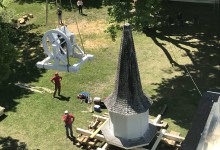
The Far Southern Crew of Erik and Brian painstakingly reproduced the historic bell yoke at First Church of Christ in Essex, MA.
FCC Essex, Erik and the Bell Yoke, Photo by Brian CoxFCC Essex, Bell Yoke in situ, Photo by Brian Cox
The Greenland Crew of Dave and Dave, Tom and Tom, Darren and Dan B. are completely restoring an antique frame in Greenland, NH, and designed a new timber frame barn to go with it. If you’ve always wanted to buy a historic house, restored by PTF, on some gorgeous property, this one will be on the market soon. Thank you to Adam Bedient for his incredible photos.
Greenland Barn, First Bent raising, Photo by Adam BedientGreenland Barn, Tom foots the first bent. Photo by Adam BedientGreenland Barn, Rafter flies. Photo by Adam Bedient
Norway UU Church is the kind of church that reminds me why we do this work. The congregation has been hosting a community lunch program for more than 25 years and the building provides a space for daily AA meetings. When I’ve been in the office for weeks, finishing up estimates I know will be shocking, I start to wonder whether all this old building stuff is worth it. What are these places worth anyways? Why save our historic barns and landmark buildings? Off-site, it gets existential.
One of my jobs is to provide an answer to these questions. Frequently, functionality is enough. A big old barn might be easier to repair than to replace and traditional approaches are proven. They last longer. They definitely give the building more life per buck. Intellectually, I’m convinced, but emotionally, I wonder, “Do these buildings really matter, to anyone?”
Norway Unitarian Universalist Church matters. The steeple has anchored Norway, Maine’s Main St for nearly two centuries. The building provides a place for people of all walks of life to gather, in a rural community, where people may love being alone, but also get lonely. In a diverse and sometimes disjointed society, we need welcoming, inspiring spaces like these, where the building reminds us of what we can achieve, and have achieved, when we work together as a community.
Norway UU Tower
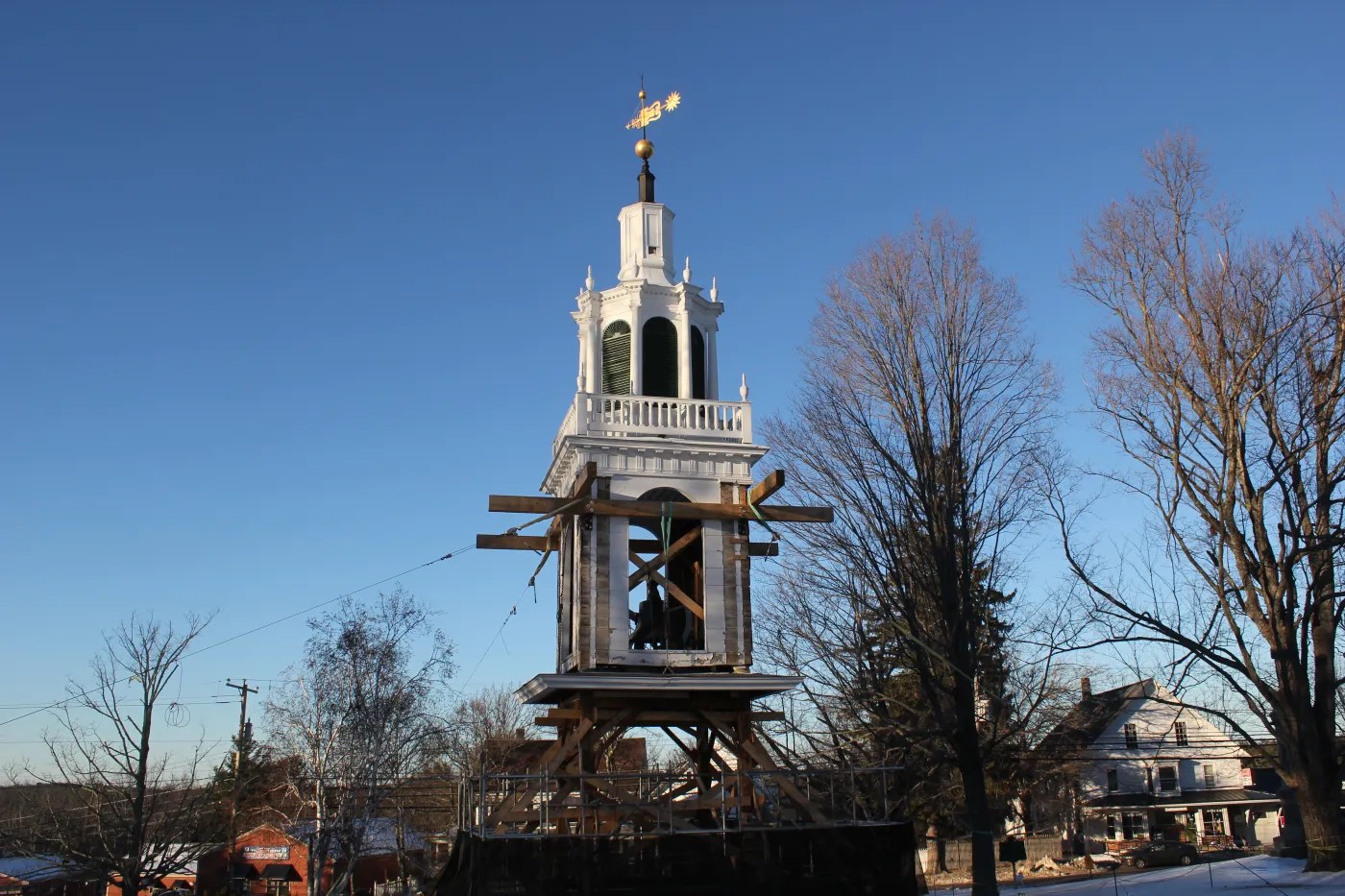
We removed the steeple last month. Steeple removals, like all crane days, are exciting, but are tinged with melancholy. Removal is often the first step toward repair, but it’s still hard to dismantle an icon like this one, especially when we don’t know exactly when it will be restored. The steeple has an open belfry, with eight posts and a dome. Initially, we had hoped to save the posts and extract the belfry as a unit. In towers like these, the belfry posts telescope deeply within the tower. At these heights, steeples face powerful wind loads. The tower roof, or bell deck, is a potential hinge point for the tower. The length of post that extends above the tower box is only about half its total height. The belfry posts rest on bed timbers that cross tower girts deep within the tower walls.
Tower and Belfry Framing
Upon further investigation, we confirmed that five of the eight posts were rotted beyond repair. When this many posts are this badly rotted, we know that there is more damage hidden behind the trim and sheathing. Additionally, the tower roof had been re-built three successive times and each set of rafters, sheathing, and shingles was stacked over the last. Woven amongst this framing were a collection of weird posts attempting to stabilize the bell. Despite the beautiful tower and belfry timber framing, the framing below the bell was a mess, making it impossible to discern which timbers were really holding up the bell. There was no way to extract the bell with the dome in place, and there was no way to selectively extract any viable posts, which weren’t likely to exist (spoiler: they didn’t).
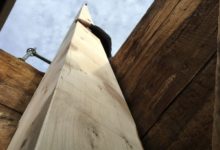
Ultimately, we made the tough decision to sever the belfry posts, and began to rig the dome accordingly. I can say, definitively, that we hate cutting posts. We hate doing it as much as we hate finding it done. We barely know the labor that went into extracting these logs from the forest, and hewing them. We know intimately the effort involved in laying out the joinery and cutting it. Cutting joinery is a joy; cutting posts may be made exciting by the adrenaline of a crane day, but is something else entirely.
Dome Crab, stabilized for flight
To prepare for crane day, the crew stabilized the crab, in the ceiling above the bell. The crab is the horizontal grid that connects the tops of the eight belfry posts and supports the half-round dome rafters. It looks like a timber hashtag and this one was #rotten. With 2x10s, we traced the layout of the crab timbers, stacking and blocking the 2x into a grid three layers thick. This stabilizes the crab for flight. Then, the crew used a laser level to establish the exact height of the rigging timbers, and the subsequent line on which we would cut the belfry posts. Early on crane day, the crane flew in the rigging timbers, arranged in another timber hashtag, about 20′ across and extending out the belfry by about three-and-a-half feet. Next, we installed bolsters between the rigging timbers and the stabilized crab, so that the dome would be lifted level. The load must be bottom-heavy, and very stable.
The crane will hold the dome in what is called an 8-point pick. A rigging strap is basketed around the end of each rigging timber, and connects to a custom-built “cage” that hangs from the crane. The cage is a square of heavy-gauge tube steel, with rigging plates at each corner. Two of the rigging timber straps shackle to each plate. Connecting the straps and shackles to the ends of the timbers is a slow and careful process, the shackles need to be oriented properly to ensure that they can’t unscrew during flight, and avoid twist in the straps. Everybody on the crew is focussed, and moving deliberately.
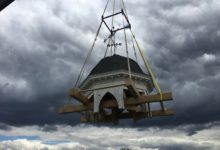
Norway Dome, off it goes
After the dome is rigged, the crane begins to cable-up and take a little weight. The crane will need to lift the dome enough that our reciprocating saw blades don’t bind, but not so much that the dome bounces as the last post is cut. Each person in the belfry was responsible for cutting two posts, as closely to the line as possible and leaving level feet for the dome to rest upon in the yard. Scott was on the radio, communicating directly with Arron and the crane operator on the ground. As we cut through the posts, we drove a wedge into the kerf to keep the kerf open, and to prevent the crane from having to take too much weight.
At every lift like this, one corner “sits hard”. No matter how evenly we’ve rigged the tower, or how centered the ball is over the building, there is always one corner that is heavier, due to the vagaries of wood density and concentrations of pigeon droppings. I was the lucky lady with the heavy corner, which meant that everyone else’s kerfs were open and free while I was still trying to finish my cut. I repeated a pass with my sawzall for the third time, and finally severed the remnant of corner board that was holding us down. The dome lifted gently, with no bounce at all.
The crowd cheered, and we descended for the best lunch I have received in more than a decade of crane days. A crowd had turned up with their lawn chairs, and we were treated to burgers, pulled pork, cole slaw, salads and desserts. A number of building committee members wanted pictures with the crew. We were enveloped in the love they feel for their church, and the enthusiasm they have for their community. On the job site that day, it was easy to understand why these places matter.
Ground Crew View
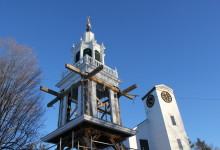
After the steeple had flown, we were finally able to see just how badly the belfry posts had deteriorated. In a number of places, the posts had been severed at the tower roof, and “secured” with small angle brackets, like you might use to fix your kitchen table. There was no scarf joint connecting the two halves of the “repaired” post, and the fasteners were rusted through. We had planned to extract the bottom halves of the tower posts one at a time, but we were able to push three of the posts over by hand, and lay the partially rotted stumps on the bell deck. The level of deterioration confirmed our decision to sever the posts. It would not have been safe to try and extract them whole. We flew the bell, and carefully demolished the upper layer of roof, upon which the bell had been sitting. We then covered the second roof level with EPDM rubber, wrapping the cornice and securing it to the tower wall with strapping.
Belfry Trim Notes
Next, we will begin the process of more thoroughly documenting and dismantling the dome, saving as much original material as possible. The bell deck will need to be re-framed. The congregation will leverage the grounded dome to finish the fundraising and get to the crane day that will restore the dome to the top of the tower as soon as possible. The congregation at Norway can take heart from East Derry, who, just this past week, hosted a crane day to restore their belfry and lanterns to the top of their 60 foot tower. come back to read about it next week.
This blog leaves a lot out. We can’t give our projects their full due here while giving them their full due out there. I’ve been especially remiss with regards to East Derry. The First Parish Project has been in progress since 2012 and includes the replacement of the undercarriage, moving the building onto a new foundation and rebuilding a belfry, lantern and spire. In the video above, we are replacing two continuous 60 foot posts in the standing tower. There was a lot of back and forth about dismantling the tower, but ultimately, we left it up because housed inside are the intricate mechanics of a historic pipe organ. Reassembly of the organ rivaled reassembly of the tower for level of complexity and expense. While we’ve been remiss in coverage of this long hard road, Paul Lindemann, a dedicated leader of the building committee, has been documenting the process on his website: Nutfield History. Paul made this sweet time-lapse video of the posts being inserted. The video may condense the day into just over a minute, but the installation of these posts was the culmination of months of documentation, design, demolition and rigging. In order to stabilize the building, the crew essentially built a skeleton tower inside the existing tower. It was big. The entire crew should be commended for their hard work, determination and fortitude, but especially Brian Cox, Dave Ewing, Dan Boyle, Tom Glynn and Seth.
It just so happens that the crew is delivering the belfry frame to the church today. Each of the full length belfry rafters are 12″x 12″x 14′ and weigh in at around 1200 lbs. We’ll keep you posted.
The last bell to leave the Revere Foundry leaves its perch. Photo by Scott Lewis
It is never a pleasure to break the news that a steeple should be removed to ground. It usually indicates a catastrophic level of deterioration and a total budget in six figures. We only make the recommendation when it is the best approach and the most economical. We remove a steeple when it is the most assured path to its restoration. These steeples define Maine’s skyline. They are one of the most important characteristics of New England’s shared architectural heritage. Every time, we worry that the steeple won’t be returned to its perch, but frequently, removal is one of the best fundraising motivators. Removing a steeple to the ground makes the job safer, it reduces staging costs. It allows us to preserve more original material. Usually, due to underlying frame damage, it isn’t just the best option, its the only option.
It’s a sad day when a steeple is removed, but it’s exciting too. The whole crew is on site, along with a big crane. The rigging is a fascinating geometric puzzle and the removal sequence is a high-wire choreographed dance. This summer, we removed two such steeples, at Benton Falls and West Auburn.
Benton Falls Congregational Church
During my first assessment visit to Benton Falls, I squeezed through a hatch in the tower roof and emerged beneath the bell cradle, banging my helmet on the last bell ever to leave the Revere Bell Foundry. On my second visit, a few months later, no amount of beating would open that hatch. The tower plates were nearly non-existent, and Paul Revere’s last bell was slowly crushing through the roof.
In the architectural glossary of my mind, Benton Falls illustrates “adorable”. This is from our original existing conditions assessment:
Built in 1828, the Benton Falls Church is understated and intimate; it is embellished just enough to fit in with its surroundings, but not make a statement of its austerity. An archetypal rural Maine church, the gable-roofed main building is 38’ x 42’, with a 12’ x 12’ tower resting on the front gable wall and first interior bent. The tower is topped by an open, octagonal colonnade, notable for containing the last bell cast by the (Paul) Revere Bell Foundry in Canton, MA. The belfry is topped by a simple lantern and well-proportioned, eight-sided spire.
Overall, the building is showing its age, alongside a history of committed Yankee maintenance.
Belfry columns, stacked on ground. Photo by Scott Lewis
A few of the turned belfry columns were rotting, and would need to be extracted from the building. The turned portion of the column was only about half its length. The bottom half is a timber blank that telescopes deeply into the building and lands on a catty corner crab 8 feet below.
Rigging stack and crab hashtag.
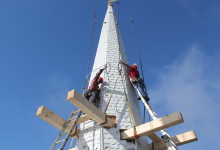
We were not able to access the lantern and spire framing on our assessment visits, but the witch’s hat needed to be removed based on the condition of the belfry posts and tower roof alone. Standing on the tower roof, and tied into the framing, the crew re-enforced the lantern crab with a triple-stacked grid of KD (kiln-dried 2×10). Then they assembled rigging timbers by laminating together four layers of 2×12. The rigging timbers were stacked on edge, and crossed like a hashtag. They extended past the lantern by half its width. Eight rigging straps choked the ends of the rigging timbers, and were hung from a square steeple cage.
Lantern crab center
The local CBS station, WABI 5, caught the crew rigging the steeple on crane day. The tv crew interviewed members of the congregation and neighbors about the importance of the church in their community. Congregants expressed their commitment to preserve the building with traditional in-kind repairs alongside the challenges of fundraising. By partnering with local craftspeople, we are able to cut costs, increase efficiency and share our knowledge, but these projects are expensive, especially for a small congregation. There are those who will promise they can do the job more cheaply. Unfortunately, it is cheap repairs, devoid of joinery and overly reliant on steel, that we are most frequently called upon to re-repair, twenty years later. There’s no fiberglass steeple that has lasted as long as a timber one.
Lantern crab, mast and strap
On the ground, we’ll be able to repair the belfry posts, and document the beautifully crafted spire. It has not one, but two gods-eye shaped crabs, one for the lantern, and another for the steeple, which is supported by a central mast. The crab and mast are secured with a wrought iron stirrup, pinned and wedged. Consistent with its age, the builders used a little bit of iron in the right places: to reinforce joinery at the crab’s center and at the ends of the trusses, preventing the rafter heels from blowing out their mortises.
Spire crab and mast
Benton Falls is currently raising money to restore their steeple, you can reach them on Facebook, where they also have a video of the steeple flying.
West Auburn’s steeple was also removed this summer, using a similar rigging system. Both churches accessed the Maine Steeples Fund to help with assessment and repair costs. West Auburn got attention from the Sun Journal and NBC’s NewsCenter Maine. You can visit them on Facebook, too, where you can see photos of their steeple flying.
Last Thursday, I popped out of bed at 4 am, like Sal on her way to Bucks Harbor. Scott informed me that if I wanted to help remove the Chestnut St Church spire in Camden, I needed to be there by 6:00. By the time I arrived, Scott and Arron had set the rigging. About a third of the way up the spire, eight laminated KD 2x10s poked through the spire like an avocado pit ready to sprout. PTF was hired to direct the spire removal and design a timber-framed transition from the old belfry frame to the new fiberglass spire. We’d worked with the G.C. before on True-Randall farm, Taylor-made Builders are good folks who do high-quality work; so even though fiberglass replacements are not our thing, we got over ourselves because Taylor and his crew are such a pleasure.
This steeple is so tall that a 120′ man-lift couldn’t reach the weathervane on the day we went up there to remove the weathervane (oops). The main church is two full-height stories. Starting just below the main ridge-line, the belfry posts rise 30′ to a plate level just below the clock dials. The original spire rafters penetrate into the belfry, landing on a girt 5′ below the plates. The spire rafters pass through the dial level, behind four 6′ diameter glass dials. Above the dials, the original spire rafters were severed and sistered with relatively light, laminated 2x4s. That repair was performed in the 1990s by a talented and eager Eagle Scout. This go-round, we designed a timber-framed “lantern” that crosses the belfry plates like a crab. Eight 8×8 posts rest upon the lower crab and support a maintenance floor behind the clock faces. The upper lantern plates, or upper crab, extends well into the fiberglass spire, 6′ above the horizon of the clock faces. Four new fiberglass dial hoods will protect the dials, and be structurally fused to the new fiberglass spire. The lantern frame we’re cutting reproduces the telescoped framing levels found in this building and other historic steeples.
Lantern Iso, X-Ray
The model we’d created for the lantern design allowed us to accurately calculate the height at which the rigging would need to be placed in order for the spire to be slightly bottom-heavy as it flew. In fact, once prone in the driveway, the spire balanced like a seesaw on the fulcrum of its rigging. A top-heavy spire might flip mid-air, which would be just as dangerous and scary as it sounds.
Chestnut St Church, Crane, and Rigging
We hung a cage from the main ball of the frame to protect the weathervane from the rigging straps. We linked together the crane operators’ longest cables and our longest rigging straps, to connect the four corners of the metal frame to our rigging beams. The last strap was doubled over, resulting in an eight point pick.
Spire cage
The crane flew the rigging up to the crew on the top of the staging, and we pulled the rigging straps away from the spire as the operator located the ball directly over the weathervane. The rigging was accessed by ladders off the staging, which was less efficient than it was photogenic.
Teamwork
Once the rigging was securely attached, we crawled inside the spire and used saw-zalls to cut first the spire sheathing, then the mast and then all eight rafters. In my experience, the penultimate step of severing the last connections is the most stressful and variable part of the entire crane day. As Arron warned the crew, a forgotten toe nail could prevent the spire from releasing safely and evenly. We were lucky to have a skillful crane operator from Keeley. We wanted the crane to take enough weight, and put enough tension on the rigging to prevent our sawzall blades from binding, but we did not want the spire to bounce or release with any energy.
Witch’s hat with a crown of thorns
Scott and Arron checked in with the operators. When we started cutting the sheathing, the crane had 1500 lbs of weight on the ball. For the mast, 2500 lbs. As the last of the rafters were cut, the crane was taking 3500 lbs. Unfortunately for the spectators on the ground, a safe spire removal looks slow and boring. Unfortunately for my story, the spire released without any hitches. The spire weighed about 8800lbs, which reflects its light framing.
A Bittersweet Triumph
The crane operator lowered the spire safely to the street, and the crew cut the cone into sections small enough to carted away by a pulp truck. The Penobscot Bay Pilot got some beautifully boring drone footage of the removal, and covered the story, here. For more photos of our process, visit our Flickr album.
The Troy Union Meetinghouse had a crane day last week. The long-leaning steeple was partially dismantled, leaving behind the two front posts to stand like wooden antennae. The entire replacement frame has been cut by a crew of local craftsmen, and will be resurrected before the end of the summer. Read more about the process here, and show your support. If you don’t see a video below, click on the link to watch the story.
The First Parish Meetinghouse of East Derry, NH is preparing for a big anniversary, its tricentennial. What does one even get for a church on its 300th? Wood? Copper? Both, as it turns out. Beginning with a thorough assessment and rehabilitation plan in 2011, the congregation has been working steadily to repair extensive damage throughout the steeple and undercarriage. This past fall, we extracted the belfry and lanterns from the steeple stack. After the new year, we documented the upper sections from a woman-lift and dismantled them from finish to frame.
Lower lantern roof, crowned with urns
As we surgically removed trim, we encountered earlier salvage efforts. Dan and Rod peeled back the gracefully curved roof between the upper and lower lanterns and revealed an oiled sailcloth roofing. The sheathing below was labeled November 1916.
Lower Lantern Posts
The frame was in far worse shape than we expected. Years of roof leaks and patchy repairs had finally overtaken the stout timbers. Once the lower lantern posts were exposed, we wondered how the structure was still standing and realized too late the bravery of dismantling it. Above, you can see that the six of the eight posts were hollow or non-existent at the top. An extensive repair campaign in the 1990s consisted of bolting channel steel and L-brackets to the crossing crab members (a “crab” is a horizontal web of timbers that spans the posts of a lower level and support inboard posts above). Looking at this picture, stiffening the crab fell far from the root of the problem.
Lower lantern crab above belfry ceiling
The crew struggled to free the timbers from their steel cages only to discover a corpse. It’s tragic that this rot wasn’t addressed when the church raised money for its repair two decades ago. A comprehensive, traditional approach at that time would have prevented the wholesale replacement necessary today.
Truss spread
In 1719, Scotch-Irish immigrants, fleeing religious persecution in Northern Ireland, settled the area that became East Derry. In 1722, they built their first meetinghouse on this site. The present structure was built in 1769. By its centennial, in 1822, the congregation had so grown that they cleaved the building in two and dragged one end 24 feet to the east. Above, you can see the first additional bay, indicated by the absent strainer beam and braces.
East Derry Wall D
In our assessment drawing above, the strainers and bracing between the trussses in bents 3 and 4 and bents 5 and 6 are non-typical. The strainers and bracing in bright green are non-existent; that is the bay in the photograph above. The yellow strainers and bracing between bents 5 and 6 do not quite reach bent 5, they are connected by a series of sisters and scabs. The evidence in the frame complies with the history: our hypothesis is that in 1822 the building was split between bents 3 and 6, (originally bents 3 and 4). Bents 6 through 9 were dragged to their current position, and bents 4 and 5 were built as exact reproductions of the originals. The strainer and braces that used to connect bent 6 (originally 4) to bent 3 were sistered to bent 5, and the strainer between bents 3 and 4 was deemed unnecessary. We are curious to uncover more of the eave wall framing, specifically the plates and the sill scarfs, to see whether there is more evidence to support our theory.
Parallel rafter chord truss
The East Derry First Parish truss is iconic. It has a king post in the center, with parallel rafter-chords and crossing pairs of ascending and descending struts. The king post is in tension, picking up the tie beam at the middle of its span, and the ascending struts rise from the king post and prevent the rafter from sagging. In the Timber Framing series, “Historic American Roof Trusses,” Jan Lewandowski explains:
Outward pressure on the walls can be eliminated entirely by affixing the feet of each rafter couple to their own tie beam. The problem of sag can then be addressed by hanging a joggled vertical member, or kingpost, from these rafters and using it in tension to support the midspan of the tie beam… By a less obvious intuitive leap, it might be realized that the midspan of the long rafters can be kept from bending by struts rising from lower joggles on the suspended kingpost.
East Derry Bents 1-4
The parallel rafter-chord is an innovation that protects the Achille’s heel of the king post truss. The casual observer often assumes that the joint between tie and king post is where we would most frequently see failure over time. I’ve seen many iron stirrups that attest to the builder’s concern for this joint. But most trusses fail at the rafter heel, where the upper rafter-chord intersects the tie beam. Of this foot joint, Lewandowski writes:
Those we can inspect seem more prone to failure and impairment than most other connections in the truss, for a combination of reasons: the lack of relish beyond the mortise and the large forces involved, coupled with the low angle of attack of rafter to tie, all exacerbated by a high incidence of leaky eaves. The significance of the roof slope is that the geometry of low-pitch roofs channels more horizontal force against potential long-grain shear failure in the tie at the foot joint than it does comparable vertical breakout load on the kingpost at the peak (see TF 72, 19). The point: on both empirical and theoretical grounds, the principal rafter-to-tie beam joint is the likely weak sister in the mix.
In Sedgwick, we saw the foot of the upper chord shear a 2″ x 12″ x 22″ block clear off the end of the tie beam (It was about the size of a hefty wedding-present-breadboard). With a parallel rafter-chord truss, the duties of principal rafter and upper chord are separated. The principal rafter, the top angled timber, carries the roof, while the upper chord, the inner angled timber, carries the compressive loads created by the truss. The upper chord intersects the tie beam farther from the end of the beam, thereby protecting the relish just past the joint from shear. We so liked this truss that we reproduced it in a building where it will be on grand display: the Lewis Conservation Center.
Steeple extracted
Paul Lindemann, East Derry historian and devoted parishioner, keeps a detailed website documenting the history of the church and their repair process. The Nutfield History blog is a fascinating read for anyone interested in New Hampshire history or building history in general. The blog also benefits from Lindemann’s web design skills, something that doesn’t always attend the dual callings of historian and parishioner.
The vigor and ingenuity of the immigrants who built this Meetinghouse is evident in its frame. We honor their labor with our efforts to preserve it. In 300 years, what will historians write about the immigrants seeking refuge in the United States today?