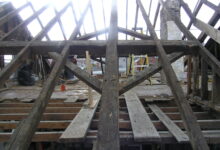
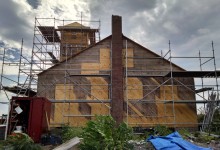
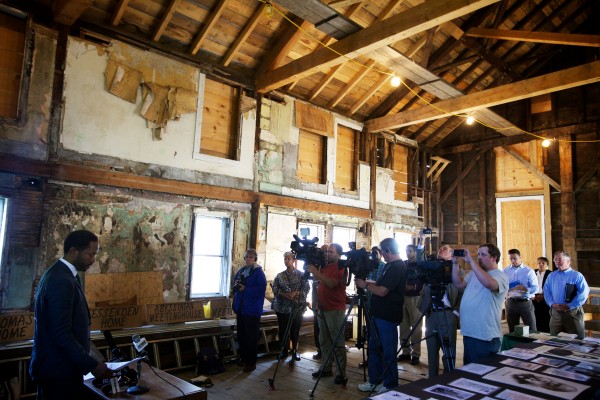
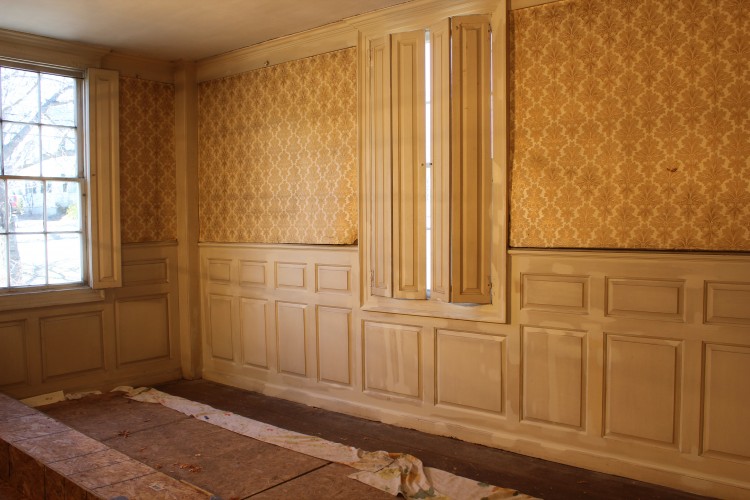
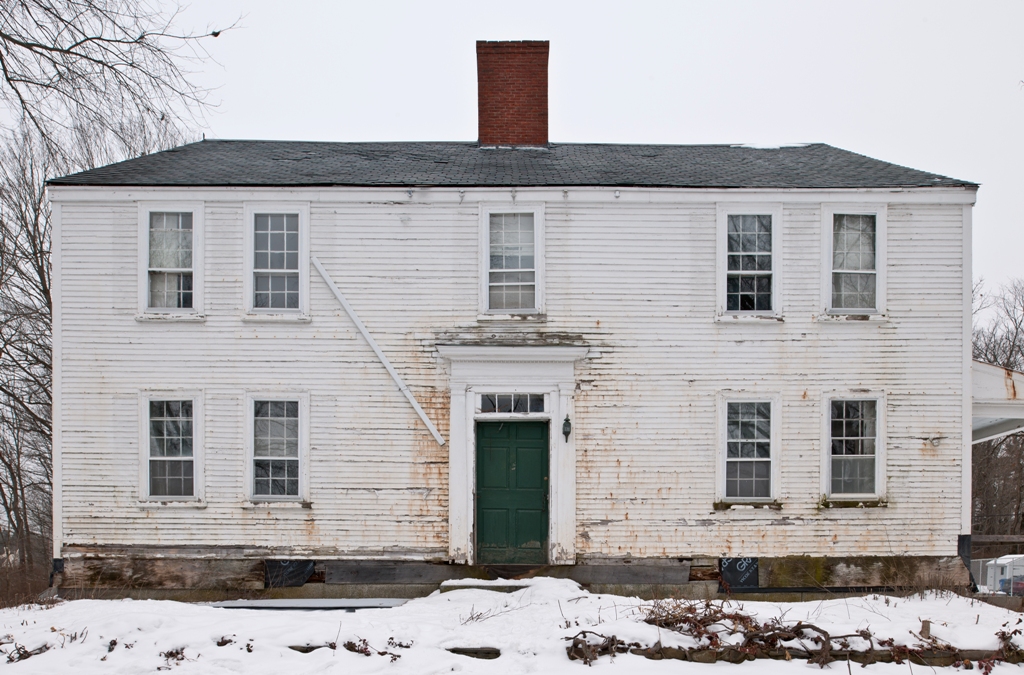
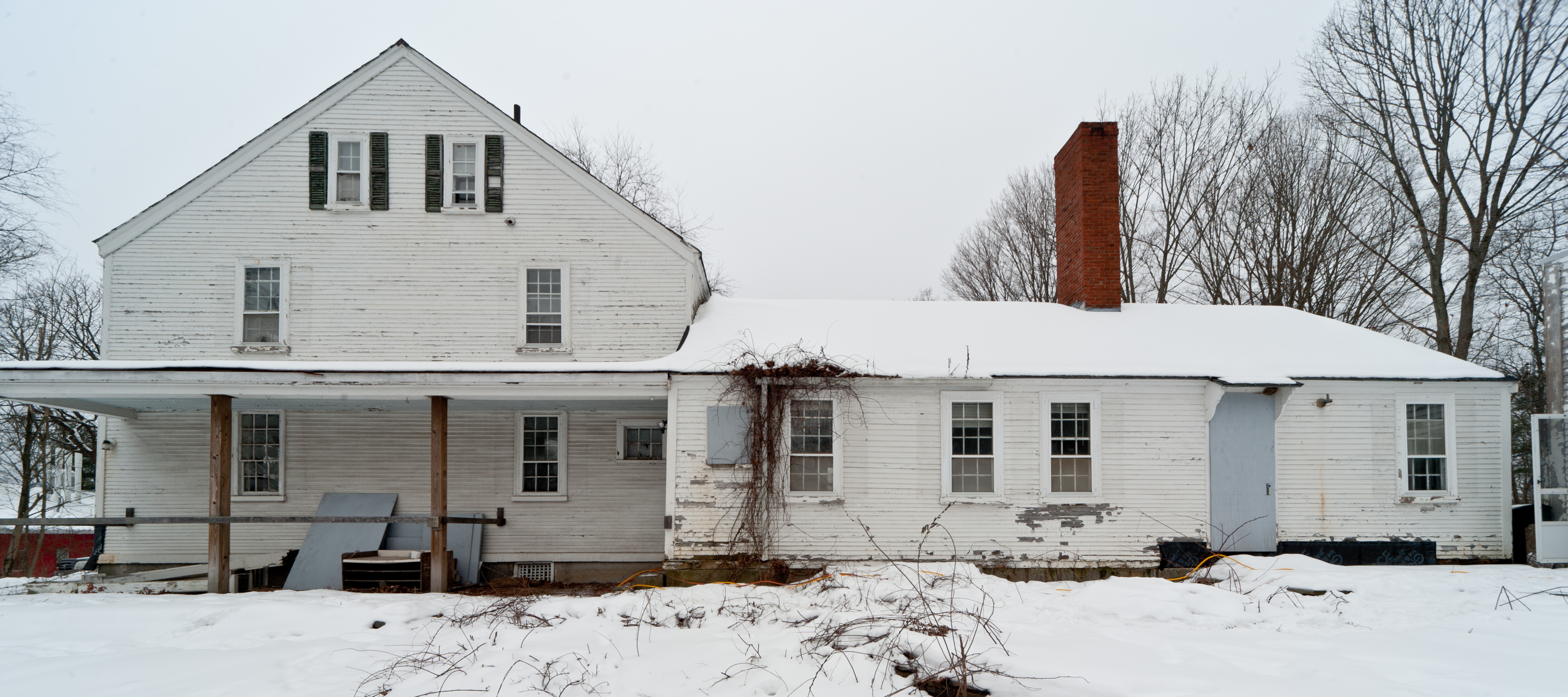
The story of the Abyssinian Meetinghouse and Leonard Cummings, its long-time board president, was on the cover of the Maine/New England section of the Maine Sunday Telegram today. The Abyssinian is the third oldest African American Meetinghouse and is located across the street from the Shipyard Brewery in Portland. Frederick Douglass trod its very floorboards. We have worked to restore the trusses and front facade, repair the timber frame and sills, and level the floor, along with documentation and sensitive demolition. It’s an important article; please read it along with the rest of Press Herald’s coverage of the Portland protests and the persistent racial disparities in Maine.
Tag Teaming Timber in 2012
The article describes just some of the work that is included in the remaining $1 million in their budget, and although we are no longer involved in the restoration (the photo above is from 2012), we cannot stress more strongly our support for this project. This building is one of the most important buildings in all of Maine. The price tag is completely in keeping with a museum-grade restoration of a building of this significance. It is the last remaining building on Portland’s Underground Railroad Trail, and should some day be visited by all Greater Portland public school students. Please consider donating, here.
You can read more about our (now completed) role in restoring the Abyssinian in these blog posts.
We are still working and distancing during the pandemic. The solitary time has given us time to catch up on some favorite history podcasts. Consider the following required listening:
Sub net pier from the top of the Wood Island staging
This blog goes dark when it’s sunniest. Seems like every day this summer has been a good day to be working outside. We’re installing the last repairs to the undercarriage at East Derry First Parish Church, installing electricity for the clock at Hampton Town Clock Tower, waiting for the last of the ceiling to be removed at the Winter St Church in Bath and finally hanging exterior trim at Wood Island. They’re all big jobs, with little updates.
East Derry First Parish Church and steeple
The First Parish Church is the biggest, heaviest building that we’ve ever lifted (thanks to Rick Geddes of Geddes Building Movers). The building was estimated at 188 tons, but actually weighs 288 tons. For the first time in PTF history, we bent a lifting bracket, as well as the shaft on a hydraulic jack (which is why we always use redundant rigging, and shim hard to ground). “It’s been quite a challenge,” says job lead Brian Cox. A poorly conceived connecting ell was dumping water and moisture onto the historic meetinghouse, resulting in a nearly complete undercarriage replacement. Almost a year ago, we removed the steeple from the building and placed it on the front lawn to await repairs. In the early spring, the building was lifted, a new 4’ basement was excavated and concrete foundation poured. In May, the church was lowered onto its new foundation. Throughout the summer, Brian Cox, Dan Boyle, Seth Richard and Kirk Hennequin have been working diligently to replace any rotten girts and floor joists. Paul Lindemann on the restoration committee has kept a thorough blog to document their process and progress, and the building’s history. Read more here.
Hampton Town Clock Tower
The small Northern contingent of Lee, Jake, Scott, Seth and Jess built the Hampton Town Clock Tower this Spring and Summer. The standalone clock tower is building-sized display case for Hampton’s historic Howard round top tower clock. The 8-day clock, with dials that read “M E M O R I A L G I F T” instead of numerals, was given to the town in 1897 and ticking in the Odd Fellows Block until the building was destroyed by fire in 1990. The building is a design departure for PTF, as it references the Odd Fellows Tower, but does not replicate it. The four gable roof, topped with a “witch’s hat” spire, and four corner pent roofs was taken from the original building. Below, the body of the building is much simpler than the Odd Fellows tower. The 10’ arched windows reference the original arches, but the elaborate corner trim was eliminated, allowing the historic clockworks to take center stage. The clock will stand on a low lofted floor above the bell, making the clockworks accessible to its civic owners for the first time in history. Phil D’Avanza is completing repairs on the clock, and Skip Heal, of Northeast lantern, donated an enormous reproduction of the original weathervane. Read more about history of this clock, from installation, through destruction, disappearance and ultimate restoration.
Sagadahoc elevated timber deck, partially erected
In August 2015, high winds shook loose nearly a third of the coved ceiling at the Winter Street Center in Bath, ME. Enormous swaths of plaster and lath crashed onto the pews, and hung loosely from the trusses. Remediating and repairing the 26’ high ceilings posed a unique challenge. The sanctuary needed to be cleaned of hazardous debris, and the rest of the dangling plaster needed to be removed. Following the removal, Sagadahoc Preservation will need to raise the funds to make necessary truss repairs and ultimately reinstall the ceiling. The process is expected to take years, and a lot of staging. Given the original timber framed floor framing, with large, widely spaced girts and joists, and the time-span of the project, it made more sense to build a timber-framed deck 13’ above the floor, and cantilevered over the balcony. The deck is perfectly flat, and allows EnviroVantage to safely remove the ceiling where it is 6’ above the deck at the eaves, and from rolling baker’s staging at the center of the room. The timber deck even allows Sagadahoc to continue to use and show the sanctuary as they fundraise for the next phase. Jake Imlay wrote a great post describing the building and our approach there. Coming soon.
Wood Island Life Saving Station boathouse and tower
The restoration of the Wood Island Life Saving Station, in Kittery Harbor, has had Arron and his salty crew of Tom, Dave, Jake, Tim, Scott, Jess, Gail and Kendall up to their armpits in work. The life saving station was built in 1908 for the U.S. life saving service and became part of the coast guard in 1915. The U.S. Navy used the site to defend Portsmouth Naval Shipyard against U-Boats during World War II. Since the early 1950’s, the life saving station has been unused. Although the island is a popular destination for kayakers launching at Fort Foster, the building fell into dangerous disrepair, with radiators dropping through the floors. The Wood Island Life Saving Station Association applied for National Register status based on the building’s historic significance, and the integrity of the original interior trim and cabinetry. Over the summer, the intrepid crew rebuilt the boathouse, porches and dormers. As ever, sheathing repairs revealed more extensive rot than expected, but we’re finally finished with taking things away, and can focus on rebuilding. This week, we commenced with hanging reproduction trim milled right in our shop in Berwick. I’ve worked in wind like that on one other job-site: Mount Washington. We hope to have the building roofed by the end of September, which will mark the completion of phase one. And we’ve had some good press, from the Portland Press Herald to the Associated Press. Read more here.
As much as we’ve enjoyed these projects, we’re looking forward to Fall, continuing repairs at the Abyssinian Meetinghouse and Troy Union Church and commencing work at the New Harbor Methodist Church, among others. When it rains, check back for more.
Abyssinian Meetinghouse, photo by Troy R. Bennet for the Bangor Daily News
Last week, the National Trust for Historic Preservation announced it’s list of America’s 11 Most Endangered Properties. The Abyssinian Meetinghouse had the dubious distinction of making it on the list. Inclusion on the list indicates the importance of the third-oldest standing African-American meetinghouse in our nation’s history, but also sheds light upon the lack of funding to complete its restoration (you can make a donation, here). The announcement was made on June 19, Juneteenth, a holiday commemorating the day in 1965 when slavery was finally abolished in Texas. When I lived in Houston, Juneteenth was really celebrated, it couldn’t pass without one noticing as it does here in Maine. Many people in Maine don’t recognize the holiday, and don’t realize that we have a significant African-American and abolitionist history. Hopefully, this list will bring attention to the one of Maine’s most important artifacts of American history. Preservation Timber Framing is honored to be a part of the restoration process.
The press conference announcing the Abyssinian’s place on the list was rousing, and much more inspiring than other press conferences I’ve been to (and with a reporter dad, I’ve been to a few). It was covered particularly well by the Bangor Daily News, and also by WMTW and WDSH. The story made the cover of the Portland Daily Sun.
The Portland Press Herald published a particularly well-researched editorial to help generate support for the building. I learned about the 1898 shipwreck that drowned 19 congregants and ultimately led to the dissolution of the church. Read the article here.
And remember, the Committee to Restore the Abyssinian takes donations.
Last week we assembled Marrett House‘s 15 foot frame and panel wall and installed it. The day felt like a mini-crane day, with shoulders instead of cranes, and a mini-rush of adrenaline. When the day was over, and we’d reversed the effects of last April’s drunken car crash, I realized that time machines are not made from plutonium and flux capacitors, but patience and the right epoxy.
Shawn, administering a B-72 injection
The broken panels and stiles were glued together using Araldite, an epoxy filler, over B-72 as a release agent. A single piece required as many as three clamping stages and often requiring a custom clamping jig for each stage. For instance, in the case of a panel split down the middle, we needed to make a jig that protected the beveled, feather edges of the panels, and use cauls to ensure that the panel glued up flat.
Panel 10, epoxied and clamped
That same jig was much too large to be used to repair breaks in the bevel edge itself, and too narrow to repair the broken thumbnail on a stile. Each clamping jig needed to be large enough to distribute pressure evenly, but refined enough to allow us to observe the joint as we applied pressure. Because it was essential that we preserve the paint on either side of the break, if the pieces shifted even 1/32 of an inch during glue up, it would be too much, and the paint lines would not align.
Paint patch test, latex primer, then light filler
The client’s goal was to preserve as much material as possible, and for those repairs to be invisible on the surface. Where paint had flaked as a result of impact, we were asked to use fillers to even the painted surface, erasing ubiquitous paint “craters”. This phase of panel repair was best approximated in Paula Abdul’s song “Opposites Attract” featuring DJ Skat Cat; as we approached the right combination of barrier, epoxy and filler, it required a process of two steps forward and one step back. We completed a series of test swatches with using araldite, Dap filler and oil paint to determine which best produces an even surface. Ultimately, we settled on ready patch, a medium-weight spackling compound that dries almost too quickly.
When it was finally time to install the panel, it was so long that we couldn’t carry it though the building. It was so long that it would have been impossible to assemble in the room itself with the added length of clamps and human bodies. So we went through the front window. Scott, Lee, Shawn and I packed the assembled wall carefully in a cage of 2x lumber, carried it from the barn and passed it though the front wall.
Panel assembly, inside, from behind
Preserving the existing paint surface was important to the curators at the Marrett House, and they requested that we infill paint only. After three attempts of trying to approximate the color, I wish I could say that we found a paint that blended perfectly, but that would require more than just one color. There were more than six different shades of cream along the panels due to fading, dirt accumulation and previous attempts to clean the wall. Fortunately, the curators were pleased with the even surface and invisible seams and weren’t interested in us finding the right shade of dinge with which to wash parts of the wall. For right now, they are happy with the way the primer patches help them to tell the story of this wall’s ordeal.
As self-aggrandizing as it seems (this is a company blog, after all) I can’t recommend a tour of the Marrett House this summer highly enough. As much as I would like you readers to visit the North parlor and exclaim, “I can’t believe a drunk driver drove through that!” It is even more exciting to learn about the Marrett sisters and the history of preserving their family home. One sister taught Helen Keller at the Baxter School for the Deaf on Mackworth Island and you can read Keller’s letters upstairs. There is a likely story about how the locks on doors of the front parlor protected Portland’s gold during the War of 1812. If you are lucky and intrepid visitor, you can puzzle over the attic framing, the whole of which was lifted 2′ during the mid-18th century.
Sill repair, brace repair and stud repair
It’s too bad that Scott, Shawn and Lee’s meticulous frame fixes will be invisible to the visiting public, but more photos are available to the public visiting our Flickr page, and an upcoming blog post focusing on the frame repairs.
Frame repairs, laps and sisters
I know in my head that it is a terrible shame that a careless criminal drunk drove a stolen car through the parlor of a 220-year-old impeccably preserved home, but in my heart I feel fortunate for the opportunity to work closely with such fine craftsmanship.
Shawn, showing his pin extraction method. Photos by author
Yesterday we began the dismantling the Marrett House panels in order to repair the broken stiles and rails. Above, Shawn shows his method for extracting the pins. He drills a tiny hole through the center of the pin, then threads a screw into the hole until it just bites, and then uses a hammer claw and a lot of padding to pry the pin out. This method prevents the blowout and denting that might occur from trying to knock the pin all the way through the joint.
Wedging the underside of the joint to avoid denting the wood.
Unbelievably tight joinery made the dismantling process both frustrating and inspiring. We softly tapped a handful of soft-wood wedges into the backside of the joint between stile and rail, and checked again and again to make sure that there were no pins or tiny nails or frass creating the unholy friction that prevented the stile from moving more than 1/32 per tap.
Panel Joinery, with end stile finally removed
Once we got the stile off, we thought we’d find a fox wedge, but there was none, just incredibly tight joinery, and stunning coping. The interior edge of stiles and rails are decorated with a thumbnail profile, and the thumbnails are coped to one another rather than mitered. Coping is the process by which the negative profile of one molding is cut into the backside of another. Good carpenters cope crown and other moldings when they meet at right angles to one another so that when the joint moves with humidity changes, the molding beneath the cope is revealed, rather than a gap. Some carpenters do it better than others, and this guy was among the neatest I have seen.
Coping detail, stile to rail
I took a lot of photos of the process; click on the slideshow below for more.
Marrett House Panels, laid out, from loft above. Photos by author
A year ago last April, just after rush hour, a man stole a Suburu in Cape Elizabeth, drunk-drove it to Standish, crossed two lanes of traffic, surfed a lawn and crashed into the Marrett House, coming to rest in its historic parlor. The stout framing members were fractured and the frame and panel wainscot splintered, but the wall’s 12-lite window survived. Not a single pane of original glass was broken. The plaster wall adjacent the window was thrust inwards and the split lath separated from the broken studs, but the 1847 wallpaper pasted to it remains intact. It’s wacky that, out of all the buildings along the way, the driver hit a well-preserved relic of the late 18th century, set well back from the road. And I can’t decide whether that’s good fortune or bad. Route 25 is a well-traveled road, and at least that part of the Marrett House is uninhabited.
Broken stile, just below window. Photo by Shawn Perry
The night of the crash, employees of Historic New England worked late into the night stabilizing and weatherizing the wall. In the following weeks, conservators carefully collected and organized the shards of woodwork and PTF assisted with flashing and estimated the repairs. When PTF came back to site three weeks ago, nearly every piece of splintered woodwork was inventoried and accounted for. Half of the paneled wall was still ajar, in place, and the other half lay in the barn loft, spread out like an exploded schematic.
Broken framing, shoved wall. Photo by Shawn Perry
This is an exciting and challenging project for us. The specifications are detailed and Historic New England requires strict oversight, but the process allows us to learn about other conservation technologies and refine our methodology. Museum clients prioritize conserving material and reversibility more than private clients. Where a private client might want a dutchman repair to a broken stile or rail, well-cemented to the original material, Historic New England wants to preserve the shards of original material, and a barrier layer of Paraloid B-72 between the epoxy and the original wood. While we usually would use West System, a brand of epoxy that has good adhesion, penetration and permanance, here the client requested Araldite, an epoxy that doesn’t penetrate the surface and, with a barrier layer, is ultimately reversible. Ultimately, it is much nicer to work with a client who really cares about their property rather than one who doesn’t really care what we do or how we do it. Fortunately, clients who don’t care about their building don’t choose PTF.
Shawn, the left stile, and mortising chisel marks from a hand-chopped mortise.
For me, the exciting part of this project is fitting together the shards of wood like a jigsaw puzzle. The task allows me to connect with the mind of the original builder, and explore his methods of construction, as well as reminisce about the 1000-piece jigsaw puzzles my aunt, my mother and I used to construct every Christmas. With all the work that Historic New England completed before we got there, I think the Christmas puzzles might have been harder.
Riven lath with the quality of stain-grade trim
The plaster hangs on individual riven lath, which fell out of fashion soon after the Marrett House was built. By 1800, most houses were built with split-board, or accordian lath, in which a single wide board, of low quality, is split and stretched down the studs. The riven lath at Marrett House is perfectly clear with impossibly straight, tight-grain; the kind of wood that many carpenters lament can’t be found today to be used for interior trim and parlor reproductions.
The quality of lath may have contributed to the survival of the plaster and wallpaper that hung on it. In the third photo, above, one can see the degree to which the wall was pushed into the room, and the damage to the studs. It should be noted that the original studs and sill were in unusually sound condition, and showed no signs of rot. The car hit the wall with enough force to completely sever the studs from their joinery.
The Marrett House project is already well on its way to completion. The stud repairs have been fit, the B-72 and epoxy arrived yesterday, and we will begin test-gluing the panels tomorrow. It’s a shame that such an historic artifact suffered from the random recklessness of a drunk driver, but the very qualities that lent this building its longevity allowed it to survive such an injury. Many of our historic buildings have suffered far worse from roof leaks and poor maintenance.
Marriage marks in stud and sill
I hadn’t seen before marriage marks like the ones used to align framing members in the west wall; I wonder whether they might be unique to the builder or to the region. Has anyone out there wandering the interwebs come across this type of marriage mark before?
For more photos of the marriage marks, riven lath and the rest of our process, click on the slideshow, below:
Arron and Jess in front of Seated Bear. Photo by Shawn Patrick Ouellette, Portland Press Herald
On Sunday, the restoration of Bernard Langlais’ wooden sculptures was covered in a full page spread of the Maine Sunday Telegram. It was a pleasure to talk with Bob Keyes, and Shawn Ouellette, of the Portland Press Herald, and to meet the with the folks who raised the money to make this restoration possible. The Ogunquit Museum of American Art is still trying to raise money for the restoration of “Horse in Field.” We’ll start taking the lion apart tomorrow, and I can’t wait. Read the article, here.
David and the Moffatts. Photo by Deb Cram, from Seacoastonline.com
Our clients often comment on a pervasive artistic sentiment within the PTF crew. Shawn Perry and David Ford pursued careers in drawing and ceramics, respectively, before becoming timber framers. Ed and myself majored in art as undergraduates, and a portrait of Reese (scroll down) hangs in the National Portrait Gallery (Reese’s friend Megan Ledbetter took the photo, but I’ll use any flimsy excuse to brag). We think that our creativity and artistic curiosity add intangible benefits to our approach to carpentry, but sometimes those benefits are shown in stark relief. David’s painting of the temporary windows at the Moffatt-Ladd House are one such occasion.
While the window sash are being repaired, David and his crew cut and fit temporary inserts for the window frames. On the plywood inserts, he drew silhouettes of former residents of the historic home, and lined out muntin divisions. Volunteers from the New Hampshire Colonial Dames and the Museum’s seasonal staff finished the inserts by painting in the silhouettes. It is always a pleasure to work with committed volunteers and a special joy to see David’s artistic talents on display. Over the holidays, all of Portsmouth will have the chance. Please read more about the project from Seacoast online.
Scraping paint off of a building is an exercise in endurance, as well as management. Not a very glamorous job, its importance in maintaining the protective coating of a building can be overlooked. Paint failure can ruin a building due to water infiltration and paint build up can hide the details that enhance the form of the building. The architect and the builder of the past worked together to imbue each building with qualities that one doesn’t see much of today. It is always a pleasure to reveal those details long hidden. It is a greater pleasure to extend the life of some of America’s most important buildings.
At the Moffatt Ladd House in Portsmouth, N.H., we are removing layers of lead and latex paint while repairing the trim and clapboards as the need presents itself. The fact that we are all carpenters may bring into question the relevance of the task at hand: Why didn’t we hire the job out? Some of us have been painters and have delved into the art and science, as well as the history of the trade. The skill required for this undertaking is well within our abilities, and our passion for preservation ensures that the job will be done right.
Scraping Bed Molding
With the right tools and procedures, work can progress at a rate that can maintain morale and avoid burnout. We have the means to sharpen the steel tools and keep a supply of the triangular carbide tips on hand. Sharpening and changing tips is part of the regimen. This breaks up the monotony while improving performance and, subsequently morale. We also don’t scrape for more than five hours a day. This allows time for the carpentry, which by this time is quite a treat. When enough ground has been covered, we can putty and prime. At the end of the day, there is a complete clean up, due to the lead.
Modillion, revealed
As we approach the completion of the third side of the house, those who have contributed have shown the resolve to see a grueling task to its end. The attention to details in craftsmanship, as well documentation, has enhanced the future of this beautiful museum house.
O'Kane Farmhouse, South Face, photo by John Butler
Preservation Timber Framing has been involved in a number of museum projects in the past. We reconstructed the Brown-Pearl and Manning Rooms for the Boston MFA, rebuilt the Moffatt-Ladd coachhouse in Portsmouth, and dismantled 16th c. Carved Ceiling Beams for the Fogg Museum at Harvard, to name a few. We are honored to have been a part of these prestigious projects, but where does this leave the many historic houses that remain on the chopping block? There are a number of legitimate reasons that a historic building cannot be, and should not be, preserved on its original site and usually this results in the building being demolished. Is it possible to take the standards used in a museum setting and apply them towards preservation in the private sector?
O'Kane East Face, photo by John Butler
The O’Kane farmhouse, c. 1790, typifies this dilemma. It is currently located across from the Child Study and Development Center on the UNH campus in Durham, NH. Thanks to the university’s stewardship, the farmhouse retains many original or early features, including indian shutters in many of the rooms, and very nearly its original room layout and partitions. Much of the panelling is likely original, and the trim elements appear to have been hung during a Federal-erarenovation. But the Child Development Center needs to expand, and the Farmhouse is wildly inappropriate for that use. Firstly, the original trim retains its original lead paint, and many decades of lead chips saturate the surrounding soil. Secondly, even if the lead were abated, the building would need to be renovated for the Center’s needs, and in the process we would lose much of the building’s architectural history.
O'Kane Cape Fireplace, by John Butler
When UNH decided to sell the building to a responsible buyer who could dismantle the building, and re-erect it faithfully elsewhere, it presented an incredible opportunity, and a unique challenge. In a museum, we are usually working on one or two rooms, long ago removed from their frames. The O’Kane farmhouse is a two-story house, with attached cape ell. In addition to its hewn, white oak frame, it has original wide-panel partitions and a fireplace surround in every room. Could we apply a curator’s techniques for careful removal and inventorying and apply it to an entire farmhouse, frame and all?
To guide us in this endeavor, we have looked to John Butler, a man with unparalleled expertise in the field of historic documentation and assessment. A long time colleague, Arron most recently worked with John on the MFA project. Since then, Butler has refined his inventory and documentation techniques still further at the Yale University Art Museum. In the past couple of weeks, Butler has completed the initial photo documentation of the building’s interior walls. His cameras are capable of capturing an entire wall, without distorting the plumb and level lines of architectural elements. After first marking a level datum line around the entire room, Butler is able to rectify the photos to an astounding level of accuracy. Using the datum, and other grid lines, we will be able to measure off of the photos, greatly saving drafting time. The photos will also be used during dismantling. Each element will be carefully removed using softwood wedges. The element will be then be traced on a large photograph, and given a number, brief description and initial assessment. The room number, wall letter, and item number will be marked in Sharpie on a patch of white shellac on the back of the piece, in the upper left hand corner. A pair of inventoriers will work with a pair of dismantlers for each room.
O'Kane Floor Plan
This past week, I have been working on measuring and drawing a simplified SketchUp model that records the rough layout of architectural elements. I measured and drew all the floorboards so that we can have a map of their item numbers, as well.
On Friday, our client, Charlie, is coming down to Durham to help with the removal of the first of the plaster layers. Some of the plaster appears to have been added later, obscuring Georgian Era partition walls. We can’t wait to see what we will find.