The Ox Barn at Sabbathday Lake Shaker Village and the Penhallow House at Strawberry Banke are two of our most historically significant projects. Both buildings were temporarily lifted by Geddes Building Movers so that they could receive completely new foundations and modern drainage systems. Jimmy and his crew are peaceful and professional and we could not recommend them more highly. We also appreciate all the news coverage these jobs have received recently. It is well deserved.
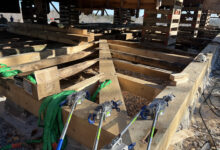
Ox Barn undercarriage diagonal floor girt
We’ve repaired the undercarriage at the Ox Barn and it was recently lowered onto its new foundation. NewsCenterMaine broadcast a nice piece about the day, and you get to see Arron being himself.
NH Chronicle broadcast a story about the ways that Strawberry Banke is adapting to increasing storm surges, groundwater levels, and climate change.
The original Tuttle house, and to the left, the original Tuttle Barn.
On and off since 2019, PTF has been involved with the restoration of the Tuttle Barn at the Desert of Maine in Freeport. The new owners, Mela and Doug Heestand, have transformed the Desert to be more welcoming for families and more clearly interpret the unique ecology of this site. This past year, we restored a historic cape for use as a visitor’s center and house museum out in the middle of their piney woods. We repaired and reassembled a late 18th-century cape frame that had been carefully disassembled and stored for more than twenty years in Swanzey, NH. It is nearly identical to the Tuttle family house that had been on the Desert property and burned down many years ago. In February, the Tuttle House project was featured on the season 3 finale of Restoration Road. You can watch the episode on Discovery or HBO.
This is most of the undercarriage (first floor) frame of the house assembled at our shop in Nottingham, NH. That big square opening in the center is where the chimney mass used to be. It is incredibly unusual to retain any original perimeter sill in a building this old. I tend to think of sills as sacrificial elements, like roofing, or clapboards.
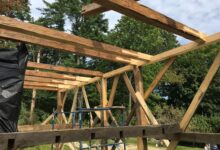
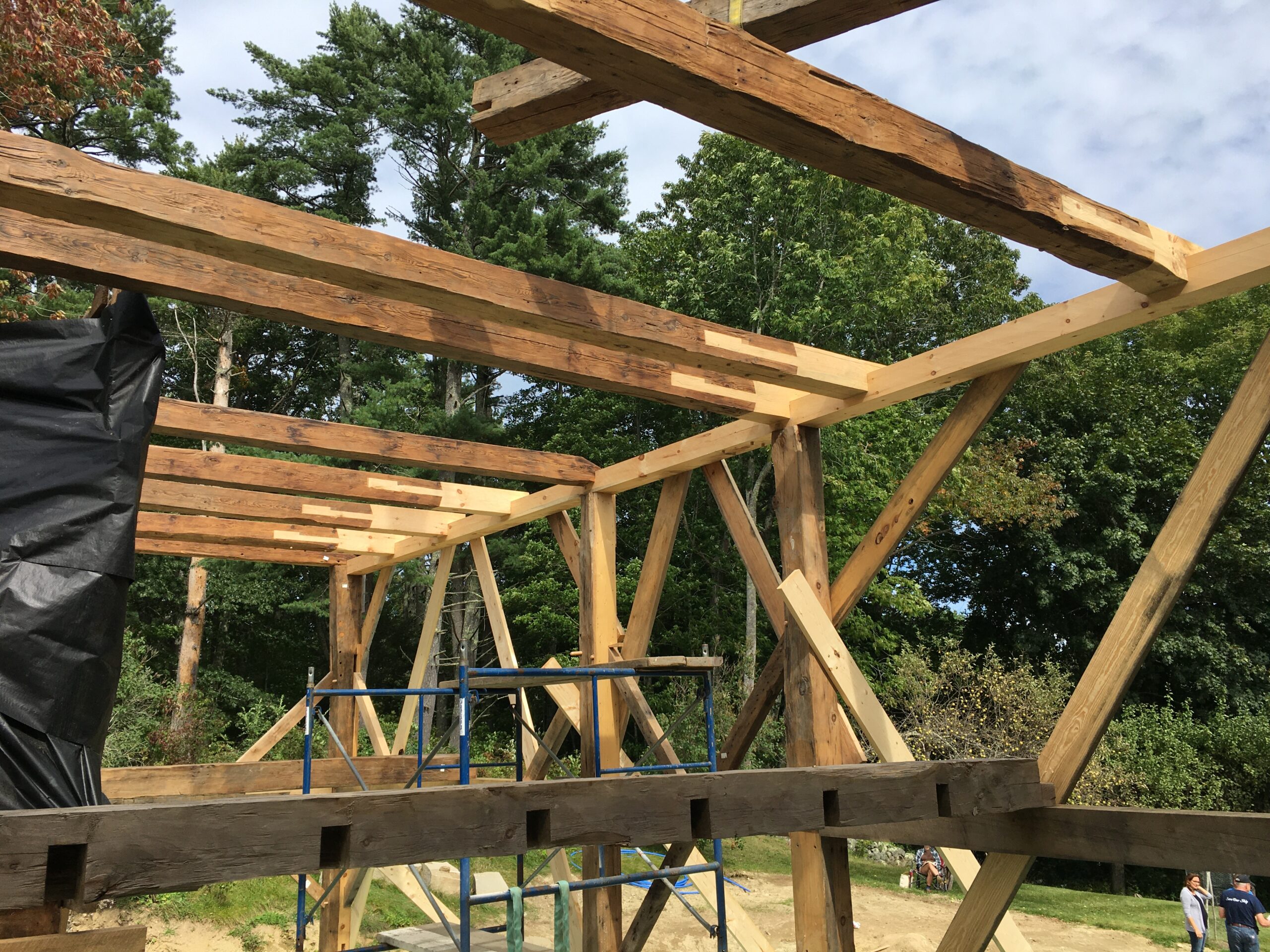
This is the roof frame assembled in the yard in Nottingham. In the foreground, you can see part of the undercarriage framing. The roof is a principal rafter, common purlin frame. We had to replace four of the rafters, the lighter colored wood. Those were sawn on a mill, and then surface-hewn.
Here is the frame after it was assembled on a new foundation on the Desert of Maine property. Those huge hewn flared posts are typical for a cape of this age (we’re guessing about 1770). The larger right bay holds the two front chambers, the chimney mass, and the entry hall. The smaller left bay holds the kitchen, birthing room, and loft stairs. It is a rugged frame, with continuous ties distributed approximately 3′ on center along the full length of the eave plate.
Dan and Brian sheathing the roof. Half of the front plate was replaced and joined to the original half with a halved and bladed scarf, on edge. Each pair of rafters lands directly over one of the continuous tie beams, and each post joins to the aligning tie beam and rafter with an English tying joint.
This is one of the front corner posts. The interior of the building will only be partially finished, with only the paneling, trim, and cabinetry that was saved with the frame. Here, some of the original post casing has been re-applied to the post. The lovely hewn surface of the tie beams will remain visible.
The kitchen retained most of its paneling and doors. The walls were lettered and the panels were numbered. This antique paint surface will be maintained, rather than repainted. The loft stairs are behind this door, the original rise and run of each stair visible in the paint lines.
This is the rear interior wall of the kitchen. Some panels were reused from another room to fill out the wall, and these were painted the same shade of white.
This is front right chamber. The painted floor was removed from the original house, as was the wide wainscot. The wainscot does not meet in the corners, and likely intersected a corner cabinet.
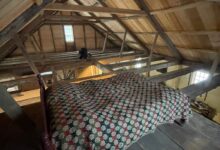
This is partially floored loft, with a first period bed. The combination of rafters, collar ties, struts, and continuous tie beams creates an incredibly rigid roof frame.
This is the borning room, with its original paneling, and an early paint color that was in place when it was disassembled. The closet was painted a bright salmon pink. The feather edge and grooves on the paneling were hand-planed, so the joiners weren’t concerned with the sides of the panels being parallel, and used as much of the board as they could.
Daron Smith and Tom Glynn built this door and sidelights based on the early photo of the original Tuttle farmhouse. The stiles and rails are joined with pinned through-mortise-and-tenons, and the solid pine panels are beveled and floating.
Daron and Tom also built the window frames and sash by hand at our shop in Nottingham. The stiles and rails are mortise-and-tenoned, and the muntins meet the sash frame with coped tenons. The upper sash is fixed and the lower sash is operable. Windows of this age would not have been weighted.
The Tuttle House frame finished. This was such a fun and creative project and a totally unique site in Maine. This summer, the building will be open and interpreted so that visitors can learn more about how it was built and how it was used. Visit Desert of Maine for more information.
Three of our projects have been in the news recently: Sabbathday Shaker Village won a $750,000 grant to rehabilitate their Herb House, the Abyssinian Meeting House will complete their restoration with $1.7 million in federal funding, and Broad Bay Church won a Maine Preservation Honor Award.
Behind the Herb House at Sabbathday Shaker Village.
The Sabbathday Shakers are restoring their Herb House; the second two stories will continue to be used to dry and process kitchen herbs grown on the property, and the basement and first floors will be expanded to provide workshop and demonstration areas. The frame itself has been combined, expanded, and adapted throughout its life and this renovation continues in that tradition. There are some honking-big timbers in the undercarriage, like 12″ x 14″, that I hope will be on display in the finished space. Read Shakers get $750,000 federal grant to renovate Herb House in the Portland Press Herald.
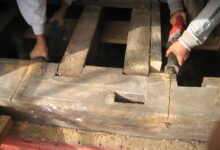
Replacing the Aby’s front sill. The “after” photos show that the timber was absolutely hollow at this point. It was sad to lose the original marriage marks, which were reproduced on the replacement sills.
The Abyssinian Meeting House is the most important building that PTF has had the honor of repairing. The finish phases of the restoration are being completed by other contractors, and we have been thrilled to watch the project progress. Read Abyssinian Meeting House restoration to get $1.7 million in federal funding in the Portland Press Herald.
Broad Bay front facade.
Broad Bay Church was another successful collaboration. PTF was hired to repair the tower’s timber frame. It is gratifying to be part of making these buildings accessible to everybody. Read Broad Bay Church Awarded Maine Preservation Honor in The Lincoln County News.
We can’t wait to get started on the Herb House, wish the Abyssinian all the best in fulfilling their goal, and congratulate Broad Bay Church on the well-earned win.
We raised the Kavanagh ell last week. The frame was in rough condition, but the owners have prioritized preserving original material as much as possible. All but one tie beam received two new ends, each joined by a timber scarf. Most of the posts received repairs as well. The undercarriage and roof system were beyond repair, and will not be seen within the finished space. The roof will be framed conventionally by Williamson Fine Homes.
Center Tenon Tie Repair, keyed, wedged, and under-squinted.
Dan Newman cut center tenon scarfs to repair the rotted ends of the tie beams. The shoulders of the scarf were under-squinted (angled) to prevent twist, and the center tenon was keyed and wedged to work in tension. The scarfs were cut with extremely tight tolerances because they will need to resist spread in the eave walls, and because they will be on display in the second story bedrooms.
Double-bladed post repair
Most of the posts required repairs as well, but Jake Imlay and Dan cut their scarf joints to preserve the maximum amount of original material. A double-bladed scarf joint attaches a new post base to an original post top, above. The length of the scarf is customized to cut out all rot and preserve the beautifully-hewn interior surfaces.
Eave wall raising with crane, and crew
The ell was relatively small, and was erected with an “eave-wall raising” (as opposed to a “bent raising”). An eave-wall raising is typical of small 18th and early 19th-century frames, with tie beams that cross the plate with half-dovetail joinery. The crew scribed all new joinery and fit all the walls, then reassembled the eave walls on the deck, and reinforced the frame with KD bracing and gussets. Using a “4-point pick”, the crane raised the east eave into place, while the crew set the post feet into their mortises. We braced the east eave and set the house-end girt into its mortise. Then we switched sides, and assumed the same positions to raise the west wall.
Assembling Bent 1
This was a relatively easy crane day because Scott and the crew were so organized. After the eaves were raised and braced, we used the lull to lift the Bent 1 girt into place. The girt is connected to its posts by both ascending and descending braces, and required a pair of hands on every brace. Cut from white oak, it was difficult to tell the old braces from the new, their edges were still so crisp. But when we went to pick one up, our arms knew the difference–the new ones weighed three times as much.
Scott tags the tie beam
Scott Lewis organized the frame raising and communicated with the crane operator. After the eave walls were standing, he rigged each of the tie beams evenly and directed them into position. This photo shows the gorgeous double-ended tie beam repairs that are the centerpiece of this preservation effort.
Jake fits a half dovetail joint
The crane placed a pick across the tops of the eave walls, so that Dan and Jake could fit the tie beams into cogs in the plates. The eaves were relatively straight and the joinery cut so cleanly that the hardest part was sliding the pick down the plate while staying clipped-in. The tie beams join to the plate with a stopped half-dove, visible above in Jake’s hand. This photo illustrates well the advantage of the wedged center tenon – much more of the original material is visible from below.
A Tale of Ten Tie Beams
The northern crew has been at Kavanagh for a while now, and rebuilt the undercarriage beneath the house this past winter. Given the extent of damage in the ell, the frame repair was relatively quick, the crew dismantled the frame in late April of this year, and spent the summer cutting scarf fixes and scribing joinery. By mid-September, we were re-erecting the frame on the fine crane day pictured here.
The PTF crew has another small frame to raise on site, and is handing the reins over to Williamson Fine Homes to finish the Ell. Then the northern crew will turn its attentions back to the main house, to repair one of the most finely crafted hip roofs in the state of Maine, surrounding a glass-floored cupola. It’s a lot of work, and we feel lucky to do it.
The story of the Abyssinian Meetinghouse and Leonard Cummings, its long-time board president, was on the cover of the Maine/New England section of the Maine Sunday Telegram today. The Abyssinian is the third oldest African American Meetinghouse and is located across the street from the Shipyard Brewery in Portland. Frederick Douglass trod its very floorboards. We have worked to restore the trusses and front facade, repair the timber frame and sills, and level the floor, along with documentation and sensitive demolition. It’s an important article; please read it along with the rest of Press Herald’s coverage of the Portland protests and the persistent racial disparities in Maine.
Tag Teaming Timber in 2012
The article describes just some of the work that is included in the remaining $1 million in their budget, and although we are no longer involved in the restoration (the photo above is from 2012), we cannot stress more strongly our support for this project. This building is one of the most important buildings in all of Maine. The price tag is completely in keeping with a museum-grade restoration of a building of this significance. It is the last remaining building on Portland’s Underground Railroad Trail, and should some day be visited by all Greater Portland public school students. Please consider donating, here.
You can read more about our (now completed) role in restoring the Abyssinian in these blog posts.
We are still working and distancing during the pandemic. The solitary time has given us time to catch up on some favorite history podcasts. Consider the following required listening:
If crane days were measured by weight, last Thursday’s crane day would be our biggest to date. East Derry’s belfry, bell and double lantern weighed 43,400 pounds, not including the rigging. The crane day might also be the biggest in terms of scope. Since 2013, we’ve lifted and moved the church onto a new foundation, rebuilt the undercarriage, replaced two tower posts, 60′ in length, and disassembled, reproduced and rebuilt the belfry and lanterns. This crane day was the culmination of more than five years of nearly continuous site-work following more than two years of fundraising, assessment and preparation. Brian, Dave, Tom and Dan have persevered through a lot of guano. Paul Lindemann and the rest of the building committee stuck with the project after the scope and cost ballooned past our earliest expectations. From the start, they’ve stayed rooted in the history of Nutfield, the colonial settlement that built the church. On Thursday, the entire crew was there, along with a few news crews, the building committee and good crowd of East Derry residents.
Scott Tightens the Rigging Clamps
On Wednesday afternoon, the crane and crew installed the rigging steel. Four steel I-beams were inserted in a grid beneath a ring of ledgers bolted to the belfry posts. The belfry posts extend deep into the tower, 12′ below the tower plates. They emerge 15′ above the tower plate. Stationed on the ground, the belfry, lower lantern, upper lantern and mast are almost as tall as the base tower, rising to just 6′ shy of the tower plates.
Rigging a tower this tall is a challenge. We want the straps to be long enough so they won’t bind on the tower, but they can’t be so long that we run out of cable on the crane. Our first arrangement of rigging straps was doubly wrong: the straps bound on the belfry baluster and were too long overall; the crane operator couldn’t retract the cable enough to get the stretch out of the rigging. Fortunately, by reversing the upper and lower straps, we were able to clear the balustrade and stay short of the crane’s reach.
Belfry Roof, Urns, Fans, Columns, and Balustrade
After the crane took a little weight, we dismantled the front wall of staging and swung the belfry away from the church and the rear staging. The belfry had been built tight to the tower, and the staging had been built tight to the belfry in order to hang the trim and apply copper to the bell deck and lanterns. Brian and Dave planned the restoration so that nearly all the finish work could be done “on the ground” before the belfry and lanterns were lifted into place. It’s a lot easier to fit elaborate trim 20′ – 40′ above the ground rather than 60′- 80′. We needed to break down the staging and swing away from the tower so that the belfry would clear the building on its way up.
Belfry in Flight
The lift from the ground to the belfry was slow and steady. Half the crew climbed the staging to the tower plates, and the other half climbed the stairs to the belfry bed timbers, 12′ below. Once the post feet were inserted past the plates, the bed timber crew made minor adjustments to the mortises and pried the post feet a quarter of an inch this way and that. When the post tenons were seated in the bed timbers, the overhangs at the bell deck just kissed the belfry plates.
Belfry in Place
There’s still more to do. The cornice trim needs to be hung at the top of the tower, at the edge of the bell deck, and the copper roofing must be extended over the drip edge on the cornice. A second finish coat of paint will be applied. But regardless of the punch list items, the crane day Thursday was a huge achievement. The crew and building committee worked together to prepare for this day, and the celebratory ease of the day was a result of their strenuous efforts.
We had some excellent news coverage of the day. The Eagle Tribune and Union Leader interviewed longtime parishioners and the folks who made the restoration possible. Watch the lift on WMUR, here and here.
Norway UU Church is the kind of church that reminds me why we do this work. The congregation has been hosting a community lunch program for more than 25 years and the building provides a space for daily AA meetings. When I’ve been in the office for weeks, finishing up estimates I know will be shocking, I start to wonder whether all this old building stuff is worth it. What are these places worth anyways? Why save our historic barns and landmark buildings? Off-site, it gets existential.
One of my jobs is to provide an answer to these questions. Frequently, functionality is enough. A big old barn might be easier to repair than to replace and traditional approaches are proven. They last longer. They definitely give the building more life per buck. Intellectually, I’m convinced, but emotionally, I wonder, “Do these buildings really matter, to anyone?”
Norway Unitarian Universalist Church matters. The steeple has anchored Norway, Maine’s Main St for nearly two centuries. The building provides a place for people of all walks of life to gather, in a rural community, where people may love being alone, but also get lonely. In a diverse and sometimes disjointed society, we need welcoming, inspiring spaces like these, where the building reminds us of what we can achieve, and have achieved, when we work together as a community.
Norway UU Tower
We removed the steeple last month. Steeple removals, like all crane days, are exciting, but are tinged with melancholy. Removal is often the first step toward repair, but it’s still hard to dismantle an icon like this one, especially when we don’t know exactly when it will be restored. The steeple has an open belfry, with eight posts and a dome. Initially, we had hoped to save the posts and extract the belfry as a unit. In towers like these, the belfry posts telescope deeply within the tower. At these heights, steeples face powerful wind loads. The tower roof, or bell deck, is a potential hinge point for the tower. The length of post that extends above the tower box is only about half its total height. The belfry posts rest on bed timbers that cross tower girts deep within the tower walls.
Tower and Belfry Framing
Upon further investigation, we confirmed that five of the eight posts were rotted beyond repair. When this many posts are this badly rotted, we know that there is more damage hidden behind the trim and sheathing. Additionally, the tower roof had been re-built three successive times and each set of rafters, sheathing, and shingles was stacked over the last. Woven amongst this framing were a collection of weird posts attempting to stabilize the bell. Despite the beautiful tower and belfry timber framing, the framing below the bell was a mess, making it impossible to discern which timbers were really holding up the bell. There was no way to extract the bell with the dome in place, and there was no way to selectively extract any viable posts, which weren’t likely to exist (spoiler: they didn’t).
Ultimately, we made the tough decision to sever the belfry posts, and began to rig the dome accordingly. I can say, definitively, that we hate cutting posts. We hate doing it as much as we hate finding it done. We barely know the labor that went into extracting these logs from the forest, and hewing them. We know intimately the effort involved in laying out the joinery and cutting it. Cutting joinery is a joy; cutting posts may be made exciting by the adrenaline of a crane day, but is something else entirely.
Dome Crab, stabilized for flight
To prepare for crane day, the crew stabilized the crab, in the ceiling above the bell. The crab is the horizontal grid that connects the tops of the eight belfry posts and supports the half-round dome rafters. It looks like a timber hashtag and this one was #rotten. With 2x10s, we traced the layout of the crab timbers, stacking and blocking the 2x into a grid three layers thick. This stabilizes the crab for flight. Then, the crew used a laser level to establish the exact height of the rigging timbers, and the subsequent line on which we would cut the belfry posts. Early on crane day, the crane flew in the rigging timbers, arranged in another timber hashtag, about 20′ across and extending out the belfry by about three-and-a-half feet. Next, we installed bolsters between the rigging timbers and the stabilized crab, so that the dome would be lifted level. The load must be bottom-heavy, and very stable.
The crane will hold the dome in what is called an 8-point pick. A rigging strap is basketed around the end of each rigging timber, and connects to a custom-built “cage” that hangs from the crane. The cage is a square of heavy-gauge tube steel, with rigging plates at each corner. Two of the rigging timber straps shackle to each plate. Connecting the straps and shackles to the ends of the timbers is a slow and careful process, the shackles need to be oriented properly to ensure that they can’t unscrew during flight, and avoid twist in the straps. Everybody on the crew is focussed, and moving deliberately.
Norway Dome, off it goes
After the dome is rigged, the crane begins to cable-up and take a little weight. The crane will need to lift the dome enough that our reciprocating saw blades don’t bind, but not so much that the dome bounces as the last post is cut. Each person in the belfry was responsible for cutting two posts, as closely to the line as possible and leaving level feet for the dome to rest upon in the yard. Scott was on the radio, communicating directly with Arron and the crane operator on the ground. As we cut through the posts, we drove a wedge into the kerf to keep the kerf open, and to prevent the crane from having to take too much weight.
At every lift like this, one corner “sits hard”. No matter how evenly we’ve rigged the tower, or how centered the ball is over the building, there is always one corner that is heavier, due to the vagaries of wood density and concentrations of pigeon droppings. I was the lucky lady with the heavy corner, which meant that everyone else’s kerfs were open and free while I was still trying to finish my cut. I repeated a pass with my sawzall for the third time, and finally severed the remnant of corner board that was holding us down. The dome lifted gently, with no bounce at all.
The crowd cheered, and we descended for the best lunch I have received in more than a decade of crane days. A crowd had turned up with their lawn chairs, and we were treated to burgers, pulled pork, cole slaw, salads and desserts. A number of building committee members wanted pictures with the crew. We were enveloped in the love they feel for their church, and the enthusiasm they have for their community. On the job site that day, it was easy to understand why these places matter.
Ground Crew View
After the steeple had flown, we were finally able to see just how badly the belfry posts had deteriorated. In a number of places, the posts had been severed at the tower roof, and “secured” with small angle brackets, like you might use to fix your kitchen table. There was no scarf joint connecting the two halves of the “repaired” post, and the fasteners were rusted through. We had planned to extract the bottom halves of the tower posts one at a time, but we were able to push three of the posts over by hand, and lay the partially rotted stumps on the bell deck. The level of deterioration confirmed our decision to sever the posts. It would not have been safe to try and extract them whole. We flew the bell, and carefully demolished the upper layer of roof, upon which the bell had been sitting. We then covered the second roof level with EPDM rubber, wrapping the cornice and securing it to the tower wall with strapping.
Belfry Trim Notes
Next, we will begin the process of more thoroughly documenting and dismantling the dome, saving as much original material as possible. The bell deck will need to be re-framed. The congregation will leverage the grounded dome to finish the fundraising and get to the crane day that will restore the dome to the top of the tower as soon as possible. The congregation at Norway can take heart from East Derry, who, just this past week, hosted a crane day to restore their belfry and lanterns to the top of their 60 foot tower. come back to read about it next week.
On Friday, East Derry First Parish Church will be hosting a celebration in honor of the 300th anniversary of Nutfield, a Scotch-Irish settlement that was the precursor to today’s Derry, Londonderry, and Manchester, NH. The crew at East Derry has been hustling to finish the belfry in preparation for the event. For a bunch of timber framers, they’ve been doing an awful lot of finish work. A more accurate name for Preservation Timber Framing would include an “and”, but the name’s long enough already.
Belfry Trim, Labeled. Photo and labelling by Brian Cox
The crew was able to preserve some of the ample belfry and lantern trim, including the eight turned columns on the upper lantern. What they couldn’t restore, they reproduced. Every week, Brian creates a photo report to keep the building committee up to date, breaking this behemoth phase into bite-size pieces. It also serves as a documentary record of repair and this basis of this blog post. Between the mutules and the guttae (the swiss cheese and the sawtooths), I’ve been inspired by both the mass production and the attention to detail.
Tom fastening slats. Photo by Brian Cox
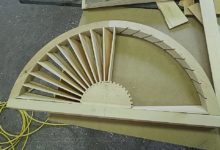
In between enormous timbers and acres of primed trim, Tom has been quietly reproducing four of the arched fans at the top of the lower lantern louvers. In carpentry, fans are kind of a thing. Their arched tops require a choice between multiple joints, or extensive short grain. In the photo above, you can see that the curve of the arched top was cut out of two wide pine boards, their long grain oriented 45 degrees to the bottom rail. The fan’s slats are precisely twisted. This delicate assembly is then mounted to the side of the lantern and exposed to strafing wind, sun, rain and snow at the top of a hundred foot tower.
Original Fan and MDF Template. Template by Tom Glynn, Photo by Brian Cox
Four of the fans were in good shape, and required “cosmetic” repairs, glueing and re-fastening. Four needed to be replaced completely. Tom started by transferring the measurements from one of the original fans to a sheet of MDF, creating a full size drawing. He used this template to begin cutting pieces from 2″ thick Eastern White Pine.
Fan core, with blade angles laid out. Photo by Brian Cox
Tom cut templates from luan on the bandsaw, and traced them out on the pine. He used the bandsaw to cut out his pieces and then laid out the dadoes carefully in pencil, copying the angles from the original fan. He used a dovetail saw and 1/4″ chisel to clean out each groove.
Those dadoes are cut! Handiwork by Tom Glynn. Photo by Brian Cox
Each fan blade is 3/16″ thick and was gently twisted as it was installed in its frame. The twist is created and held by the angled dadoes. The angle on the half round core is different than the exterior arch. At the core, the blade is more perpendicular to the face of the fan, which allows all the blades to fit, and gives the appearance that the rays are opening up like a sunburst.
Fan blades. Photo by Brian Cox
Fortunately, Tom was able to copy the angles from the original fan blades, rather than calculate the angles from scratch. A lot of folks think it’s easiest to scrap the old and start anew. On a piece like this, we were grateful to retain the knowledge of the old-timers from the evidence left in the original pieces.
Half-finished. Photo by Brian Cox
Once the fans were finished, they were primed with two coats of California alkyd primer and two more coats of California latex paint. Commonly, fans are decorative, which means that they were not always used for ventilation, and were applied over solid sheathing as was the case here.
Fan fit with arched trim. Photo by Brian Cox
Still, each exterior element needs to shed water to protect the elements behind it. Each fan was fit with arched trim. The flush board trim projects 2″, while the frame and blades of the fan are only 1 3/4″ in thickness. This will protect the fan from wind driven rain running down the face of the flush board siding. Each vertical joint is backed with a spacer batten to prevent water from getting between the boards and penetrating into the frame.
Louvers, Columns and Fans, installed. Photo by Brian Cox
With every detail in this tower, the crew considered the path of rain water. We use tight fitting joints and carefully considered flashing details to keep water out, rather than caulking. Caulk is an important tool to stabilize deterioration and prevent further rot. Ultimately, though, it is a band-aid, which is promised to last 20 years, and starts to shrink and fail in the first season. This is why PTF goes beyond the frame and performs finish work. We work on buildings that have commonly withstood 200 years, and we want our repairs to last 200 more. When the bottom of the structure begins 60 feet from the ground, we know that the caulking won’t be re-applied every five years, and the building will be lucky if it gets repainted every twenty. Protecting the frame starts with the finish, and our trim is not only beautiful, it is functional.
We love to share our work in person. We hope to see you at the Nutfield celebration this weekend!
The Barn at Bondgarden Farm has been the talk of Eliot all summer. Nearly a hundred feet long and roofed in slate, the barn was always a stunner, but in July, Rick Geddes lifted the barn 6 feet in the air, and neighbors and newscrews took note. Geddes threaded four 50 foot, 12 inch H-beams into the building running in two parallel lines down the eave bays. Then he crossed the H-beams with eight perpendicular I-beams to pick up the loft joists in each bay. He gently lifted the H-beams using his truck’s hydraulic system, and rested them on six tidy cribbing piles. At this point, the repair work could commence.
Dan explains lifting in front of the hole cut for the steel
Built in the 1860s, the entire undercarriage was rotted, and the basement was no longer necessary. Bob Cantwell crunched up the undercarriage and excavated the basement. Chris McKinnon poured a new frost wall around the perimeter and two level grade beams beneath the drive posts. The new barn floor is crushed stone, which will be more appropriate for its equine occupants.
Bladed scarf repair
Most of the post feet were quite mushy, and required new feet or re-repairs. Fortunately, a few good posts remained, from which Dan and Tom could establish a standard post length. After checking for level with a transit, they used the top of the grade beam as a reference line. From there, they repaired each drive post to the standard overall length. In most cases, the post was repaired with a center tenon scarf, which resists twisting and preserves the maximum amount of original material. In cases where the rot extended above the loft or needed to be removed on one side more than the other, they repaired the foot with a bladed scarf joint, a traditional repair. We commonly see this scarf in old barns, repaired more than a century ago.
Center Tenon Repair
For decades, cattle used the drive posts as scratching posts. Below the loft, their stallside faces have been carved into gentle curves. The joists above were scalloped by the teeth of bored horses. We preserved the patina of the posts and fared the fixes to their organic profiles.
New girts and new eave wall
Once the repairs were installed, Dan and Tom could begin to address the hay lofts. Originally, there were a row of tying girts about halfway up the posts. The barn was converted to house taller livestock, after it had already begun to sink. The remuddlers removed the lower loft girts and snapped a level line on the uneven parallel posts. They neglected to replace the tying girts and erected stall walls, which were clad in 2x6s and filled with insulation. They slapped up loft joists, which broke over the stalls. In some places, the posts had dropped eight inches when replacement clapboards were hung. For now, on the backside of the barn, you can still see how far the barn was out of level by the undulation in the line of clapboards.
New stall studs
The crew used staging boxes to stabilize the loft floors and remove the poorly designed stalls. Then they leveled the lofts to the newly plumbed posts and installed level loft girts between the posts in 6″ x 10″ eastern white pine. The Goranssons will stock the lofts with hay for their horses.
Rear wall wave
Last but not least, Victor Wright, of the Heritage Company, will repair the slate roof. In some ways, all this work was to preserve the intact slate, worth tens of thousands of dollars. There aren’t many barns anywhere that were roofed in slate, but especially in Eliot. As they were interviewed by TV crews, the Goranssons explained why they went through this process to save their barn. They value the craftsmanship embodied within it. During the repair process, they witnessed how much work goes into raising a timber frame of this size. For centuries to come, their neighbors will witness the fruits of their efforts.
At East Derry, we knew the lantern was in bad shape, but we couldn’t know the full extent until we had it on the ground. Brian Cox was the job lead. He says, “The will of the church was holding that thing together, many layers of lead paint, and band-aid flashing details.” It was chilling to observe the extent of the damage, and know the structure was in this condition when it was still 80′ above the congregation.
Lower lantern, inside. Photo by author
Once the frame was exposed, we documented and measured every piece. The design is both complex and well-balanced. Each post is connected to its opposite with an upper and lower girt, and a plate across the top. The eight posts hold hands like four couples in a square dance. David Ewing produced cut drawings for each unique timber. To orient the crew, he provided a key alongside each drawing, highlighting the timber’s location within the frame. This helped the crew organize all the pieces, and to double-check their layout. The color-coded cut key is an innovation we’ll continue to use on all future drawing sets.
Lantern Posts C1 & B4. Drawing by David Ewing
The lantern posts are five-sided; when the building is trimmed out, a turned column will adorn each point of the octagon. Four parallel bed timbers cross the belfry plates and support the eight posts. The bed timbers are crossed by a fifth perpendicular timber, which bears the foot of the mast. The plate level is co-planar and arranged like a hashtag. Two full length plates run parallel to the beds, and two interrupted plates run counter to them. The timber hashtag is connected by hefty mortise and tenon joinery.
Lower Lantern, before. Photo by Arron Sturgis
The lower lantern frame was test fit in our yard in Nottingham, NH. The assembly was smooth and painless thanks to thorough drawings, accurate cutting, and the lull. The doubled, overlapping girts make for a stout frame, capable of enduring high wind-loads at the top of the tower. In dimension, this lantern frame is similar to the one we built to support the Camden spire last year, but the design is very different. Camden was reinforced by an array of braces and had stacked, overlapping plates. The bed timbers there were a stacked hashtag, while the ones here are co-planar and parallel. One of the great joys of this job is seeing the ways in which builders solve the problem of constructing a steeple or spire. The vocabulary of design in a barn is much more consistent; I can accurately model a barn from a phone description. Steeples are not that way, every time I crawl through the hatch, I am greeted by a new, intricate design. Part of our mission, and others, is to protect this repository of proven designs.
Lantern Fitting. Photo by Brian Cox
Obviously, there were aspects of the building that did not stand the test of time. The flashing between the upper lantern and the sweep roof was the most significant failure, and the extreme height limited the steeple’s overall maintenance. Brian was determined to minimize the plethora of tiny penetrations produced by face fastening. With every steeple restoration, we run into this conflict: it is much easier to mill and assemble trim elements in the comfort of our shop, allowing us the luxury of heat, and finely maintained cabinet tools. It is possible to work at the church, but then we have to contend with weather, job-site tools, commuting and staging. Brian decided to assemble the eight faces of the lantern in removeable panels that could be reapplied on-site.
Rusty fasteners indicate where water has penetrated the finish. Photo by Brian Cox
While the lantern was standing in the yard, the crew fit the sides with horizontal nailers, toe-screwing them to the inside of the frame. They sheathed each face with wide tongue and groove pine, blind-nailing through the tongue. Then they backed out the screws and removed each face as a solid panel. The louvers will be hung on top of the panel – they were never functional – and the panels will be craned in as a unit. This will limit the amount of time the crew has to spend working from a hundred foot staging tower as well as water penetration around the fasteners.
Flute testing. Photo by Brian Cox
The frame was decimated, but the most iconic trim details will remain in service. All sixteen urns will be reused, a handful will require new bases. All eight turned columns will be repaired and returned to new, well-flashed pedestals. The louvers and fans will be stripped and re-used, as will the weathervane, and both railings. Cornice trim was painstakingly documented. Sixteen distinct profiles were custom milled by Noah Tremblay and his crew from African Mahogany; the fluted panels and guttae were carved in house.
Lower lantern and belfry railings. Photo by Brian Cox
We’d prefer that these buildings not need our help at all. But given their deteriorated circumstances, we’re grateful we get to do the fix. Next up: scarfing the belfry posts, and joining together the floor, in 12″ x 12″ white oak.