Hey, real quick! We’ve been cutting scarf fixes for enormous post feet, and fitting teleport pads for octagonal lanterns. Updates on Chestnut St Lantern, Brasen Hill Barn, and Jennison Barn, below.
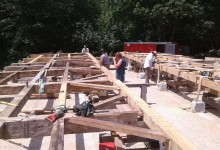
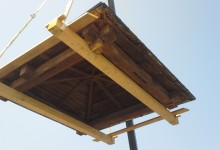
Teleport Pad, Photo by Jacob Imlay
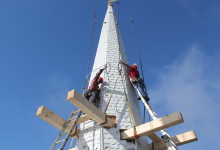
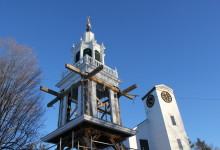
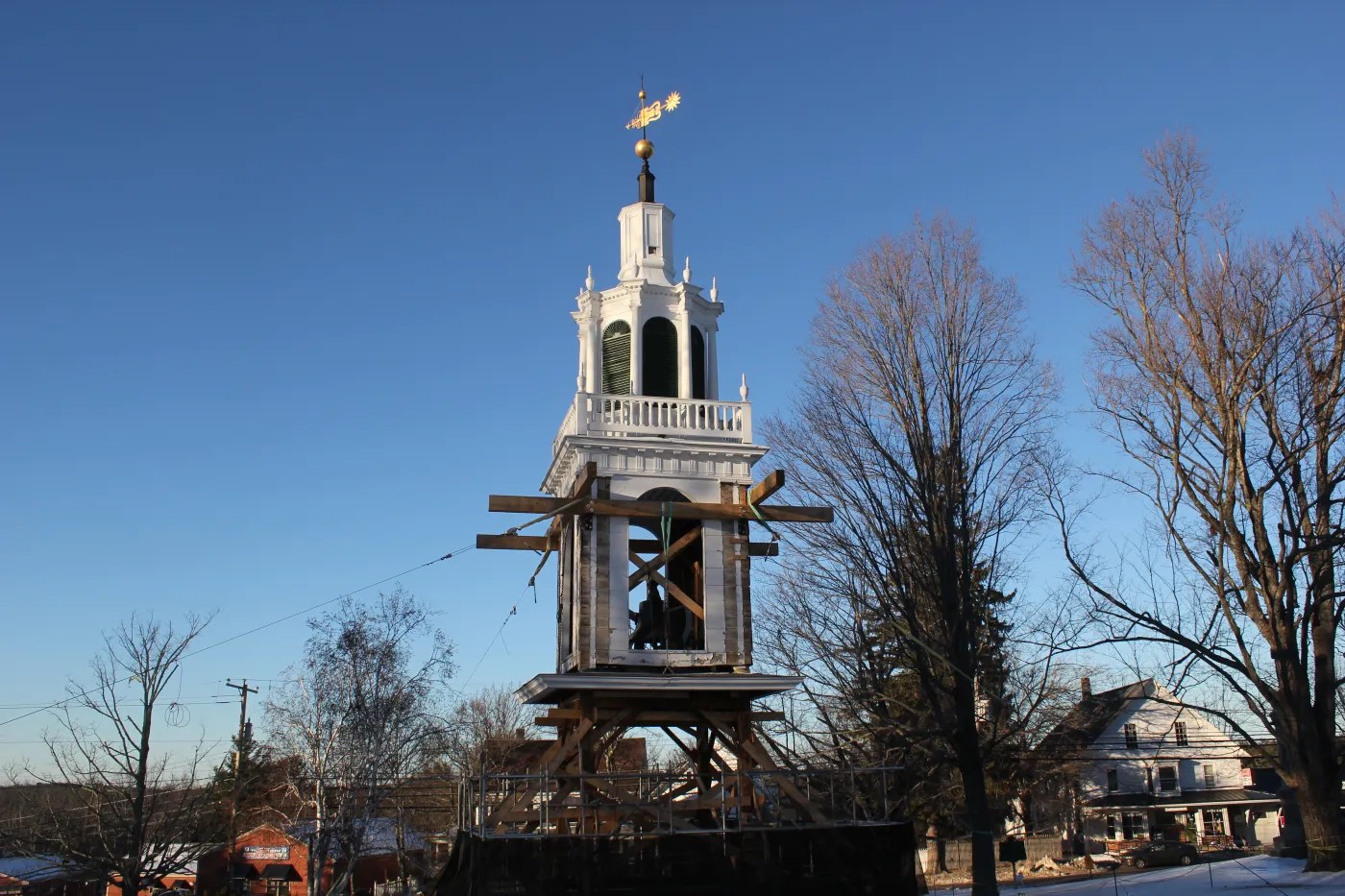
Chestnut St Church Lantern, Camden, ME: This cute little lantern was cut and fit at the shop, and is ready for transport to the Lyman-Morse boat shop later this week. There it will be fit with a 50-foot fiberglass spire and four 7-foot half-round hoods. Jake laid out the frame and Tim, Zach and Charlie cut and fit the joinery. Zach’s experience building guitars and Tim’s experience making furniture helped maintain tight tolerances. The entire lantern and spire will be laid down on a low-riding flatbed for final transport to the church, where a crane will tip the entire assembly up vertical. It is important that the joinery is tight in order to withstand the torque and lateral loads. Scott, Tim and Arron worked with Taylor-made builders up in Camden to plumb the tower and repair the belfry post feet at the Chestnut St Church. More about removing the old spire, here.
Lady Lantern, photo by Jacob Imlay
Brasen Hill Barn, Barrington, NH: Led by Dave and Dan, the rest of the crew have been busy with an enormous barn restoration at Brazen Hill Farm. The barn is beautifully hewn, with drive posts like tree trunks. The deterioration was extensive and the barn was completely dismantled for repairs. The extent of rot meant that the barn was heavily braced and was disassembled piece by piece by a crew of eight over two days.
Brasen Barn from above, photo by Josh McNally
Dave, Dan, Tom, Byam and Michael have been busy making traditional timber frame repairs at our shop in Nottingham, NH. Given the extent of damage, the crew worked hard to preserve any viable original material. That means a lot of dutchman and post feet fixes. Dan Boyle documented the repair and fitting process. A few of his process photos, below.
Undersquinted face fix, photo by Dan Boyle
An under-squinted dutchman repair can be used to repair the cheek of a mortise where a pin has blown out the relish. The rest of the post was in good condition and of a dimension and quality that is difficult (but not impossible) to find today.
Get (in the) Bent Brian, photo by Dan Boyle
After the rotten timbers are repaired or reproduced, we use come-alongs to pull the joinery tight and the bent square. Then we drill holes for the 1-inch oak pins that will hold the joinery together.
Eave fitting, photo by Dan Boyle
The barn is big, almost 70-feet long and 40-feet wide. It contains seven bents. The finished frame was raised almost a month ago, and Dave and Scott documented the process by helmet-cam. Stay tuned for the movie.
Jennison Barn, photo by Josh McNally
Jennison Barn, Lee, NH: New Hampshire Preservation Alliance has featured the Jennison Barn as one of their 52 barns in 52 weeks. The NHPA article captures why preservation is important on a human scale, from families to communities. Read their story, here.
Last Thursday, I popped out of bed at 4 am, like Sal on her way to Bucks Harbor. Scott informed me that if I wanted to help remove the Chestnut St Church spire in Camden, I needed to be there by 6:00. By the time I arrived, Scott and Arron had set the rigging. About a third of the way up the spire, eight laminated KD 2x10s poked through the spire like an avocado pit ready to sprout. PTF was hired to direct the spire removal and design a timber-framed transition from the old belfry frame to the new fiberglass spire. We’d worked with the G.C. before on True-Randall farm, Taylor-made Builders are good folks who do high-quality work; so even though fiberglass replacements are not our thing, we got over ourselves because Taylor and his crew are such a pleasure.
This steeple is so tall that a 120′ man-lift couldn’t reach the weathervane on the day we went up there to remove the weathervane (oops). The main church is two full-height stories. Starting just below the main ridge-line, the belfry posts rise 30′ to a plate level just below the clock dials. The original spire rafters penetrate into the belfry, landing on a girt 5′ below the plates. The spire rafters pass through the dial level, behind four 6′ diameter glass dials. Above the dials, the original spire rafters were severed and sistered with relatively light, laminated 2x4s. That repair was performed in the 1990s by a talented and eager Eagle Scout. This go-round, we designed a timber-framed “lantern” that crosses the belfry plates like a crab. Eight 8×8 posts rest upon the lower crab and support a maintenance floor behind the clock faces. The upper lantern plates, or upper crab, extends well into the fiberglass spire, 6′ above the horizon of the clock faces. Four new fiberglass dial hoods will protect the dials, and be structurally fused to the new fiberglass spire. The lantern frame we’re cutting reproduces the telescoped framing levels found in this building and other historic steeples.
Lantern Iso, X-Ray
The model we’d created for the lantern design allowed us to accurately calculate the height at which the rigging would need to be placed in order for the spire to be slightly bottom-heavy as it flew. In fact, once prone in the driveway, the spire balanced like a seesaw on the fulcrum of its rigging. A top-heavy spire might flip mid-air, which would be just as dangerous and scary as it sounds.
Chestnut St Church, Crane, and Rigging
We hung a cage from the main ball of the frame to protect the weathervane from the rigging straps. We linked together the crane operators’ longest cables and our longest rigging straps, to connect the four corners of the metal frame to our rigging beams. The last strap was doubled over, resulting in an eight point pick.
Spire cage
The crane flew the rigging up to the crew on the top of the staging, and we pulled the rigging straps away from the spire as the operator located the ball directly over the weathervane. The rigging was accessed by ladders off the staging, which was less efficient than it was photogenic.
Teamwork
Once the rigging was securely attached, we crawled inside the spire and used saw-zalls to cut first the spire sheathing, then the mast and then all eight rafters. In my experience, the penultimate step of severing the last connections is the most stressful and variable part of the entire crane day. As Arron warned the crew, a forgotten toe nail could prevent the spire from releasing safely and evenly. We were lucky to have a skillful crane operator from Keeley. We wanted the crane to take enough weight, and put enough tension on the rigging to prevent our sawzall blades from binding, but we did not want the spire to bounce or release with any energy.
Witch’s hat with a crown of thorns
Scott and Arron checked in with the operators. When we started cutting the sheathing, the crane had 1500 lbs of weight on the ball. For the mast, 2500 lbs. As the last of the rafters were cut, the crane was taking 3500 lbs. Unfortunately for the spectators on the ground, a safe spire removal looks slow and boring. Unfortunately for my story, the spire released without any hitches. The spire weighed about 8800lbs, which reflects its light framing.
A Bittersweet Triumph
The crane operator lowered the spire safely to the street, and the crew cut the cone into sections small enough to carted away by a pulp truck. The Penobscot Bay Pilot got some beautifully boring drone footage of the removal, and covered the story, here. For more photos of our process, visit our Flickr album.
The Troy Union Meetinghouse had a crane day last week. The long-leaning steeple was partially dismantled, leaving behind the two front posts to stand like wooden antennae. The entire replacement frame has been cut by a crew of local craftsmen, and will be resurrected before the end of the summer. Read more about the process here, and show your support. If you don’t see a video below, click on the link to watch the story.
The First Parish Meetinghouse of East Derry, NH is preparing for a big anniversary, its tricentennial. What does one even get for a church on its 300th? Wood? Copper? Both, as it turns out. Beginning with a thorough assessment and rehabilitation plan in 2011, the congregation has been working steadily to repair extensive damage throughout the steeple and undercarriage. This past fall, we extracted the belfry and lanterns from the steeple stack. After the new year, we documented the upper sections from a woman-lift and dismantled them from finish to frame.
Lower lantern roof, crowned with urns
As we surgically removed trim, we encountered earlier salvage efforts. Dan and Rod peeled back the gracefully curved roof between the upper and lower lanterns and revealed an oiled sailcloth roofing. The sheathing below was labeled November 1916.
Lower Lantern Posts
The frame was in far worse shape than we expected. Years of roof leaks and patchy repairs had finally overtaken the stout timbers. Once the lower lantern posts were exposed, we wondered how the structure was still standing and realized too late the bravery of dismantling it. Above, you can see that the six of the eight posts were hollow or non-existent at the top. An extensive repair campaign in the 1990s consisted of bolting channel steel and L-brackets to the crossing crab members (a “crab” is a horizontal web of timbers that spans the posts of a lower level and support inboard posts above). Looking at this picture, stiffening the crab fell far from the root of the problem.
Lower lantern crab above belfry ceiling
The crew struggled to free the timbers from their steel cages only to discover a corpse. It’s tragic that this rot wasn’t addressed when the church raised money for its repair two decades ago. A comprehensive, traditional approach at that time would have prevented the wholesale replacement necessary today.
Truss spread
In 1719, Scotch-Irish immigrants, fleeing religious persecution in Northern Ireland, settled the area that became East Derry. In 1722, they built their first meetinghouse on this site. The present structure was built in 1769. By its centennial, in 1822, the congregation had so grown that they cleaved the building in two and dragged one end 24 feet to the east. Above, you can see the first additional bay, indicated by the absent strainer beam and braces.
East Derry Wall D
In our assessment drawing above, the strainers and bracing between the trussses in bents 3 and 4 and bents 5 and 6 are non-typical. The strainers and bracing in bright green are non-existent; that is the bay in the photograph above. The yellow strainers and bracing between bents 5 and 6 do not quite reach bent 5, they are connected by a series of sisters and scabs. The evidence in the frame complies with the history: our hypothesis is that in 1822 the building was split between bents 3 and 6, (originally bents 3 and 4). Bents 6 through 9 were dragged to their current position, and bents 4 and 5 were built as exact reproductions of the originals. The strainer and braces that used to connect bent 6 (originally 4) to bent 3 were sistered to bent 5, and the strainer between bents 3 and 4 was deemed unnecessary. We are curious to uncover more of the eave wall framing, specifically the plates and the sill scarfs, to see whether there is more evidence to support our theory.
Parallel rafter chord truss
The East Derry First Parish truss is iconic. It has a king post in the center, with parallel rafter-chords and crossing pairs of ascending and descending struts. The king post is in tension, picking up the tie beam at the middle of its span, and the ascending struts rise from the king post and prevent the rafter from sagging. In the Timber Framing series, “Historic American Roof Trusses,” Jan Lewandowski explains:
Outward pressure on the walls can be eliminated entirely by affixing the feet of each rafter couple to their own tie beam. The problem of sag can then be addressed by hanging a joggled vertical member, or kingpost, from these rafters and using it in tension to support the midspan of the tie beam… By a less obvious intuitive leap, it might be realized that the midspan of the long rafters can be kept from bending by struts rising from lower joggles on the suspended kingpost.
East Derry Bents 1-4
The parallel rafter-chord is an innovation that protects the Achille’s heel of the king post truss. The casual observer often assumes that the joint between tie and king post is where we would most frequently see failure over time. I’ve seen many iron stirrups that attest to the builder’s concern for this joint. But most trusses fail at the rafter heel, where the upper rafter-chord intersects the tie beam. Of this foot joint, Lewandowski writes:
Those we can inspect seem more prone to failure and impairment than most other connections in the truss, for a combination of reasons: the lack of relish beyond the mortise and the large forces involved, coupled with the low angle of attack of rafter to tie, all exacerbated by a high incidence of leaky eaves. The significance of the roof slope is that the geometry of low-pitch roofs channels more horizontal force against potential long-grain shear failure in the tie at the foot joint than it does comparable vertical breakout load on the kingpost at the peak (see TF 72, 19). The point: on both empirical and theoretical grounds, the principal rafter-to-tie beam joint is the likely weak sister in the mix.
In Sedgwick, we saw the foot of the upper chord shear a 2″ x 12″ x 22″ block clear off the end of the tie beam (It was about the size of a hefty wedding-present-breadboard). With a parallel rafter-chord truss, the duties of principal rafter and upper chord are separated. The principal rafter, the top angled timber, carries the roof, while the upper chord, the inner angled timber, carries the compressive loads created by the truss. The upper chord intersects the tie beam farther from the end of the beam, thereby protecting the relish just past the joint from shear. We so liked this truss that we reproduced it in a building where it will be on grand display: the Lewis Conservation Center.
Steeple extracted
Paul Lindemann, East Derry historian and devoted parishioner, keeps a detailed website documenting the history of the church and their repair process. The Nutfield History blog is a fascinating read for anyone interested in New Hampshire history or building history in general. The blog also benefits from Lindemann’s web design skills, something that doesn’t always attend the dual callings of historian and parishioner.
The vigor and ingenuity of the immigrants who built this Meetinghouse is evident in its frame. We honor their labor with our efforts to preserve it. In 300 years, what will historians write about the immigrants seeking refuge in the United States today?
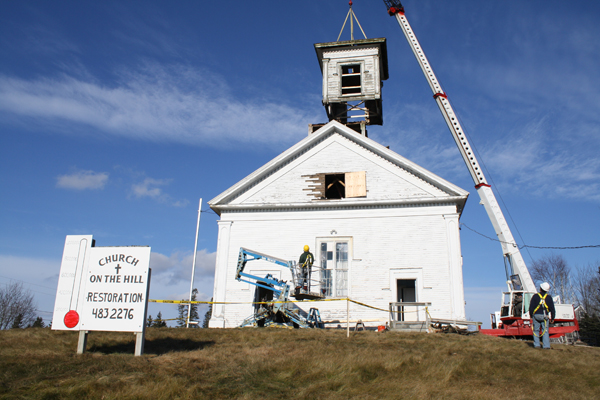
Church on the Hill – photo credit Maine Steeples Project
The Maine Steeples Project provides crucial support to the communities that are preserving Maine’s most iconic structures. A collaborative effort of Maine Preservation, the Maine Community Foundation, and a donor-advised fund, the foundation matches community-raised funds and provides professional guidance. From their newly-updated website:
The Maine Steeples Project supports local efforts to assess and restore church steeples of historic, cultural, and community significance to cities and towns in Maine. The program seeks to match local resources devoted to restoring steeples. Its priority is to support efforts to restore existing steeples, but reconstruction requests may be considered in unique circumstances.
For those interested in preserving a steeple in their community (or steeple-enthusiasts in general), we encourage you to visit their fresh website with information about the program, and eligibility requirements.
Castine First Parish Church, photos by Lee Hoagland
On the northeastern side of Penobscot Bay in downeast Maine sits the town of Castine, an elegant town with a rich history. Our crew was called into town because some structural issues had been detected in its First Parish Unitarian Universalist Church. Having never visited before I was struck by the town’s wealth of early American architecture. I feel that a short note on the town’s early turbulent history goes a long way to support much of the building’s history. Castine was originally settled as a trading post in 1613 by the French. However, it spent the next century being taken back and forth between the Colonists, British and French, with even the Dutch having control for a bit. After the French and Indian War the Maine coast was opened up to the Massachusetts colonists, only to have it re-seized by the British in the Revolutionary War, which eventually led to the Penobscot Expedition, one of the greatest losses in American naval history. It then was briefly returned to the colonies, in which time Castine became a town (separating from neighboring Penobscot in 1796). Castine was then again re-seized by the British in the War of 1812, where they controlled it for the length of the war.
In the years that followed Castine was able to prosper thanks to the booming fishing and timber industries that ran through the Penobscot River and Penobscot Bay, making Castine the perfect place for ship captains to build their dream homes
The First Parish church that we are working on had originally started construction in 1790 and became a meeting house in 1796 with a steeple protruding out from the front gable. However, it did not have a minister until 1798. These dates are important because they correspond with the timeline of the town. The people of the town were most inspired during that time when they were rallying to be their own town. The need for a place to meet was essential in becoming a community, and not another military post.
Shawn working in tower box
According to our research the original design had a steeple and tower box out front. The joinery layout supported the research because the bent that makes up the front gable wall is referenced to the inside of the building, in the same direction as the rest of the bents. Typically the reference face on the exterior southern bent is flipped around so that that all exterior walls are referenced to the outside of the building. Thus we can make the conclusion that there was a tower box bent in front of what now is the front gable, making it an interior bent at that time.
Sweet dragon and cross in tower hip roof
The building stayed this way until the prosperous town was at yet another turning point. The First Parish Church represented more liberal Unitarian beliefs, and in 1828, a more conservative religious offshoot was created, calling themselves “The New Trinitarian Society,” and founding the Trinitarian Congregational Parish. By 1831, in an effort to stay with the times, the First Parish church took the steeple off the front, and installed a Greek Revival belfry on top of the front gable. In some readings it is described as a “joyful crown” and is thought to be a Bulfinch design. Inside the tower box, the joinery again supports this history. Each of the hewn posts are joined by scarf joints to sawn timbers that extend the box higher into a hipped roof. The hipped roof was constructed with a truncated dragon and cross joint to carry the hipped rafter. Between the scarfed posts and the roof three new girts were installed. Two girts run perpendicular to the bents and one runs parallel to the front gable, off the second bent. All three girts are supported by ascending and descending 4×5” braces which run by each other to tie that level to the top plate.
The fourth girt that makes up the tower box was once a tie girt in the bent adjacent the original tower box. This tie girt is located approximately two feet below from the additional three girts. Floor joists are cogged over these girts, running perpendicular to the bents. Four bed timbers rest on that floor. The bed timbers support the eight posts that create the belfry. These posts are 10×10” white pine from the level of the bed timbers to the roof frame, then turn into columns with ionic capping at the top. The bed timbers are in a concentric square inside of the girt level, their weight and the weight of the belfry posts supported by the floor joists, rather than directly over the girts. This caused the girts to roll in towards the interior.
Rotten belfry post
In the first half of 2012, Castine contacted PTF about a leaky roof. Since the posts penetrate the hipped roof, it creates eight holes in the roof that need to be flashed with the utmost care, so that water cannot run down the post and sit on the bed timbers, rotting out both the bed timber and the post foot. That is what happened in this church’s case. Thus we find our scope of work: to replace the rotted bed timbers and fix any post bottoms that might need it.
Jack and bracket supporting belfry post while bed timber is replaced
One of the real challenges on this project was to lift all of the posts, and everything above the tower box, to access the old bed timbers while still being able to move our new timbers into position. We threaded 2x8s into the tower box and screwed them to the studs and braces of the tower box creating a laminated beam just outside the ring of belfry tower posts. Then we used other 2×8 beneath the laminated beam as jack studs, transferring the load directly to the tower girts. We lag-screwed an L-shaped steel bracket to each post, and used hydraulic jacks on top of the laminated beam to lift the bracket and the post it was attached to. This gave us the opportunity to lift all the posts while having the entire interior of the tower box to do our work.
Only half of one bed timber looked original, sitting in same orientation as the others which looked like mid-20th century fixes. This led us to believe that flashing must have leaked at least once before. When we removed one of the newer bed timbers, we found a signature and date of 1936. This also matched up with church records.
Tom, post fix, and bed timbers
We decided that since we were replacing so much and needed to lift the entire belfry that we had an opportunity to change the design for the better and used a common historical design in which the bed timbers are run from the middle of connecting eave walls, picking up two of the posts. This transferring of the weight onto the girts spreads the load out onto the walls and off the floor joist. To do this, we needed a fourth girt in which would run coplanar with the three other girts. So we fabricated a girt that joined to the posts with free tenons inserted in the bottom of the girts, allowing it to take horizontal tension and vertical compression.
Rolling bed timber into building
Now that we had a coplanar box we were able to bring up our 9×12” white oak bed timbers. One of the big challenges of this project was getting the timbers up to the tower box while only having interior staircases to move through, but we were able to get them where needed them to go through a series of rigging. Fortunately all of the members were just small enough that they could fit.
Inserting bed timber
We had two chain falls that helped immensely and with that we fabricated slides out of dimensional lumber that saved all around wear and tear. We all really get our jollies off during this kind of rigging and by the time it was over we felt more connected than ever with the timber framers of the past in the ever present quest to lift heavy things up high.
New girt installed in front bent
After the bed timbers were in place we were able to connect them to the belfry posts using free tenons that engaged the bed timbers. Although we were confident in the soundness of the timber elements we installed threaded rod between the girts and the bed timbers and between bed timbers and posts creating a tension connection that would help hold the belfry to the tower box and the rest of the building. This gives the belfry additional stability, which is helpful in cases of extreme weather.
Overall, we enjoyed the dynamic nature of the project and the rich history of Castine. We found the locals to be friendly and knowledgeable and the ocean views to be one of a kind. Although Castine doesn’t have the fame that some other early battleground areas do, it has a staggering significance in its role in the shaping of both the State of Maine and the United States.
-Lee Hoagland
Click on the slideshow below for more photos from the Castine project:
We have begun replacing the clock faces of the First Parish Congregational Church in York, Maine. Formed in 1636, the congregation is the oldest in Maine. The current building was built in 1747, and moved to its position, facing the road, in 1888.
Big Caulk
It is time for this old girl to get a face lift. Her frown lines brim with caulk. The clock faces are simply painted on the flush siding and framed with trim applied directly to the surface. Considering the lack of flashing, the trim has held up well, and we suspect that we will be able to restore and reuse approximately 75% of it. The white painted sides are in good shape, but because the faces are painted directly on the siding, we will have to replace the paneling totally. We speculated that the deterioration of the black portion was due to the increased heat absorption and movement of black painted wood, but concluded that the difference in wear was more likely due to better maintenance of the white portion. It is much easier (if you can call painting a steeple easy) to slap white paint on the trim and outer siding, than removing the numbers for painting, and cutting black paint in around the trim. But we can only apply makeup for so long, and at this point, this clock tower’s going under the knife. Click on the photos below for more information.
The crane arrived today. Tomorrow, it will lift the new belfry, bell and spire onto the clock tower . Keeley, the crane operators, will be using the same crane and lifting from the back parking lot again, with a lot more weight in the trunk.
As the spire has been rigged since last week (we have been looking forward to this) we spent the day with last minute preparations: collecting the clock from the library, dropping the staging around the spire, building out the staging up top and installing two more braces at the base of the clock tower.