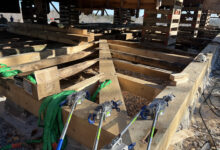
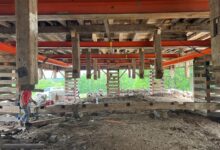
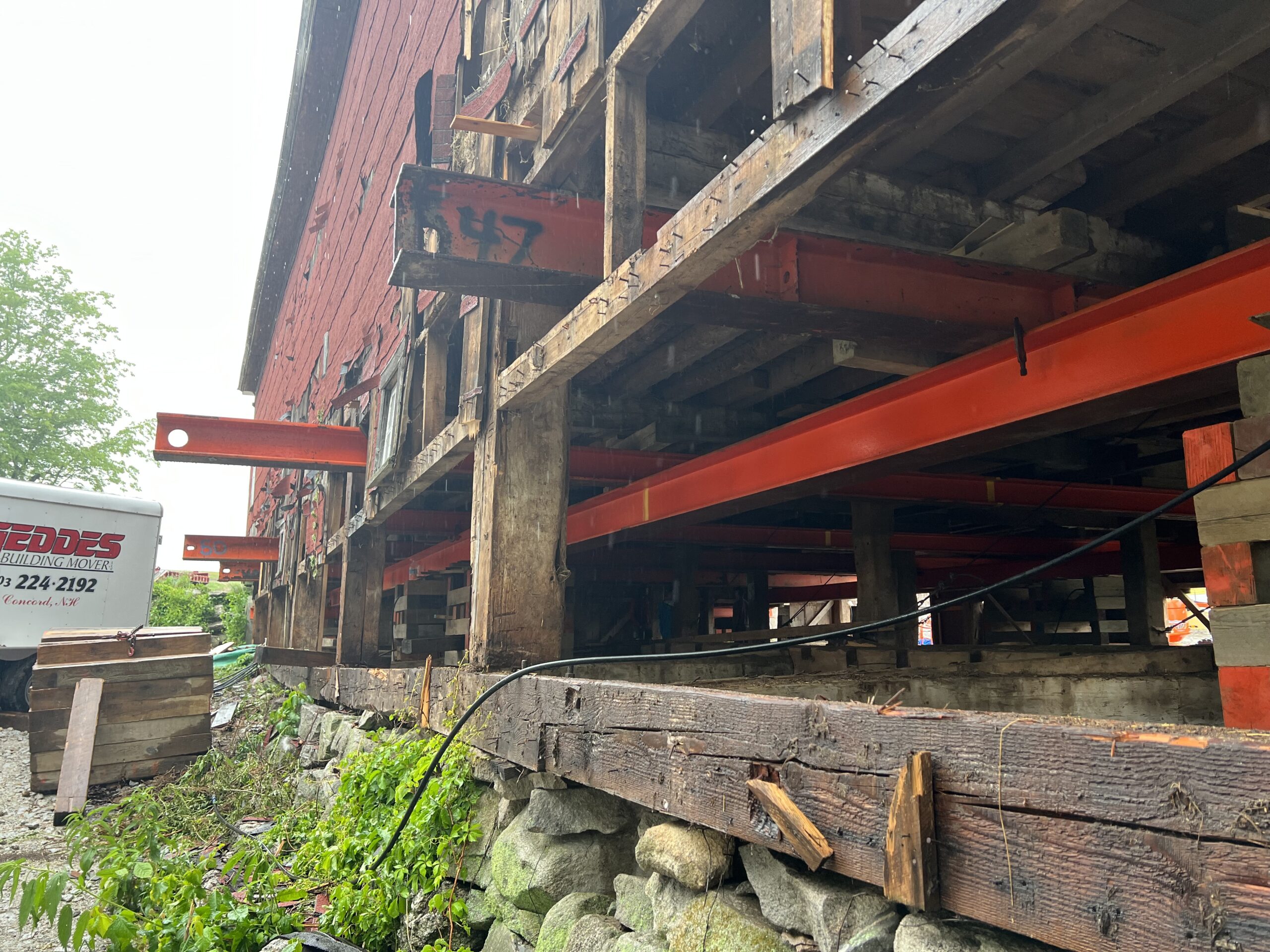
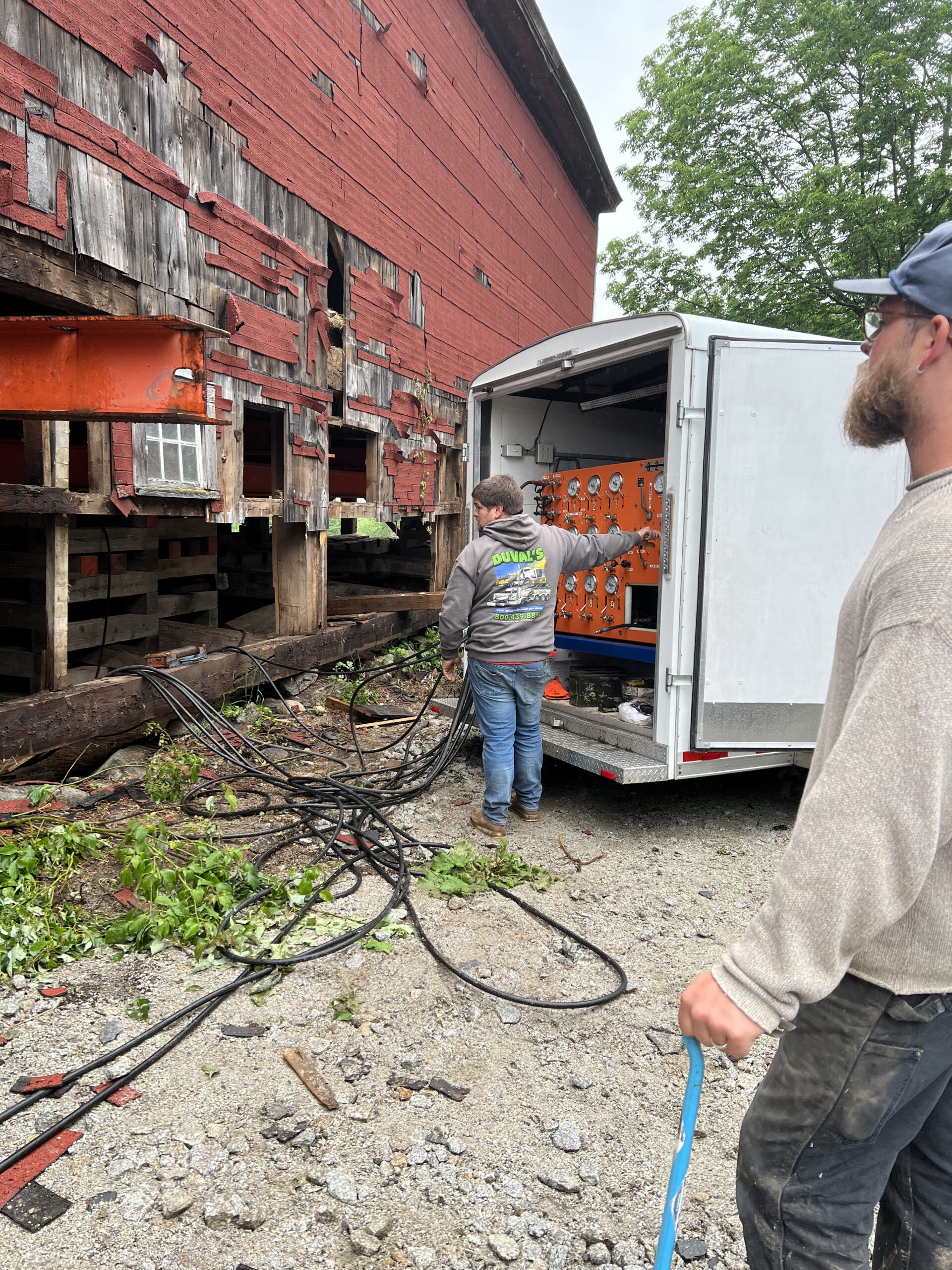
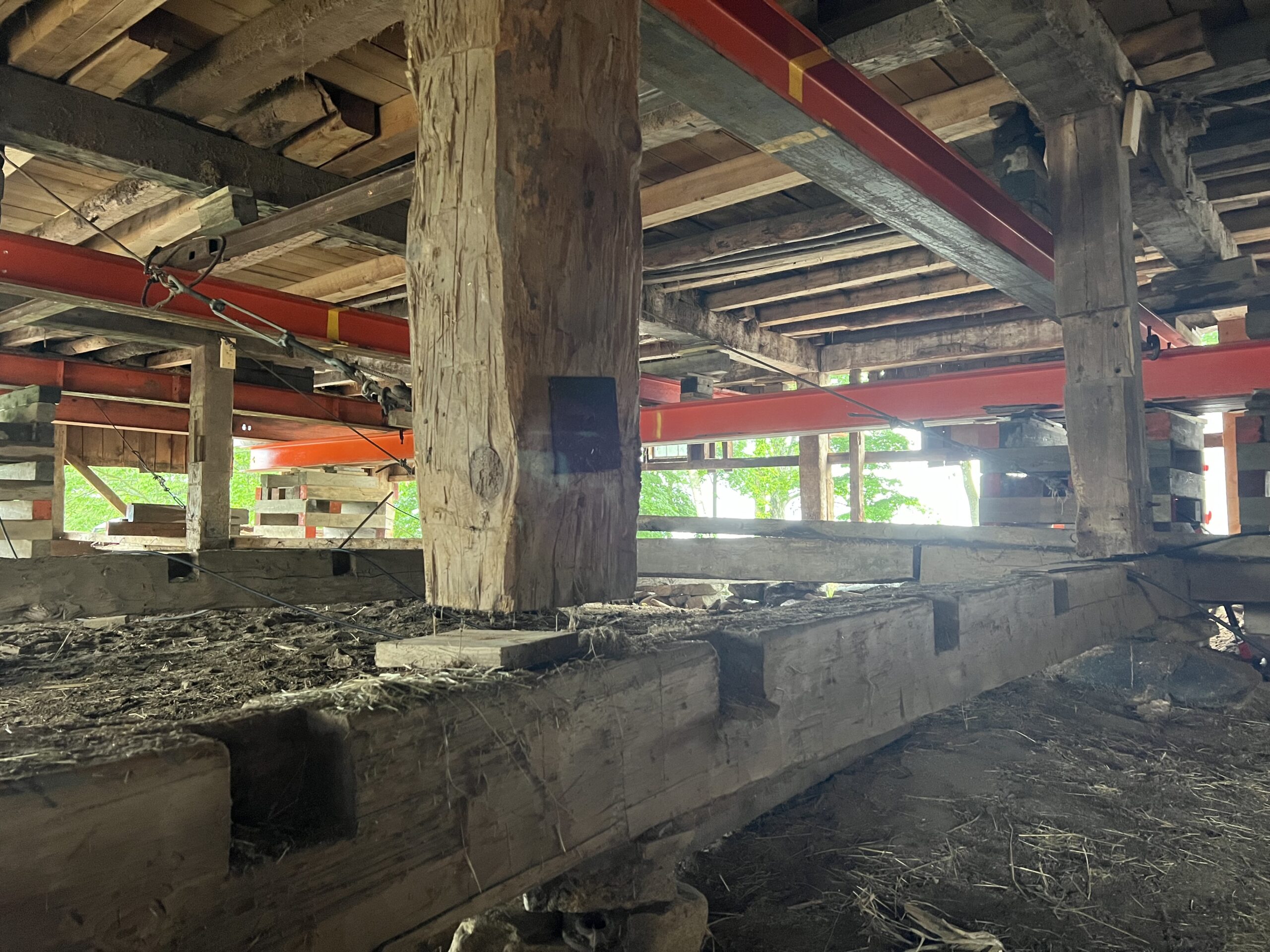
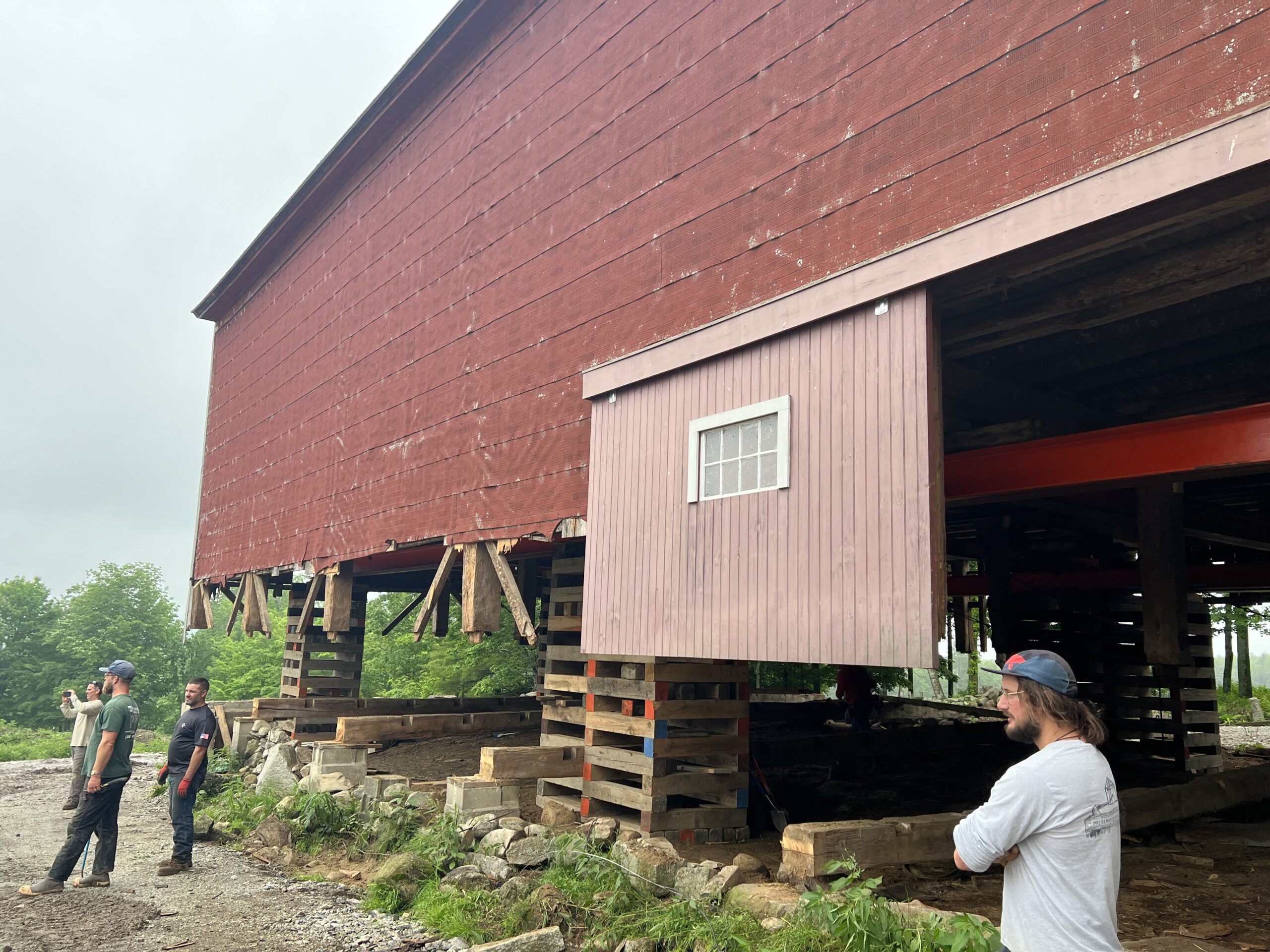
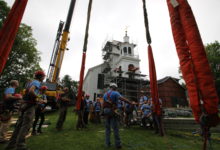
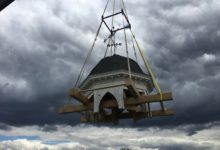
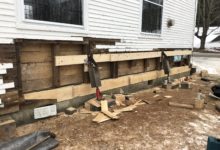
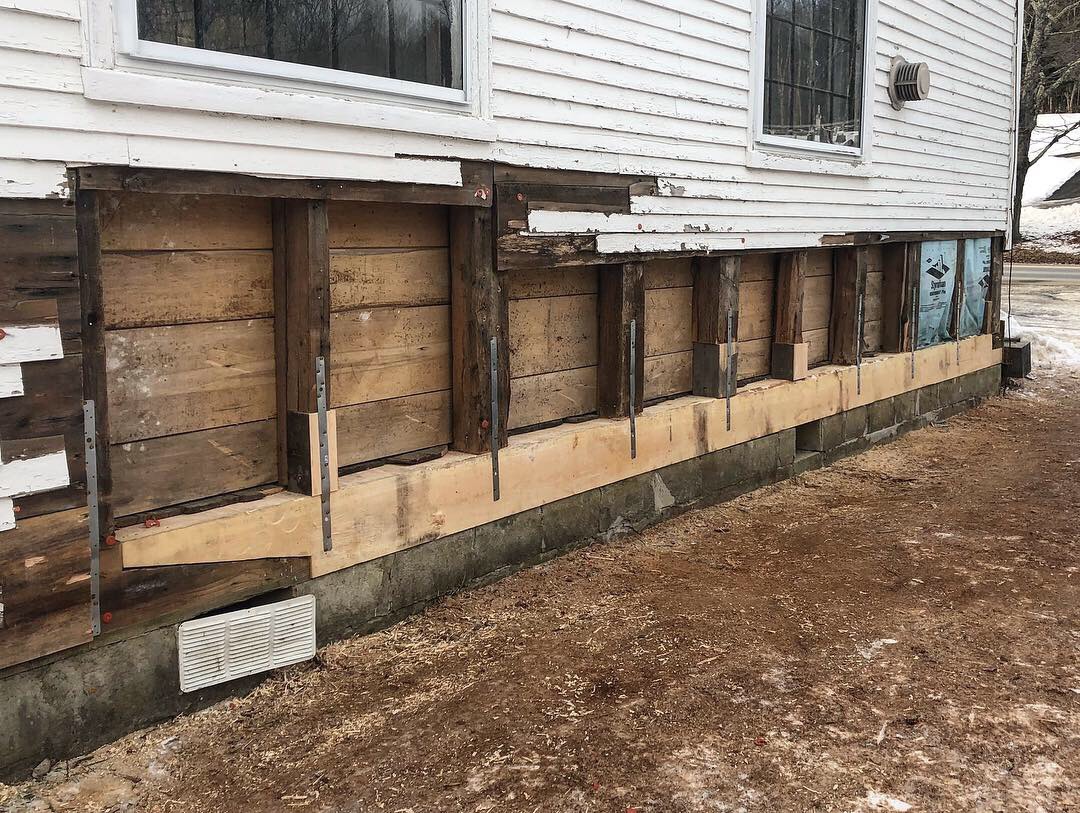
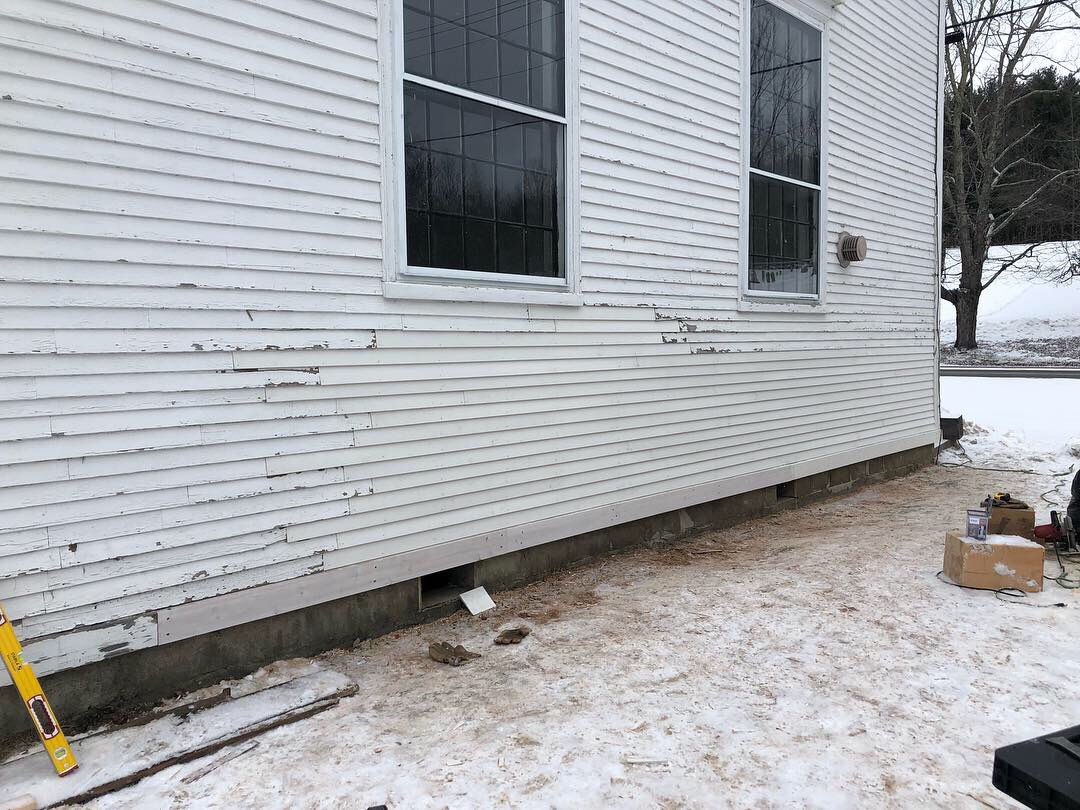
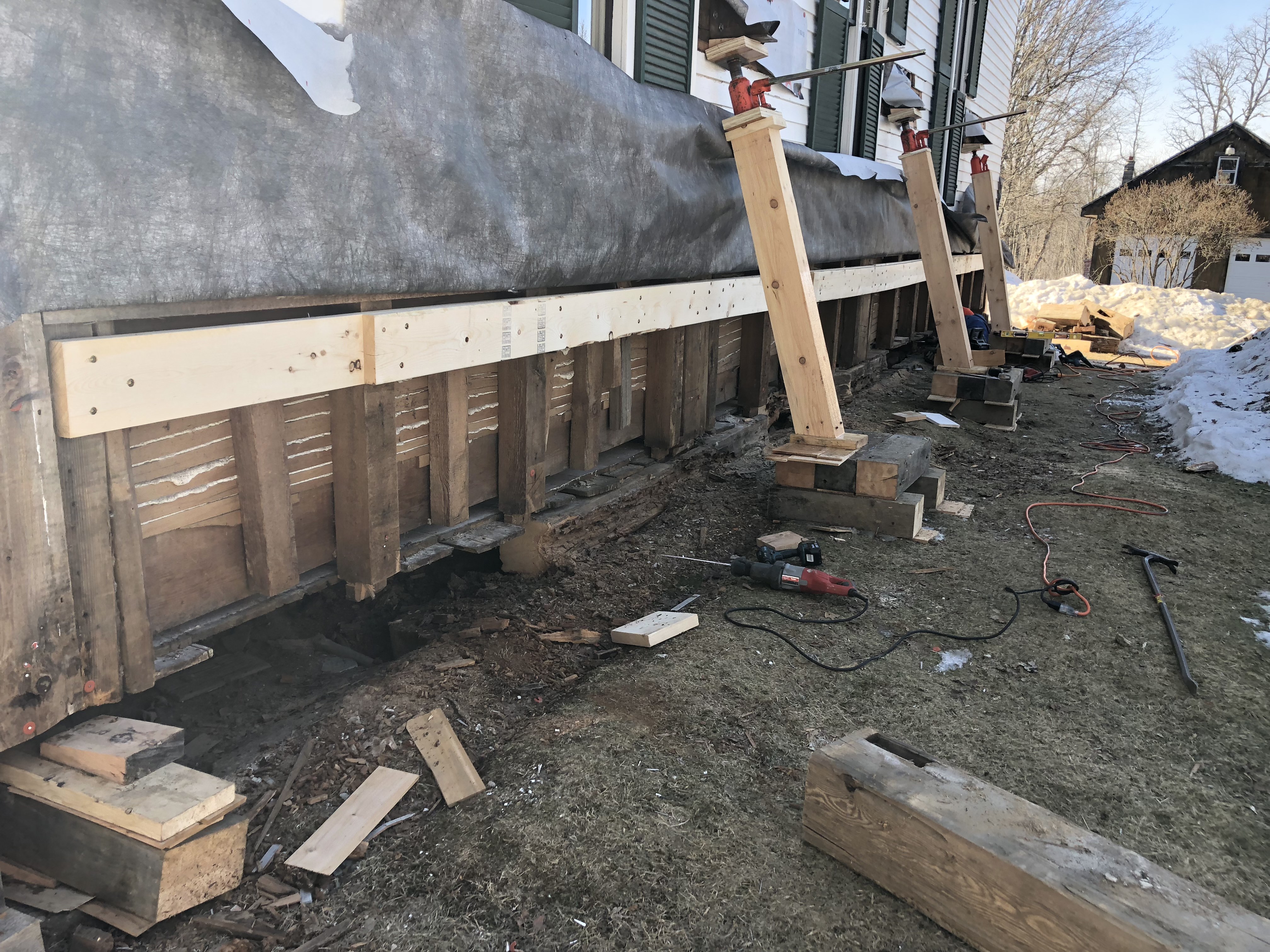
The Ox Barn at Sabbathday Lake Shaker Village and the Penhallow House at Strawberry Banke are two of our most historically significant projects. Both buildings were temporarily lifted by Geddes Building Movers so that they could receive completely new foundations and modern drainage systems. Jimmy and his crew are peaceful and professional and we could not recommend them more highly. We also appreciate all the news coverage these jobs have received recently. It is well deserved.
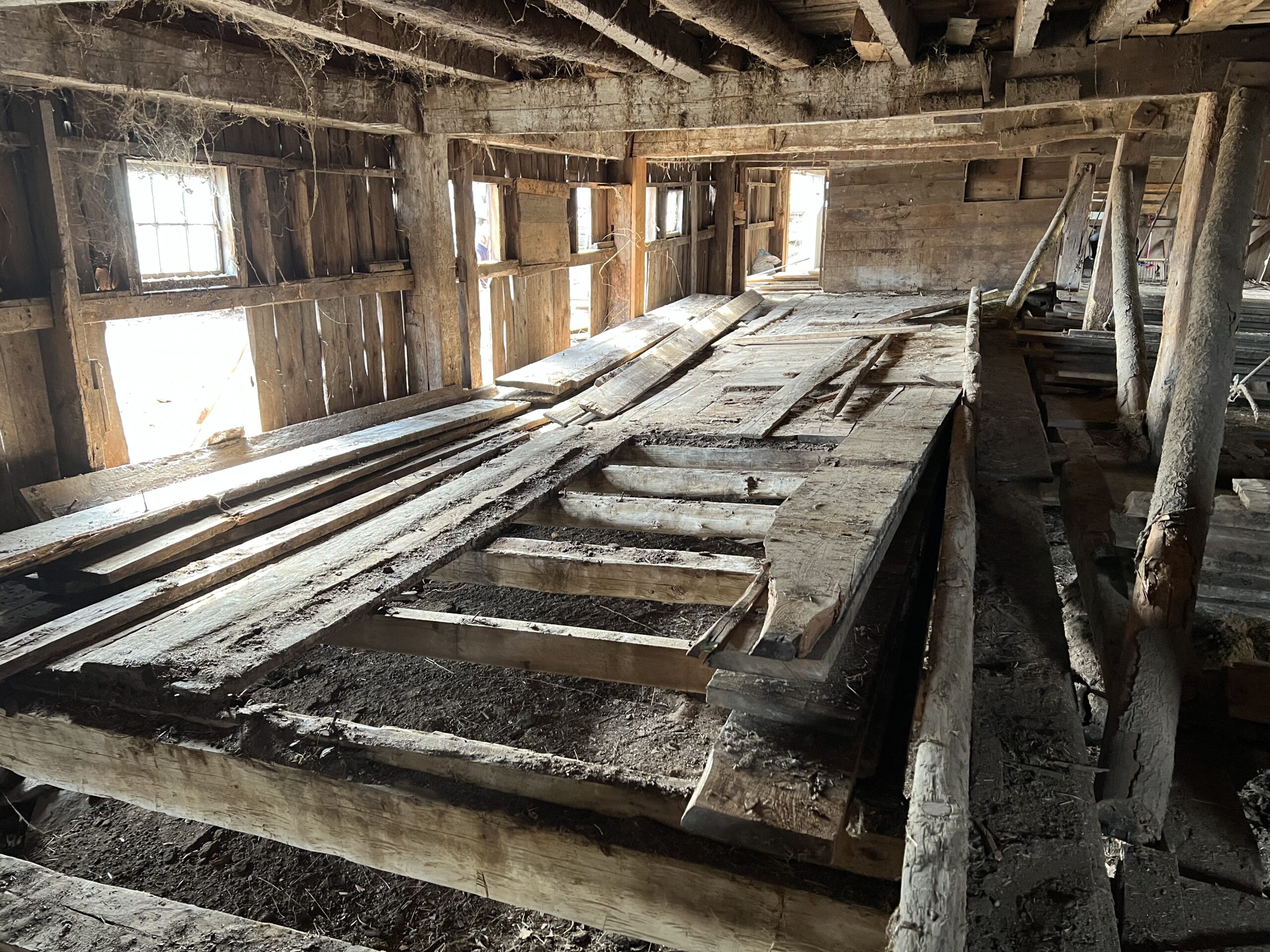
Ox Barn undercarriage diagonal floor girt
We’ve repaired the undercarriage at the Ox Barn and it was recently lowered onto its new foundation. NewsCenterMaine broadcast a nice piece about the day, and you get to see Arron being himself.
NH Chronicle broadcast a story about the ways that Strawberry Banke is adapting to increasing storm surges, groundwater levels, and climate change.
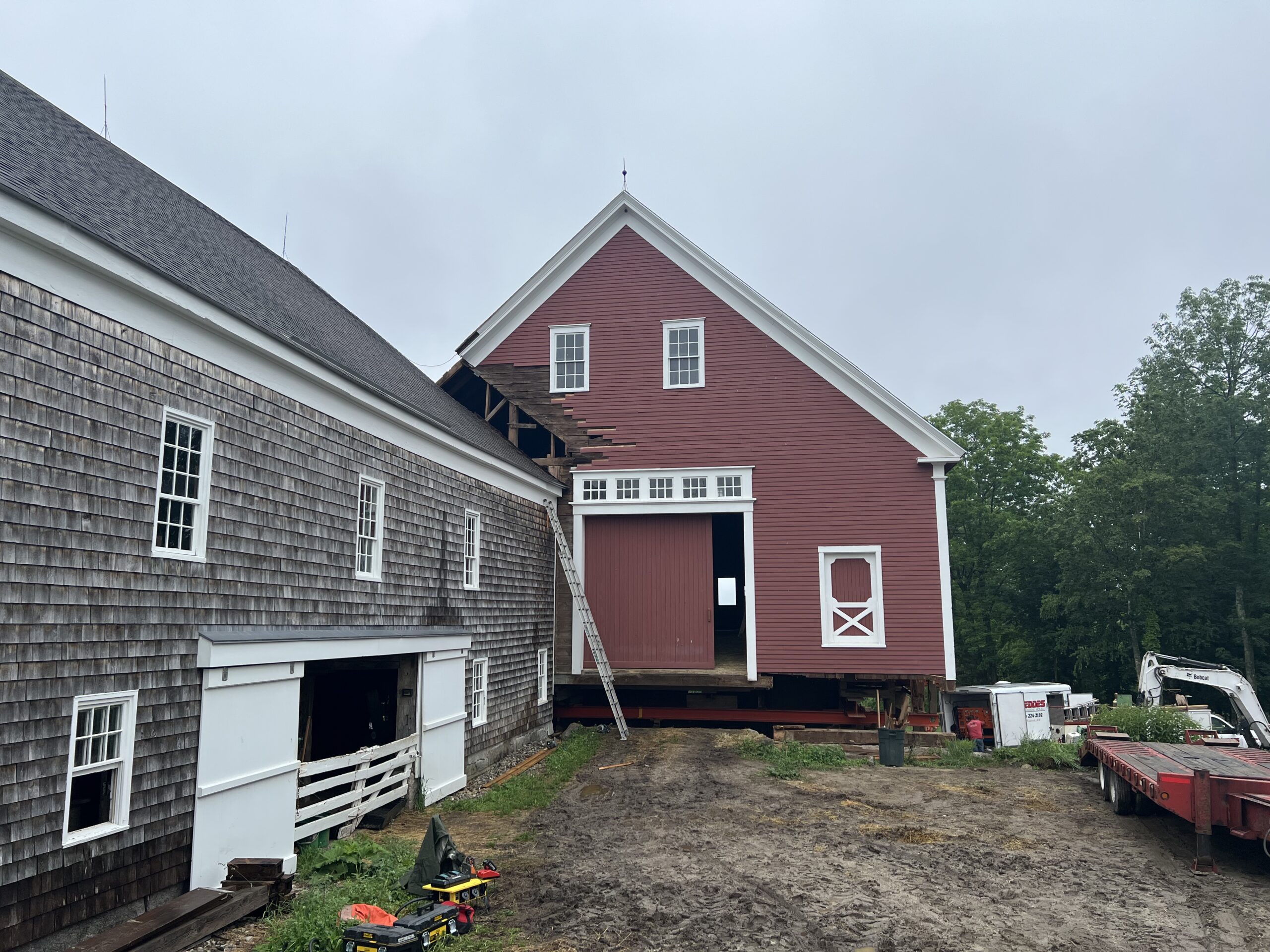
This is the Sabbathday Shaker “Stables” in the left foreground and “Ox Barn” in the right background. Perhaps you’ve seen them? They make up the little logo on highway signs telling drivers to “take the next exit!” (And you should, Sabbathday Shaker Village is both fascinating and chill). We’ve performed extensive assessments on both of these buildings, and the Shakers received a $500k grant to repair the Ox Barn, a process we embarked upon this past month.
This is just inside the front gable doors, in the main drive, on the hay floor. The Ox Barn was originally built in 1830, to house Oxen on the ground floor, and store hay on the first floor, where this photo was taken. The frame was altered dramatically in 1891, when the roof pitch was raised to match the Stables Barn in front, and the two barns were connected. The roof pitch was originally much shallower, and the center drive posts significantly shorter.
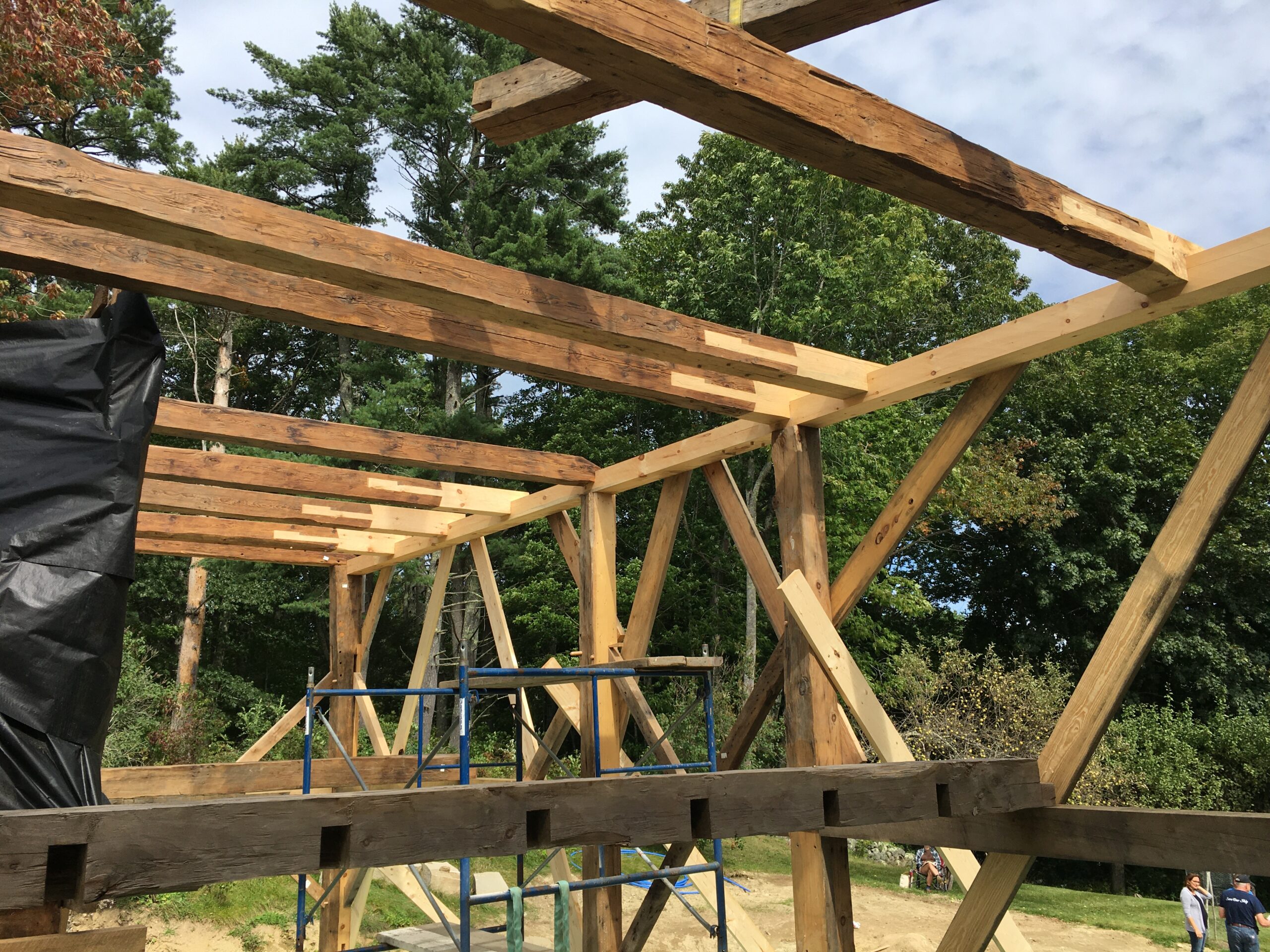
The original rafters were too short to support the full span of the new roof pitch, but they were left in place and tilted upwards. They can be seen in the above photo supported by a continuous, horizontal purlin-plate above a series of purlin posts and stout braces. Given evidence we found in the Stables Barn, there is a good chance that this purlin-plate is original to the frame and was simply lifted to its new height and reused for the same purpose. Each of the original common rafters have been sistered to a new, dimensional one.
A post and descending brace, located on the ground floor, exhibit these lovely marriage marks. This is within the original gable end wall, that was extended to connect to the Stables in 1891. That little tent-looking symbol, after the VII, is often used to indicate a gable end.
This barn is huge. It is 46′ across the gable and 87′ along the eave, but its height is truly impressive. The eave posts extend down past the hay level to land on a foundation a full story below. And because of the slope of the grade, the foundation wall itself is 6′ tall at the rear gable. The eave posts, original to 1830, are more than 22′ long. Some of the posts are about 10″ x 11″ at the sill and 10″ x 15″ at the plate. One of the posts is 12″ wide and 17″ deep at the teasel tenon. The photo above was taken on the ground floor, where the Oxen were kept. It shows the south eave wall and the full length eave posts in bents 5, 6, and 7. At the very top center of the frame, you can see how a large carrying timber, 12″ x 12″, which supports the hay floor above, intersects the eave post and rests in a tapered haunch.
The ground floor looked like a time capsule when we visited for our first assessment. Some of the cobwebs were included in the National Register designation. This big honking post is just one story high and supports the carrying timber that supports the drive floor joists. The Ox Barn has undergone a number of stabilizations in its lifetime. I especially liked this series of cables and log bracing installed under the guidance of Sister Mildred in 1967.
We were asked to assess the building after the Shakers observed movement in the south eave wall and these large dramatic checks in a majority of the south eave posts. This photo shows a vertical post, flared at the top to about 12″ wide and 15″ deep. There is a 4′ crack along the grain of the post, also called a “check”. A horizontal tie beam runs from the left side of the photo to the top of the post, and intersects a timber plate that runs from the lower right of the photo, parallel with the eave wall and under a series of common rafters. In an English tying joint, the eave plate rests on the exterior half of the post, and the interior half of the post rises past the plate to join to the tie beam with a teasel tenon. Typically, the tie beam also joins the plate with a half-dovetail-shaped cog. Originally, in 1830, this roof was framed with large principal rafters, which joined directly to the top of the tie beam, with small common rafters filling in-between. In the far background, on the rear gable tie beam, you can see where a little seat was cut into the top of the tie beam to receive the diagonal rafter. When the roof was rebuilt in 1891, the common rafters were reused, but the principal rafters were not. The tie beam had less of a direct role in resisting the outward thrust of the roof, and the plate received that force alone. Later in the 20th century, the timber plate suffered rot and was replaced in a number of sections. The half-dovetail joints at the ends of the tie beams either rotted away or were cut off. The result is that the roof pushed outward on the plate while the tie beam heroically resisted that force at the inner teasel tenon. The connections between the plate and the outer half of the post and the tie beam and the inner half of the post were strong enough, over time, to rip a 12″ post in half like a piece of newsprint.
We aren’t the first folks to try and solve this problem. This photo shows three different stabilization attempts. The earliest is a wrought iron dog, which looks like a big staple. The rough hewn tie beam enters the frame from lower right, and the circular sawn plate runs horizontally across the photo. This plate is a replacement member, and the end of the tie beam, with its half dovetail joinery, was severed during that repair process. You can see a mortise in the top of the tie beam which once received the tenon on the bottom of a principal rafter. After the dog didn’t work, through bolts and cables were installed to help tie the eave walls together. Later, as the framing deteriorated further, large L-brackets made of plate steel were installed to connect the tie beam and plates.
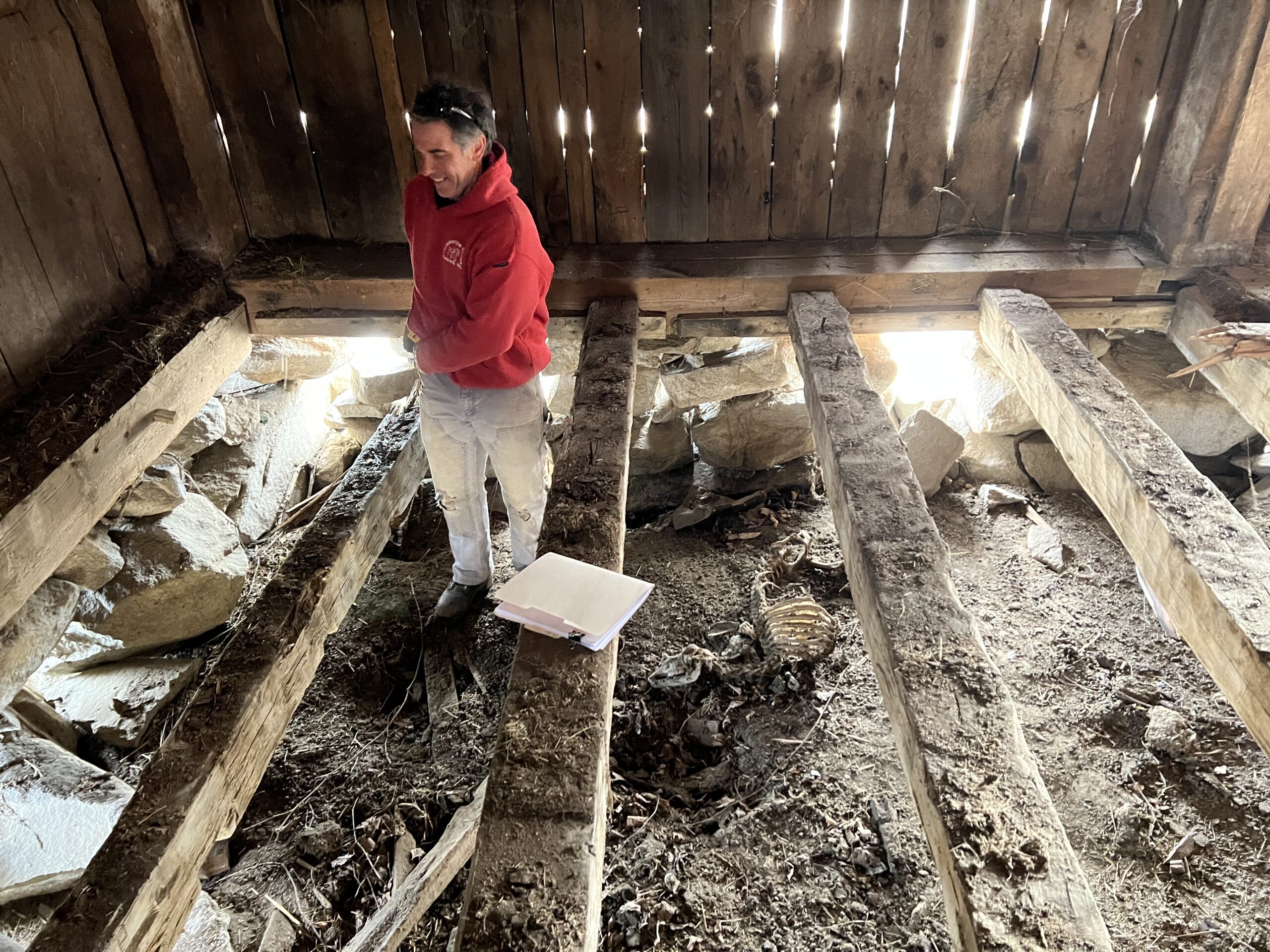
A lot of the problems at the plate level were exacerbated by trouble at the foundation. Decades of drainage problems and frost heaving have shifted the field stone foundation. It would make no sense to repair the tops of the posts until the problems in the foundation were addressed. PTF determined that the most economical way to repair the foundation was by lifting the building on steel. Because so much of the ground floor needed repair, including replacement of the perimeter sills, the steel would be inserted above the sill level, and ground floor framing completely dismantled while the site was excavated and the foundation rebuilt. The Shaker community rallied a legion of volunteers to clean out the cobwebs, lumber and farm equipment. PTF then got to work carefully removing the flooring and documenting the framing. Beneath the floor, we discovered the remains of a few long lost friends.
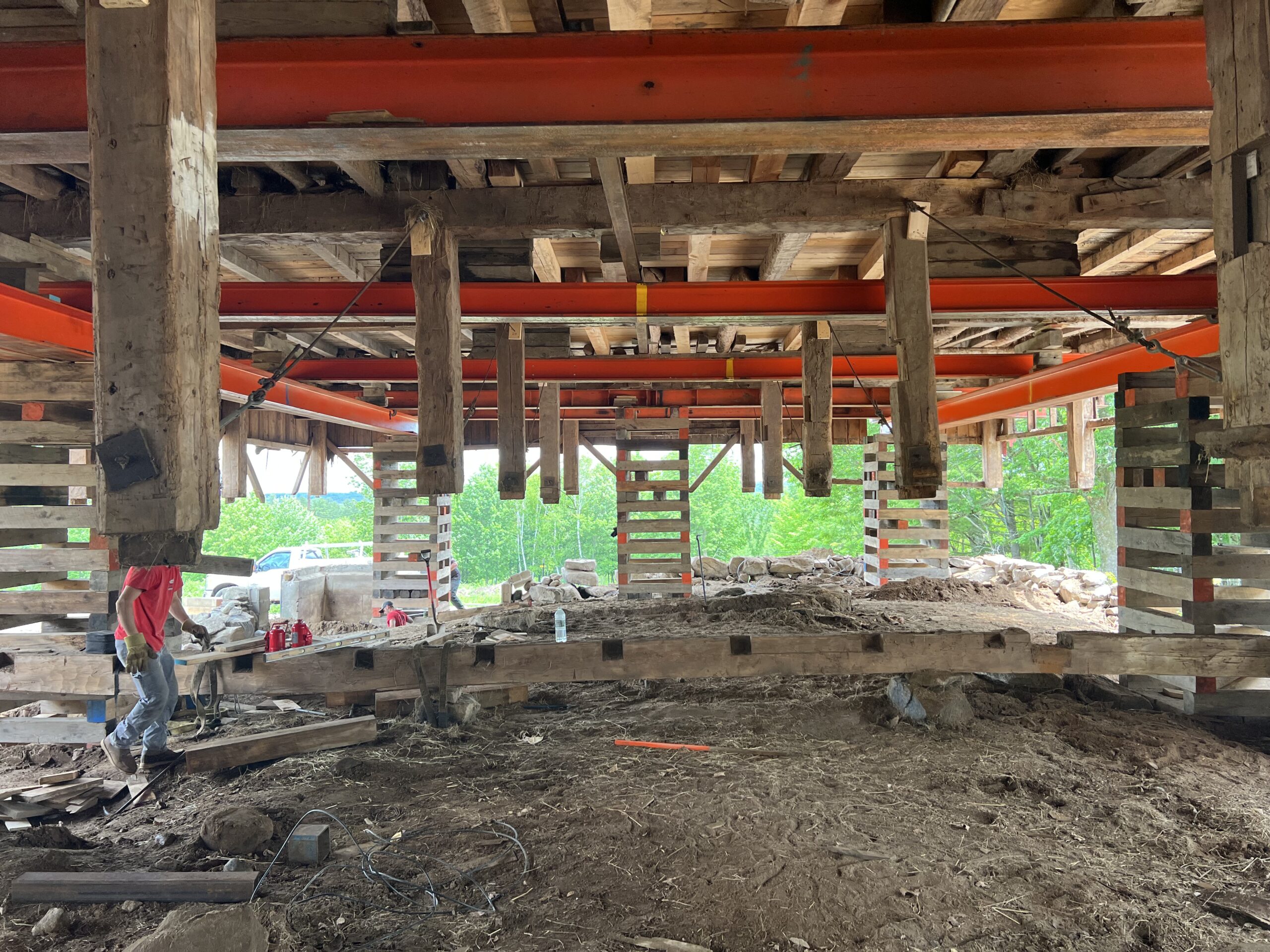
PTF stripped a lot of later sheathing and cladding from the bottom six feet of the building. Geddes building movers inserted a grid of steel above the sill level and below the hay floor framing. The framing was carefully blocked and shimmed tight to the steel. The steel is supported on a series of cribbing piles inside the building footprint, and hydraulic jacks are placed in the center of the cribbing piles, just below the steel.
The jacks are all controlled from a central unit in the back of this truck. Jimmy Paveglio is operating the jacks while his crew and the PTF crew are monitoring how the frame is lifting. From the dials on the truck, he can identify when the frame is impeded or rubbing on the adjacent Stables building.
Prior to the main lifting day, we disconnected the Ox Barn from the Stables and disengaged all the joinery between the posts, braces and plates. Ideally, we would keep all mortise and tenon joinery intact. Unfortunately, some of the tenons had been cut during previous sill replacements, but a lot of it original framing and joinery is visible in this photo. Look at that beautiful hewing!
On that first afternoon after Geddes had inserted the steel and rigged the building, we were very pleased to come up three inches. It was a good sign that the major lift would go smoothly on the following day, with all the community watching, along with the news cameras.
Geddes goal was to lift the building high enough that the excavators could get their machinery around and under the frame. They were very thoughtful about locating their cribbing piles so as not interfere with forming and rebuilding the foundation. The lift went smoothly, and we reached our goal before coffee break. The result was almost anticlimactic, because the process was so steady. The building went up at about an inch a minute, and we’d released it so successfully that there aren’t any interesting challenges to report. Geddes then helped us disassemble the remaining floor framing.
The photo above shows the frame lifted on cribbing, the drive posts dangling from the hay floor carrying timbers. Those long 22′ eave posts can be seen hanging down along the outside walls. The last ground floor carrying timber, seen in the foreground, will be carefully removed, and then the excavator will remove all the organic matter from within the building footprint. He will dig long trenches for the footers and foundation walls to be poured below grade, and the masons will rebuild the stone walls above grade. PTF is replacing most of the perimeter sills and one of the six continuous carrying timbers. Approximately a quarter of the floor joists will need to be replaced.
The barn will remain at this height until the fall, when we have finished our sill repairs (it has been made weathertight since this photo was taken). Once the building is restored to its new foundation, we can fix the plates and post tops. The Portland Press Herald covered the lift, and Geddes had some great front page photos. I am really looking forward to spending the rest of the summer in New Gloucester.
The original Tuttle house, and to the left, the original Tuttle Barn.
On and off since 2019, PTF has been involved with the restoration of the Tuttle Barn at the Desert of Maine in Freeport. The new owners, Mela and Doug Heestand, have transformed the Desert to be more welcoming for families and more clearly interpret the unique ecology of this site. This past year, we restored a historic cape for use as a visitor’s center and house museum out in the middle of their piney woods. We repaired and reassembled a late 18th-century cape frame that had been carefully disassembled and stored for more than twenty years in Swanzey, NH. It is nearly identical to the Tuttle family house that had been on the Desert property and burned down many years ago. In February, the Tuttle House project was featured on the season 3 finale of Restoration Road. You can watch the episode on Discovery or HBO.
This is most of the undercarriage (first floor) frame of the house assembled at our shop in Nottingham, NH. That big square opening in the center is where the chimney mass used to be. It is incredibly unusual to retain any original perimeter sill in a building this old. I tend to think of sills as sacrificial elements, like roofing, or clapboards.
This is the roof frame assembled in the yard in Nottingham. In the foreground, you can see part of the undercarriage framing. The roof is a principal rafter, common purlin frame. We had to replace four of the rafters, the lighter colored wood. Those were sawn on a mill, and then surface-hewn.
Here is the frame after it was assembled on a new foundation on the Desert of Maine property. Those huge hewn flared posts are typical for a cape of this age (we’re guessing about 1770). The larger right bay holds the two front chambers, the chimney mass, and the entry hall. The smaller left bay holds the kitchen, birthing room, and loft stairs. It is a rugged frame, with continuous ties distributed approximately 3′ on center along the full length of the eave plate.
Dan and Brian sheathing the roof. Half of the front plate was replaced and joined to the original half with a halved and bladed scarf, on edge. Each pair of rafters lands directly over one of the continuous tie beams, and each post joins to the aligning tie beam and rafter with an English tying joint.
This is one of the front corner posts. The interior of the building will only be partially finished, with only the paneling, trim, and cabinetry that was saved with the frame. Here, some of the original post casing has been re-applied to the post. The lovely hewn surface of the tie beams will remain visible.
The kitchen retained most of its paneling and doors. The walls were lettered and the panels were numbered. This antique paint surface will be maintained, rather than repainted. The loft stairs are behind this door, the original rise and run of each stair visible in the paint lines.
This is the rear interior wall of the kitchen. Some panels were reused from another room to fill out the wall, and these were painted the same shade of white.
This is front right chamber. The painted floor was removed from the original house, as was the wide wainscot. The wainscot does not meet in the corners, and likely intersected a corner cabinet.
This is partially floored loft, with a first period bed. The combination of rafters, collar ties, struts, and continuous tie beams creates an incredibly rigid roof frame.
This is the borning room, with its original paneling, and an early paint color that was in place when it was disassembled. The closet was painted a bright salmon pink. The feather edge and grooves on the paneling were hand-planed, so the joiners weren’t concerned with the sides of the panels being parallel, and used as much of the board as they could.
Daron Smith and Tom Glynn built this door and sidelights based on the early photo of the original Tuttle farmhouse. The stiles and rails are joined with pinned through-mortise-and-tenons, and the solid pine panels are beveled and floating.
Daron and Tom also built the window frames and sash by hand at our shop in Nottingham. The stiles and rails are mortise-and-tenoned, and the muntins meet the sash frame with coped tenons. The upper sash is fixed and the lower sash is operable. Windows of this age would not have been weighted.
The Tuttle House frame finished. This was such a fun and creative project and a totally unique site in Maine. This summer, the building will be open and interpreted so that visitors can learn more about how it was built and how it was used. Visit Desert of Maine for more information.
Three of our projects have been in the news recently: Sabbathday Shaker Village won a $750,000 grant to rehabilitate their Herb House, the Abyssinian Meeting House will complete their restoration with $1.7 million in federal funding, and Broad Bay Church won a Maine Preservation Honor Award.
Behind the Herb House at Sabbathday Shaker Village.
The Sabbathday Shakers are restoring their Herb House; the second two stories will continue to be used to dry and process kitchen herbs grown on the property, and the basement and first floors will be expanded to provide workshop and demonstration areas. The frame itself has been combined, expanded, and adapted throughout its life and this renovation continues in that tradition. There are some honking-big timbers in the undercarriage, like 12″ x 14″, that I hope will be on display in the finished space. Read Shakers get $750,000 federal grant to renovate Herb House in the Portland Press Herald.
Replacing the Aby’s front sill. The “after” photos show that the timber was absolutely hollow at this point. It was sad to lose the original marriage marks, which were reproduced on the replacement sills.
The Abyssinian Meeting House is the most important building that PTF has had the honor of repairing. The finish phases of the restoration are being completed by other contractors, and we have been thrilled to watch the project progress. Read Abyssinian Meeting House restoration to get $1.7 million in federal funding in the Portland Press Herald.
Broad Bay front facade.
Broad Bay Church was another successful collaboration. PTF was hired to repair the tower’s timber frame. It is gratifying to be part of making these buildings accessible to everybody. Read Broad Bay Church Awarded Maine Preservation Honor in The Lincoln County News.
We can’t wait to get started on the Herb House, wish the Abyssinian all the best in fulfilling their goal, and congratulate Broad Bay Church on the well-earned win.
We raised the Kavanagh ell last week. The frame was in rough condition, but the owners have prioritized preserving original material as much as possible. All but one tie beam received two new ends, each joined by a timber scarf. Most of the posts received repairs as well. The undercarriage and roof system were beyond repair, and will not be seen within the finished space. The roof will be framed conventionally by Williamson Fine Homes.
Center Tenon Tie Repair, keyed, wedged, and under-squinted.
Dan Newman cut center tenon scarfs to repair the rotted ends of the tie beams. The shoulders of the scarf were under-squinted (angled) to prevent twist, and the center tenon was keyed and wedged to work in tension. The scarfs were cut with extremely tight tolerances because they will need to resist spread in the eave walls, and because they will be on display in the second story bedrooms.
Double-bladed post repair
Most of the posts required repairs as well, but Jake Imlay and Dan cut their scarf joints to preserve the maximum amount of original material. A double-bladed scarf joint attaches a new post base to an original post top, above. The length of the scarf is customized to cut out all rot and preserve the beautifully-hewn interior surfaces.
Eave wall raising with crane, and crew
The ell was relatively small, and was erected with an “eave-wall raising” (as opposed to a “bent raising”). An eave-wall raising is typical of small 18th and early 19th-century frames, with tie beams that cross the plate with half-dovetail joinery. The crew scribed all new joinery and fit all the walls, then reassembled the eave walls on the deck, and reinforced the frame with KD bracing and gussets. Using a “4-point pick”, the crane raised the east eave into place, while the crew set the post feet into their mortises. We braced the east eave and set the house-end girt into its mortise. Then we switched sides, and assumed the same positions to raise the west wall.
Assembling Bent 1
This was a relatively easy crane day because Scott and the crew were so organized. After the eaves were raised and braced, we used the lull to lift the Bent 1 girt into place. The girt is connected to its posts by both ascending and descending braces, and required a pair of hands on every brace. Cut from white oak, it was difficult to tell the old braces from the new, their edges were still so crisp. But when we went to pick one up, our arms knew the difference–the new ones weighed three times as much.
Scott tags the tie beam
Scott Lewis organized the frame raising and communicated with the crane operator. After the eave walls were standing, he rigged each of the tie beams evenly and directed them into position. This photo shows the gorgeous double-ended tie beam repairs that are the centerpiece of this preservation effort.
Jake fits a half dovetail joint
The crane placed a pick across the tops of the eave walls, so that Dan and Jake could fit the tie beams into cogs in the plates. The eaves were relatively straight and the joinery cut so cleanly that the hardest part was sliding the pick down the plate while staying clipped-in. The tie beams join to the plate with a stopped half-dove, visible above in Jake’s hand. This photo illustrates well the advantage of the wedged center tenon – much more of the original material is visible from below.
A Tale of Ten Tie Beams
The northern crew has been at Kavanagh for a while now, and rebuilt the undercarriage beneath the house this past winter. Given the extent of damage in the ell, the frame repair was relatively quick, the crew dismantled the frame in late April of this year, and spent the summer cutting scarf fixes and scribing joinery. By mid-September, we were re-erecting the frame on the fine crane day pictured here.
The PTF crew has another small frame to raise on site, and is handing the reins over to Williamson Fine Homes to finish the Ell. Then the northern crew will turn its attentions back to the main house, to repair one of the most finely crafted hip roofs in the state of Maine, surrounding a glass-floored cupola. It’s a lot of work, and we feel lucky to do it.
Chester Church, Assessment, March 2018, Photos by Arron Sturgis and David Ewing
Chester Congregational Church is a Greek Revival cutie with a facade that can stop traffic. It was originally built in 1773, 90 degrees to its current orientation, with a tower that stood proud of the end bent, an open belfry, and eight-sided spire. In the 1840s, the building was turned, the tower was enclosed within the body of the church, and a narthex was added, with an enclosed belfry and four-sided, oblique spire. In 2018, PTF was called to assess the building, and investigate damage to the tower frame. In the attic, we encountered an incredible queen post truss system.
Queen Post Truss Frame
A queen post truss allows a church to have a large open sanctuary, uninterrupted by interior posts. The vertical queen posts support the bottom chord, which stretches from eave wall to eave wall. King post trusses are common in late 18th and 19th century churches, but a modified queen post truss like this one is rare. This truss contains two queen posts connected by a horizontal strainer, and braced by two upper chords, which are the diagonal timbers running parallel inside the rafters. The trusses are connected down the length of the building by a sturdy series of girts and ascending braces. They are further stabilized by those big, long logs running the length of the building. Those were likely used to help erect the frame, especially the front tower.
Belfry interior, March 2018 assessment
The belfry tower posts were in more trouble. Previously, this corner had been stabilized with metal gussets. Unfortunately, large plates of metal can cause ambient moisture to condense against the posts, and prevent them from drying out, exacerbating the rot.
Belfry corner post, August 2021, prior to repair
The post was badly rotted behind the metal plates, and required a timber scarf repair. Additionally, the horizontal bed timbers supporting the spire were rotten, and needed to be replaced. The design of the tower frame is unusual, the bed timbers rest on a ring of girts that run just below the tower top plates; the beds are sandwiched between the two rings of timbers.
Spire removed, July 29, 2021
In order to replace the bed timbers and repair the belfry posts, we removed the spire to the ground. It can seem dramatic to remove a big piece of the building, and can spook the congregation, but ultimately, this was the most efficient (and economical) way to repair the tower. With that weight on the ground, we were able to make repairs without setting staging and rigging through the center of the sanctuary.
Belfry corner post, repaired
Arron repaired the corner post with this custom scarf joint, which preserved good original material and joinery. Timber repairs are the most effective and longest-lasting way to repair an old frame. Metal plates will lead to further rot, and many (but not all) metal brackets are not strong enough. We find scarf joints like these in many old frames, old repairs that have lasted for centuries. We cut the same scarf joints with the benefit of power tools. These days, Arron, our boss, doesn’t get out in the field as much as he would like, but he cut this scarf himself. Dan whispered to me that the fix fit on the first try, no kerfing required. Turns out Arron’s still got it.
Repaired Belfry Plates, Post and Girts, August 2021
A few of the girts and plates were replaced as well. The new top plate was joined to the old using a floating tenon, which is a like a big spline, fastened with oak pins. We find that wooden mortise-and-tenon joinery is stronger and longer-lasting than modern brackets and fasteners. All wood moves over time resulting in metal fasteners working free, which is dangerous if the fasteners are the only thing supporting your girt. We generally use metal fasteners as tension connectors, and timber joinery to support the weight of the frame. We reproduce joinery that has been proven over time, or improve the joint so that the girt is solidly supported on the post, compensating for any shrinkage. Here, the girts supporting the bed timbers receive a little extra help from new studs within the wall plane.
Unfortunately, our crew, Dan, Erik, Tom W., and David G., have been working so fast and have been so focussed on repairs that they neglected to take any pictures of the spire’s return to its aerie. A crane placed the old spire on its new bed timbers on September 16, 38 days after it was removed. Ultimately, spire removal was the speediest road to recovery, and the church can continue to stop traffic.
The Union Leader covered the raising here, and they have some great pictures.
If you don’t already know Timber Framing, the journal of the Timber Framer’s Guild, you should. It contains information about techniques like simplified scribing, and engineering for framers, as well as in-depth coverage of projects that are even cooler than ours. I wrote the following article for the issue published last March 2019. It covers the adaptive re-use of the colloquially-known “Burd Barn” and benefitted from extensive editing by Michael Cuba and Adam Miller. I was so honored to have it published there. Subscribe, subscribe! You won’t be disappointed.
Smith-Bradbury in situ
New Life for a Kennebunkport Barn Timber Framing, Number 131, March 2019
At 17 ft. by 38 ft., Kennebunkport’s Smith Bradbury Barn is small. It is also remarkably intact, containing almost all of its original framing members. Although studs have been moved, and removed, and window and door openings added, the standing frame exhibits an impressive integrity and consistency. Recently, our company was called upon to repair the barn as part of a larger, house renovation and expansion project. While the rest of the project strains the bounds of preservation, in the technical sense, the barn remains an island oasis in a sea of modern construction.
The barn stands behind the Smith Bradbury house, built in 1793. The home is on the National Historic Register as part of the Kennebunkport Historic District, and was home to Charles Bradbury, author of the 1837 History of Kennebunkport. Smith Bradbury, the house’s namesake, was a merchant who came to Kennebunkport from Newburyport in about 1790. During that same year, the shipbuilder Tobias Lord moved his operation from the Mousam River to the more navigable landing site on the Kennebunk River. The site was called, descriptively, “The Landing”, and is located about two miles upriver from the Bradbury plot. Kennebunk merchants were granted their own customs district, and numerous shipbuilding operations made The Landing the commercial center of the region until 1860, when the main economic driver was shifting to tourism.
Roof Frame
The barn’s timbers are neatly hewn, with few visible juggling marks and little tear-out. The style, form and tool marks are consistent with the late 18th century. At that time, builders in the region had some sawmill access, but it was typical for the major timbers to be hewn. A notable feature, this barn’s braces are also hewn, which is atypical but not unique. The walls have mortise and tenon studs and the bevel-edged sheathing was hung with wrought nails. A hewn barn frame with studs and horizontal sheathing is uncommon for our region of southern Maine. From a structural perspective, the Bradbury barn is an artifact of profound historical significance for the town of Kennebunkport. It is extremely rare for a building of this size and age to remain so unchanged, especially in a bustling tourist town.
Currently, the barn consists of three bays, defined by four bents, which is typical for many 18th-century New England frames. At least one bent was removed and replaced by a breezeway, connecting the barn and house. In bent four, now the gable end of the truncated barn, the single original post contains empty loft-girt and brace mortises on its sheathed gable face. The first two bays are 9 feet and 12 feet wide. The third bay is wider at 16 feet, and is supplemented by an additional pair of rafters at the mid-span. The plates are 38 feet long and contain original, identical, stop-splayed scarf joints with 4-ft. tables. The plate scarfs are centered in the current iteration of the building, and don’t offer any clues to the missing bent. It is common enough for plate scarfs not to be centered that their centering now doesn’t negate the fifth bent theory. The overlaps of the purlins, on the other hand, are more informative.
Rafter-purlin connection
The principal rafter – common purlin roof is simple, beautiful, and typical for the region. The remaining bents contain all of their original framing members in excellent, functional condition. The pitch of the roof carries from the rafters through the tie ends. The rafter feet and tie beam ends show no deterioration at the eaves. Exterior trims are simple with just a narrow soffit hung on the flat, with a beaded edge. (Soffit pic?)Narrow purlins connect the rafters. Cut from saplings, the purlins maintain the taper of the tree and are quite charming. They are hewn and squared in the first bay and taper to the round thereafter. These purlins are continuous over the first two bents, and are staggered over the third and fourth pair of rafters, extending past the rafter like the tails of a bow. The location of the overlaps suggest that the barn was once one bent longer. If the building had an additional set of rafters, the carefully staggered purlins would have been centered over the middle two pairs of rafters.
West eave wall
The first bay incorporates a high girt in the eaves wall, almost nine feet above the sill, to allow for hay wagon or carriage entry. In the remaining bays, the loft hangs only six and half feet from the top of the sills. All the better to admire the loft joists, which are beautifully hewn. They extend the full width of the barn and rest on top of the wall girts. The studded walls have caused many a framer to look for evidence that the building might have once been a house. To date, it appears that the building was always and only used as a barn, from the drive-bay, to the lack of a chimney, and the consistent orientation in the reference faces of the bents. The lack of a foundation proved definitive. The sills were balanced upon dry-laid piers of stone, set on grade, and open to the elements. The studding is striking, and unusual, but ultimately, it is the only element that whispered “house.”
In the early aughts, the rear wall of the barn was melting into the landscape. The damage to the frame and subsequent repairs indicate a roof leak gone on too long. The lack of a foundation was finally wearing out the sills, and multiple generations of fenestrations were taking their toll. The owners sought a repair sympathetic to the timber frame, but they hired a contractor unacquainted with timber framing. The carpenter got as far as ordering a solid timber post, but severed all the associated joinery when he installed it. Unfortunately, this is a common occurrence, and among the primary reasons we get calls. We replace more timbers less than two decades old, than timbers older than two centuries. And, when original material is rotted, it is often due to recent alterations to the building, a re-roofing that fails its flashing detail or a foundation repair that relies too heavily on concrete. Fortunately, his alterations were localized to the immediate area surrounding the rear post in the fourth bent, and the rest of the frame was left intact.
By the time we were called, in late 2017, the barn frame was slated to be repurposed as a master suite and incorporated into an addition that includes a library and dining room. The adaptive reuse and respectful repairs will ensure that the frame will remain standing and in use. The architect’s design respects the historic character of the house as well as the contemporary needs of the occupants. In the barn, the clients have prioritized retaining original material wherever possible. The whitewash on the hewn timbers, left over from their working days, will be preserved. The scarf repairs will be visible in the bedroom. The juxtaposition between old and new will highlight the craftsmanship of the original frame and bespoke quality of the repairs.
Burd on steel by Tim Sweeney
The first step in the barn’s reuse would be to eliminate its most barn-like characteristic and pour a basement. We wasted no labor toiling beneath a standing frame. Building movers made quick work of picking the frame up by its loft girts and rolling it over a grid of steel I-beams to four cribbing piles in the backyard. (crib photo) The sill system was completely rotten. We replaced it with a hybrid floor system: timber sills hung with I-joists and covered with engineered subflooring. Manufactured materials may not be our cup of tea, but that’s what contemporary collaborations are made of. Using conventional methods in the first floor allowed us to concentrate labor where it will be seen. We may have demolished the rotten floor framing entirely, but we were able to preserve historic posts that required extensive repair. The posts were joined to the timber sills with traditional mortise and tenon, and anchored to the foundation with Simpson straps embedded in the concrete.
Tom Glynn
In July of 2018, the building was rolled back to its foundation. Tom Glynn oversaw the timber repairs. You might recognize Tom from the guild conferences; he looks a lot like Willie Nelson (although that doesn’t really narrow things down). Tom’s worked with the company for over two decades. During that time, he’s embarked upon the reproduction of an 18th-century blacksmith’s shop using only period tools, and keeps a bench in his kitchen to sharpen his chisels and plane irons. In the repair of the Smith Bradbury barn, Tom is mentoring our next generation of traditional timber framers.
The first round of repairs addressed the posts. In order to accommodate contemporary humans in general, and a 6 ft. 2 in. occupant specifically, all of the posts were raised by six inches. The northwest half of the barn, including the high loft, was in sound condition. The posts in bents one and two maintained their post feet as well as their original bevel edge sheathing. Tom and the crew raised the intact posts onto plinth blocks. Three posts required extensive repairs, and the post that was replaced in the aughts was replaced yet again, with joinery.
Halved and bladed post repair
In order to retain the maximum amount of original material, the crew employed a bridle joint fix on the bottom halves of the bent three posts. A long slot mortise is cut into the old timber, preserving the interior and exterior faces, and a post foot with a long center tenon replaces the rotten end. The rear post required an additional shoulder repair at the girt level, on the sheathing side of the timber. The front corner post, in bent four, required a five-foot halved-and-bladed scarf joint. This scarf will resist twist in the corner post and replaces extensive rot on the sheathing side of the post. It is common for clients to fully replace posts that have been damaged along more than half their length, but it is not always necessary. When posts are replaced, their story is erased. A repaired post can be one of the most appealing details in a restored frame, and, if designed and cut correctly, plenty strong. As a result, the Smith Bradbury barn will contain much more original material, with only one post replaced in full. The scarf joints will add character and help tell the story of the building. The finished interior will have integrity and consistency.
To that end, the crew repaired stud feet with undersquinted lap joints and replaced missing studs to their original mortises. While post scarfs typically require more labor than replacement posts, stud fixes like these don’t take much more time than cutting and installing new studs. This is especially true with the economy of scale achieved by repairing an entire wall of stud feet.
Stop-splayed, under-squinted and keyed scarf joint
Touring the barn at the end of the framing phase, Tom pointed to Jake’s stop-splayed, under-squinted and keyed scarf joints as the element he was most proud of. “The joint works really well when it fits tight,” he said. “They came together really nice.” The stop-splayed scarf works well in shear, the under-squinting helps it resist twist, and the key in the center helps the joint to perform in tension. During the aughts, the well-meaning contractor replaced 11 ft. of the rear plate and joined it to the existing plate with a six-inch lap. A well-supported lap repair can work in a plate, especially if its abutments are under-squinted, but six inches doesn’t provide enough bearing to securely fasten the two elements. The tie beams were unceremoniously severed at the plate repair, with no joinery to reconnect them. In order to repair the ties, and reestablish their function, Tom and his crew cut one half of the scarf into the original tie beam end and a complimentary half into a new, in-kind timber. In the new end of the tie beam, they cut a traditional English tying joint with a teazle mortise and half dovetail.
East wall girt repair
The stop-splayed and keyed scarf was also used on each of the long, eaves wall girts between bents three and four. Tom’s compliment was specifically directed at the east girt, located in the center of the largest area of repair. The east wall, near bent four, had been damaged extensively by water infiltration. He was particularly happy with how the repairs came together during assembly. In that corner, the crew needed to replace a corner post, install the rear girt fix, and install a rather long plate fix. The plate repair alone extended 22 feet from the corner post to the original scarf joint at the center of the building. They cut and installed the tie beam fixes first. They precut the replacement post, plate and girt fixes on the bench. After everything was cut, the crew headered the loft joists and installed dead men under the tie beams, jacking the tie beam just enough to slide over the top of plate. With just three crew members, they installed the post, girt and plate fixes the following day. The pieces were cut accurately and required minimal adjustment. On a busy jobsite, crowded with multiple contractors, it was a relief to have the major part of assembly go so smoothly.
It isn’t every job that so thoroughly prioritizes repair over replacement. Our old-fashioned ideals weren’t even reflected across the rest of the jobsite. But inside this little barn, the attention to detail was the kind of challenge that thrills our crew. As Tim Sweeney, one of the members of the next preservation generation, said, “It’s the artistic part of the job.”
If crane days were measured by weight, last Thursday’s crane day would be our biggest to date. East Derry’s belfry, bell and double lantern weighed 43,400 pounds, not including the rigging. The crane day might also be the biggest in terms of scope. Since 2013, we’ve lifted and moved the church onto a new foundation, rebuilt the undercarriage, replaced two tower posts, 60′ in length, and disassembled, reproduced and rebuilt the belfry and lanterns. This crane day was the culmination of more than five years of nearly continuous site-work following more than two years of fundraising, assessment and preparation. Brian, Dave, Tom and Dan have persevered through a lot of guano. Paul Lindemann and the rest of the building committee stuck with the project after the scope and cost ballooned past our earliest expectations. From the start, they’ve stayed rooted in the history of Nutfield, the colonial settlement that built the church. On Thursday, the entire crew was there, along with a few news crews, the building committee and good crowd of East Derry residents.
Scott Tightens the Rigging Clamps
On Wednesday afternoon, the crane and crew installed the rigging steel. Four steel I-beams were inserted in a grid beneath a ring of ledgers bolted to the belfry posts. The belfry posts extend deep into the tower, 12′ below the tower plates. They emerge 15′ above the tower plate. Stationed on the ground, the belfry, lower lantern, upper lantern and mast are almost as tall as the base tower, rising to just 6′ shy of the tower plates.
Rigging a tower this tall is a challenge. We want the straps to be long enough so they won’t bind on the tower, but they can’t be so long that we run out of cable on the crane. Our first arrangement of rigging straps was doubly wrong: the straps bound on the belfry baluster and were too long overall; the crane operator couldn’t retract the cable enough to get the stretch out of the rigging. Fortunately, by reversing the upper and lower straps, we were able to clear the balustrade and stay short of the crane’s reach.
Belfry Roof, Urns, Fans, Columns, and Balustrade
After the crane took a little weight, we dismantled the front wall of staging and swung the belfry away from the church and the rear staging. The belfry had been built tight to the tower, and the staging had been built tight to the belfry in order to hang the trim and apply copper to the bell deck and lanterns. Brian and Dave planned the restoration so that nearly all the finish work could be done “on the ground” before the belfry and lanterns were lifted into place. It’s a lot easier to fit elaborate trim 20′ – 40′ above the ground rather than 60′- 80′. We needed to break down the staging and swing away from the tower so that the belfry would clear the building on its way up.
Belfry in Flight
The lift from the ground to the belfry was slow and steady. Half the crew climbed the staging to the tower plates, and the other half climbed the stairs to the belfry bed timbers, 12′ below. Once the post feet were inserted past the plates, the bed timber crew made minor adjustments to the mortises and pried the post feet a quarter of an inch this way and that. When the post tenons were seated in the bed timbers, the overhangs at the bell deck just kissed the belfry plates.
Belfry in Place
There’s still more to do. The cornice trim needs to be hung at the top of the tower, at the edge of the bell deck, and the copper roofing must be extended over the drip edge on the cornice. A second finish coat of paint will be applied. But regardless of the punch list items, the crane day Thursday was a huge achievement. The crew and building committee worked together to prepare for this day, and the celebratory ease of the day was a result of their strenuous efforts.
We had some excellent news coverage of the day. The Eagle Tribune and Union Leader interviewed longtime parishioners and the folks who made the restoration possible. Watch the lift on WMUR, here and here.
Norway UU Church is the kind of church that reminds me why we do this work. The congregation has been hosting a community lunch program for more than 25 years and the building provides a space for daily AA meetings. When I’ve been in the office for weeks, finishing up estimates I know will be shocking, I start to wonder whether all this old building stuff is worth it. What are these places worth anyways? Why save our historic barns and landmark buildings? Off-site, it gets existential.
One of my jobs is to provide an answer to these questions. Frequently, functionality is enough. A big old barn might be easier to repair than to replace and traditional approaches are proven. They last longer. They definitely give the building more life per buck. Intellectually, I’m convinced, but emotionally, I wonder, “Do these buildings really matter, to anyone?”
Norway Unitarian Universalist Church matters. The steeple has anchored Norway, Maine’s Main St for nearly two centuries. The building provides a place for people of all walks of life to gather, in a rural community, where people may love being alone, but also get lonely. In a diverse and sometimes disjointed society, we need welcoming, inspiring spaces like these, where the building reminds us of what we can achieve, and have achieved, when we work together as a community.
Norway UU Tower
We removed the steeple last month. Steeple removals, like all crane days, are exciting, but are tinged with melancholy. Removal is often the first step toward repair, but it’s still hard to dismantle an icon like this one, especially when we don’t know exactly when it will be restored. The steeple has an open belfry, with eight posts and a dome. Initially, we had hoped to save the posts and extract the belfry as a unit. In towers like these, the belfry posts telescope deeply within the tower. At these heights, steeples face powerful wind loads. The tower roof, or bell deck, is a potential hinge point for the tower. The length of post that extends above the tower box is only about half its total height. The belfry posts rest on bed timbers that cross tower girts deep within the tower walls.
Tower and Belfry Framing
Upon further investigation, we confirmed that five of the eight posts were rotted beyond repair. When this many posts are this badly rotted, we know that there is more damage hidden behind the trim and sheathing. Additionally, the tower roof had been re-built three successive times and each set of rafters, sheathing, and shingles was stacked over the last. Woven amongst this framing were a collection of weird posts attempting to stabilize the bell. Despite the beautiful tower and belfry timber framing, the framing below the bell was a mess, making it impossible to discern which timbers were really holding up the bell. There was no way to extract the bell with the dome in place, and there was no way to selectively extract any viable posts, which weren’t likely to exist (spoiler: they didn’t).
Ultimately, we made the tough decision to sever the belfry posts, and began to rig the dome accordingly. I can say, definitively, that we hate cutting posts. We hate doing it as much as we hate finding it done. We barely know the labor that went into extracting these logs from the forest, and hewing them. We know intimately the effort involved in laying out the joinery and cutting it. Cutting joinery is a joy; cutting posts may be made exciting by the adrenaline of a crane day, but is something else entirely.
Dome Crab, stabilized for flight
To prepare for crane day, the crew stabilized the crab, in the ceiling above the bell. The crab is the horizontal grid that connects the tops of the eight belfry posts and supports the half-round dome rafters. It looks like a timber hashtag and this one was #rotten. With 2x10s, we traced the layout of the crab timbers, stacking and blocking the 2x into a grid three layers thick. This stabilizes the crab for flight. Then, the crew used a laser level to establish the exact height of the rigging timbers, and the subsequent line on which we would cut the belfry posts. Early on crane day, the crane flew in the rigging timbers, arranged in another timber hashtag, about 20′ across and extending out the belfry by about three-and-a-half feet. Next, we installed bolsters between the rigging timbers and the stabilized crab, so that the dome would be lifted level. The load must be bottom-heavy, and very stable.
The crane will hold the dome in what is called an 8-point pick. A rigging strap is basketed around the end of each rigging timber, and connects to a custom-built “cage” that hangs from the crane. The cage is a square of heavy-gauge tube steel, with rigging plates at each corner. Two of the rigging timber straps shackle to each plate. Connecting the straps and shackles to the ends of the timbers is a slow and careful process, the shackles need to be oriented properly to ensure that they can’t unscrew during flight, and avoid twist in the straps. Everybody on the crew is focussed, and moving deliberately.
Norway Dome, off it goes
After the dome is rigged, the crane begins to cable-up and take a little weight. The crane will need to lift the dome enough that our reciprocating saw blades don’t bind, but not so much that the dome bounces as the last post is cut. Each person in the belfry was responsible for cutting two posts, as closely to the line as possible and leaving level feet for the dome to rest upon in the yard. Scott was on the radio, communicating directly with Arron and the crane operator on the ground. As we cut through the posts, we drove a wedge into the kerf to keep the kerf open, and to prevent the crane from having to take too much weight.
At every lift like this, one corner “sits hard”. No matter how evenly we’ve rigged the tower, or how centered the ball is over the building, there is always one corner that is heavier, due to the vagaries of wood density and concentrations of pigeon droppings. I was the lucky lady with the heavy corner, which meant that everyone else’s kerfs were open and free while I was still trying to finish my cut. I repeated a pass with my sawzall for the third time, and finally severed the remnant of corner board that was holding us down. The dome lifted gently, with no bounce at all.
The crowd cheered, and we descended for the best lunch I have received in more than a decade of crane days. A crowd had turned up with their lawn chairs, and we were treated to burgers, pulled pork, cole slaw, salads and desserts. A number of building committee members wanted pictures with the crew. We were enveloped in the love they feel for their church, and the enthusiasm they have for their community. On the job site that day, it was easy to understand why these places matter.
Ground Crew View
After the steeple had flown, we were finally able to see just how badly the belfry posts had deteriorated. In a number of places, the posts had been severed at the tower roof, and “secured” with small angle brackets, like you might use to fix your kitchen table. There was no scarf joint connecting the two halves of the “repaired” post, and the fasteners were rusted through. We had planned to extract the bottom halves of the tower posts one at a time, but we were able to push three of the posts over by hand, and lay the partially rotted stumps on the bell deck. The level of deterioration confirmed our decision to sever the posts. It would not have been safe to try and extract them whole. We flew the bell, and carefully demolished the upper layer of roof, upon which the bell had been sitting. We then covered the second roof level with EPDM rubber, wrapping the cornice and securing it to the tower wall with strapping.
Belfry Trim Notes
Next, we will begin the process of more thoroughly documenting and dismantling the dome, saving as much original material as possible. The bell deck will need to be re-framed. The congregation will leverage the grounded dome to finish the fundraising and get to the crane day that will restore the dome to the top of the tower as soon as possible. The congregation at Norway can take heart from East Derry, who, just this past week, hosted a crane day to restore their belfry and lanterns to the top of their 60 foot tower. come back to read about it next week.
Frames rot from the bottom up. Water condenses on the foundation and rots the sill from below, or enters at the eaves and runs down the wall framing, rotting the sill from above. Some sills are sunk by splash back. In the dead of night, sill rot can haunt you; it seems catastrophic. But rotten sills are so common that their repair is our most standardized process, and can be buttoned up in a little over two weeks. We’ve repaired two church sills already this year. The jobs in Troy and Benton Falls ran smoothly and efficiently in the background, while we tossed and turned over pilaster this and custom-trim that. These sill jobs aren’t flashy, they’re basic (in the best way). They are also amongst the highest repair priorities, and essential to a building’s longevity.
We repaired Troy’s sill first, in January. A short section of sill was completely rotten. The building still has some of its original sill, but the rotted section had been replaced before, maybe 25 years ago, in hemlock. It had been damaged by splash-back off the propane tank and condensation resulting from drilling through the sill for the propane line. The sill was fairly low to the ground and drainage was poor (typical). There was no gutter, which is probably best for the building, but the ten inch overhang didn’t protect the sill from its fate. We connected the posts and studs with a tripled 2×10 ledger. On each post, we hung a stout metal L-bracket. We used hydraulic jacks, resting on short, angled dead men and cribbing, to take the weight of the wall off of the existing sill. The 20th century replacement was installed with a nice stop-splayed scarf, which we matched with our repair. The job took a little over two weeks.
II. Troy, repaired. Photo by Tim SweeneyIII. Troy, buttoned. Photo by Tim Sweeney
The north eave sill at Benton Falls succumbed to years of organic matter built up along the eave wall, which made the sill nearly earth bound. Poor drainage and splash back didn’t help its cause. This building was different from Troy in that the sills were resting upon original granite capstones that had sunk and shifted over time. Using a laser level up in the attic and measuring the height of the plate at each post, we determined that the rear wall of the building had dropped three inches. During the repair, the crew gently lifted the rear of the building so that it was returned to within a half inch of level. The crew then replaced the entire 8″ x 8″ x 42′ sill. It was in three pieces connected by stop splayed scarfs, like those used at Troy. The building committee has contracted with a company to improve the drainage around the building, and, while they’re at it, pick up the rear cap-stones and install solid stone shims beneath them.
Benton Falls, lifted (here we go again). Photo by Tim Sweeney
You’d be forgiven for thinking I made a mistake and inserted the same lifting photo for Troy and Benton. Not so! The repair process was nearly identical. Don’t be afeared of sill rot. Just fix it, and sleep soundly.