Tag: Trim Repair

  • The Sleet Hits the Fan

    The Sleet Hits the Fan

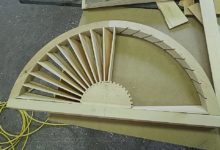
    Finished Fan. Photo by Brian Cox
    Finished Fan. Photo by Brian Cox

    On Friday, East Derry First Parish Church will be hosting a celebration in honor of the 300th anniversary of Nutfield, a Scotch-Irish settlement that was the precursor to today’s Derry, Londonderry, and Manchester, NH. The crew at East Derry has been hustling to finish the belfry in preparation for the event. For a bunch of timber framers, they’ve been doing an awful lot of finish work. A more accurate name for Preservation Timber Framing would include an “and”, but the name’s long enough already.

    Belfry Trim, Labeled
    Belfry Trim, Labeled. Photo and labelling by Brian Cox

    The crew was able to preserve some of the ample belfry and lantern trim, including the eight turned columns on the upper lantern. What they couldn’t restore, they reproduced. Every week, Brian creates a photo report to keep the building committee up to date, breaking this behemoth phase into bite-size pieces. It also serves as a documentary record of repair and this basis of this blog post. Between the mutules and the guttae (the swiss cheese and the sawtooths), I’ve been inspired by both the mass production and the attention to detail.

    Tom fastening slats. Photo by Brian Cox
    Tom fastening slats. Photo by Brian Cox

    In between enormous timbers and acres of primed trim, Tom has been quietly reproducing four of the arched fans at the top of the lower lantern louvers. In carpentry, fans are kind of a thing. Their arched tops require a choice between multiple joints, or extensive short grain. In the photo above, you can see that the curve of the arched top was cut out of two wide pine boards, their long grain oriented 45 degrees to the bottom rail. The fan’s slats are precisely twisted. This delicate assembly is then mounted to the side of the lantern and exposed to strafing wind, sun, rain and snow at the top of a hundred foot tower.

    Original Fan and MDF Template. Template by Tom Glynn, Photo by Brian Cox
    Original Fan and MDF Template. Template by Tom Glynn, Photo by Brian Cox

    Four of the fans were in good shape, and required “cosmetic” repairs, glueing and re-fastening. Four needed to be replaced completely. Tom started by transferring the measurements from one of the original fans to a sheet of MDF, creating a full size drawing. He used this template to begin cutting pieces from 2″ thick Eastern White Pine.

    Fan core, with blade angles laid out. Photo by Brian Cox
    Fan core, with blade angles laid out. Photo by Brian Cox

    Tom cut templates from luan on the bandsaw, and traced them out on the pine. He used the bandsaw to cut out his pieces and then laid out the dadoes carefully in pencil, copying the angles from the original fan. He used a dovetail saw and 1/4″ chisel to clean out each groove.

    Those dadoes are cut! Handiwork by Tom Glynn. Photo by Brian Cox
    Those dadoes are cut! Handiwork by Tom Glynn. Photo by Brian Cox

    Each fan blade is 3/16″ thick and was gently twisted as it was installed in its frame. The twist is created and held by the angled dadoes. The angle on the half round core is different than the exterior arch. At the core, the blade is more perpendicular to the face of the fan, which allows all the blades to fit, and gives the appearance that the rays are opening up like a sunburst.

    Fan blades. Photo by Brian Cox
    Fan blades. Photo by Brian Cox

    Fortunately, Tom was able to copy the angles from the original fan blades, rather than calculate the angles from scratch. A lot of folks think it’s easiest to scrap the old and start anew. On a piece like this, we were grateful to retain the knowledge of the old-timers from the evidence left in the original pieces.

    Half-finished. Photo by Brian Cox
    Half-finished. Photo by Brian Cox

    Once the fans were finished, they were primed with two coats of California alkyd primer and two more coats of California latex paint. Commonly, fans are decorative, which means that they were not always used for ventilation, and were applied over solid sheathing as was the case here.

    Fan fit with arched trim. Photo by Brian Cox
    Fan fit with arched trim. Photo by Brian Cox

    Still, each exterior element needs to shed water to protect the elements behind it. Each fan was fit with arched trim. The flush board trim projects 2″, while the frame and blades of the fan are only 1 3/4″ in thickness. This will protect the fan from wind driven rain running down the face of the flush board siding. Each vertical joint is backed with a spacer batten to prevent water from getting between the boards and penetrating into the frame.

    Louvers, Columns and Fans, installed. Photo by Brian Cox
    Louvers, Columns and Fans, installed. Photo by Brian Cox

    With every detail in this tower, the crew considered the path of rain water. We use tight fitting joints and carefully considered flashing details to keep water out, rather than caulking. Caulk is an important tool to stabilize deterioration and prevent further rot. Ultimately, though, it is a band-aid, which is promised to last 20 years, and starts to shrink and fail in the first season. This is why PTF goes beyond the frame and performs finish work. We work on buildings that have commonly withstood 200 years, and we want our repairs to last 200 more. When the bottom of the structure begins 60 feet from the ground, we know that the caulking won’t be re-applied every five years, and the building will be lucky if it gets repainted every twenty. Protecting the frame starts with the finish, and our trim is not only beautiful, it is functional.

    We love to share our work in person. We hope to see you at the Nutfield celebration this weekend! 
  • Huge and Hollow

    Huge and Hollow

    Northwood BeforeDeep into the winter of 2014, a banner stretched like caution tape across the front of Northwood Congregational Church. It implored commuters from Portsmouth and Concord, “Don’t Judge a Church By It’s Outside. Look for Restoration Coming Soon!” The red text on white vinyl was the freshest trim on the front facade. The porch sagged, the paint was peeling, and the carved finials once crowning the belfry were many years gone. Still, any driver might have noticed the huge fluted columns more than 30″ in diameter. An unhurried driver might have recognized the church as one of the best examples of Greek Revival architecture in the state, even in its dilapidated state. The slight skew to the banner underscored the meaning in its message. No passerby could have guessed the depth of commitment within the building committee and dynamism of the congregation behind it. The PTF crew restored their church from 2015-2016.

    Early Photograph Northwood Congregational ChurchThe work was far-ranging, from repairing lightning damage in a king post to reproducing those finials from photographs. But the most impressive repairs were in the columns. The open portico is an important structural element, bringing half of the belfry weight to ground. But they are also an important decorative element, each stave carved with a tapered flute. When we first assessed the site, in winter of 2014, the deck supporting the columns sloped dramatically away from the building. The bottoms of the columns themselves were rotting, showing signs of decay, and the belfry leaned precipitously toward the road. Beneath the deck, we found a rubble stone foundation build on grade. There was no footer, no stone below grade, much less frost line. We supported the belfry on timber deadmen, staging, and steel I-beams while we removed the columns, replaced the foundation, rebuilt the deck, and repaired the columns. Arron documented the process in a series of photos, below.

    He described the tilt of the porch as “not quite 45 degrees.”

    Northwood porch foundation

    The crew transferred the belfry weight to structural staging, timber “deadmen”, and a steel I-Beams that picked up the corners diagonally. The rigging was accessed and adjusted by the crew using ringlock staging. Once confident that the belfry was adequately supported, the crew began to cut away the old, decaying deck, to prepare the columns for removal.

    Northwood porch, dismantling

    Using a chain fall, Tom lowered the columns safely to the ground. A custom carriage was used to transport the columns to our shop. At nearly 20′ long, one column claimed the entire trailer.

    Tom lowers the column safely to ground

    After the columns had been removed, we focused on foundation repair. The parish hall foundation had a granite cap stone foundation that was built at grade; there was no frost wall or footers beneath it. The parish hall was supported on cribbing and jacks, and the granite capstones were carefully removed. Using extreme care, Bob Cantwell excavated the soils below the parish hall. Chris McKinnon poured substantial footers. Then he used a one sided form to pour a frost wall up to and underneath the parish hall slab. The granite capstones were replaced, and new sills installed.

    The front wall of the church, under the columns, was similarly unsupported. The sagging deck was removed, and new footers, frost piers and frost wall were formed and poured. This foundation accepts the all of the weight from the front pediment, the portico, and half the tower loads.
    Front portico footerThe crew replaced the deck framing with white oak. The dimensions and layout of the timbers were identical to the original. They were tenoned into mortises on the front sill, and pitched slightly away from the building.

    Deck framing in white oak

    The new deck will support the portico and tower above. The structural columns were hollow. They were constructed out of individual staves toe-nailed to a series of round wooden forms.
    Hollow columnsWe assessed each individual stave for damage, trying to retain as much original material as possible. Where replacement was necessary, we cut tapered Eastern White Pine dutchmen and spliced them to the original flutes.
    Individual stave repairEach column capital was inspected, repaired and painted. They were constructed from rings of boards stacked, rotated, and laminated together. Each top was modified slightly to accept a structural post.
    Column capitalStructural timber posts were hidden inside the fluted columns. The posts were a necessary upgrade that will better transfer tower loads to the ground. The structural post was installed directly beneath the front exterior tie beam. The columns were not originally centered under the beam, and are not centered around the structural post.
    Structural post inside hollow columnOnce the front half of the columns is installed, the structural post is completely hidden. The front portico looks as it did originally, but is much more structurally sound.
    3 of 4 columns replacedOnce the columns were replaced, the crew could focus on structural repairs inside the belfry. The lower tower girts were replaced in-kind, along with the belfry bed timbers. All framing repairs were completed without dismantling the tower or removing the belfry. Once the structural repairs were completed, the exterior trim was restored. Balustrade elements were carved by hand, matching the few remnants of the original details, and early photographs. New louvers replaced poor reproductions. Bump outs were flashed with copper and new copper step flashing was installed at the base of the tower. The copper belfry roof was in good condition, and was modified slightly to accept the balustrade. George McKie, of Service Painting out of Lynn, MA, did a beautiful job of scraping, priming and finish painting. We are very proud of the result, but more than that, we are grateful to have been invited into this community. This project was so successful because the building committee recognized the importance of their landmark and committed themselves to appropriate preservation. They were one of the most responsive and knowledgeable groups with which we’ve ever had the pleasure to work.
    Northwood Belfry

  • Natural woods, their individuality and friendliness*

    Natural woods, their individuality and friendliness*

    Tom pets his pine
    Tom pets his pine

    There exists in wood a quality so satisfying that the proper use of it in the structural features of a house produces an effect of completeness which does away with the need of elaborate furnishings or decoration.

    – Gustav Stickley, The Craftsman, July 1905

    Every now and then, I encounter a windbag who wants to tell me how I can no longer find the wood needed to properly restore 18th-century buildings.  And he’s partly right, as windbags unfortunately are. Wainscot found in the Demeritt-O’Kane house was composed of a single clear panel 26″ wide and 17′ long. It is difficult, and not even always ethical, to obtain boards of that quality, and that is just one reason we preserve and repair original material whenever feasible. But sourcing wide, clear, heartwood pine (as well as large timbers) is challenging, not impossible. If one sources further afield than the local lumberyard and invests in good relationships with a variety of sawyers, it is possible to obtain wood qualified to our task.

    Shawn Perry is one such partner with which PTF is fortunate to work.  Most clients know him as the stout and skilled joiner found on jobs that range from a cylindrical water tower in Boxford, MA to a steeple in Castine, ME.  With his wife Rebecca, Shawn manages their homestead in Lebanon, NH and often supplies PTF with black locust pulled from his woodlot by Judy and Aurora, their draft horses. Shawn, neighbor Steve Collins, of Belgian Meadows Farm and Les Burden, of Burden Tree Farm in Farmington, are three off-the-beaten path suppliers who help us source the wood required for especially discriminating jobs. Through these relationships, Shawn was able to procure pine logs 27-30 inches in diameter, knowing immediately their value if not their ultimate destination.  He milled the logs to 1″ boards and stickered and seasoned them, slowly, over years. The resulting boards were almost entirely heartwood, very nearly clear, and 16-22″ wide.

    Fireplace wall, evened to the eye
    Fireplace wall, evened to the eye

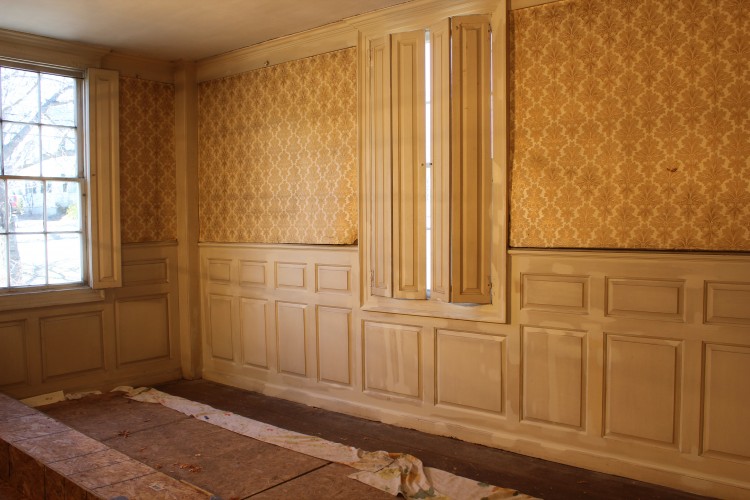
    The boards were destined for the interior of the c.1790 farmhouse at iFarm. The client and architect specified a simple fireplace surround appropriate to the date and station of the original house.  It consists of a beaded panel wall with a beaded, horizontal lintel. The tongue and groove boards serve both as wall paneling and as trim at the door openings (rather than an applied door casing). The lines are clean, and, for all their traditional authenticity, modern-looking. Fine carpenters will recognize that this austerity of line leads to the most demanding construction. From our perspective, the real purpose of casings and moldings is not to add ornament, but to hide the joints at borders; without it, every cut must be perfect.

    Flush door "casing"
    Flush door “casing”

    Dan, Dave and Tom milled the boards at the shop and finished preparing the surface with careful hand-planing. They used a very sharp and very shallow blade, in order to prevent tear-out. Progressing slowly and incrementally, they were able to identify a change of grain before the plane dug in, and would duly switch direction. Many people recognize the fine scallops associated with a traditionally hand-planed surface, but don’t know that a sharp hand-plane also leaves pine with an iridescent sheen. Side-by-side, the crisply cut fibers of a hand-planed surface is an obvious improvement over the hazy, abraded surface left by fine sandpaper (even without the scallops, which should be shallow, and whisper rather than shout).

    Tom cut the beaded edge with a tablesaw cutter with a 1/4″ round bead and a quirk that comes to a point. Usually, he’d cut the bead with his selection of molding planes but their flat-bottomed quirks did not match the original profile found at iFarm.

    Back on the iFarm, the fireplace wall in the living room was slightly curved and well out of plumb. Before fitting the paneling, Tom strung a series of mason lines along its length and furred out the wall to within 1/2″ of flat.  If he had attempted to make the wall perfectly plumb and true, the wall would have appeared drastically uneven at the corners, at the door openings and worst, in the middle of the room, where the wall intersects the masonry of the fireplace.

    Wall paneling scribed to original joists and second story floorboards
    Wall paneling scribed to original joists and second story floorboards

    A final challenge awaited Tom at installation.  The wide pine paneling runs full length, from floor to ceiling. Each board needed to be scribed to both the new floor and to the original second story floorboards that create the ceiling. The undersides of the second floor boards were rough and uneven, and not one of the original oak joists was square. When necessary, Tom first cut a pattern out of 1/4″ luan, and fit that before using the pattern to cut the pine.

    Tom and the wall, if only the photographer had been as careful with her focus as tom was with his carpentry
    Tom and the wall – if only the photographer was as careful with her focus as Tom is with his carpentry.

    The results are impressive.  Even as construction continues, the room is very pleasant to be in. The raw pine is warm, and even though the design is very simple, the fine craftsmanship is evident. As I was admiring his work, I asked Tom if, after all that effort, this wood was perfect, and he said, “No.”  Which is true, and evidence of his standards as much as his loquacity. I was reminded of Robert Adam, our teacher at North Bennet, who taught us to choose sticks of Eastern White Pine that are devoid of sapwood and tightly vertical grained, even if they contain pin knots. These are highly preferable to the clear flat-grained stock often found in “Select” piles.  The rot-repellent extractives that give Eastern White Pine heartwood its pinkish hue are why we still find 200-year old trim on New England’s capes – trim which is often “marred” by tiny pin knots. In a 1909 article in the Craftsman, Gustav Stickley addresses the selection for perfection in wood. He wrote:

    …We are too apt, when we are choosing wood for the interior of our houses or for the making of our furniture, to put a money value on it rather than to allow ourselves to appreciate its natural beauty. For it is a fact that the greatest beauty often lies in wood that is faulty and comparatively valueless from a commercial point of view, and that by throwing this aside we sacrifice the most interesting characteristic of the woodwork.  When we do strive for the effects produced by crooked growth and irregular grain, we go to the other extreme and instead of studying each particular piece of wood and using it exactly where it belongs with relation to the rest, we hunt out deliberately the most gnarled and knotted pieces, so that the result instead of being interesting a natural and inevitable way, is eccentric and artificial.

    This is the greater pity because, after all, it requires only a little interest, care and discrimination to give to the woodwork of a room just the kind of interest and beauty that belong to it. Instead of that we are apt either to imitate the wealthy man who built a cottage in the Adirondacks and paneled it throughout with spruce so carefully selected that not a single knot appeared throughout the entire house, or else we go to the opposite extreme and deliberately select the wood of irregular and faulty grain for the entire house, instead of letting it appear here and there as natural

    – Gustav Stickley, The Craftsman, May 1909

    For more photos of iFarm, please visit our Flickr album.

    *The title for this post was taken from an article by Gustav Stickley, in his journal The Craftsman: “Home training in cabinet work: the texture and quality of natural woods, their individuality and friendliness.”

  • Guest Post by David Ewing: iFarm update

    Guest Post by David Ewing: iFarm update

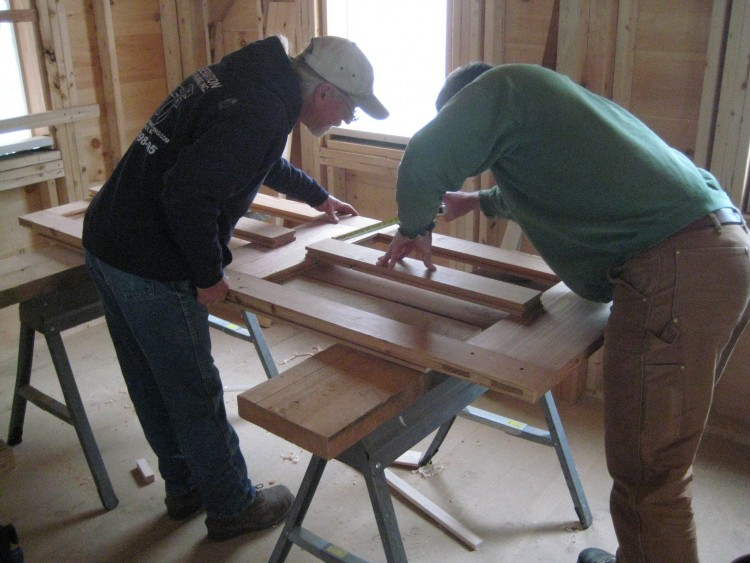
    Tom and Dan, assembling a frame and panel door, photos by Dave Ewing
    Tom and Dan, fitting the center stile of a frame and panel door.  Photos courtesy of the author

    Since 2009, the iFarm in Boxford, Massachusetts has been keeping crews from PTF busy. Christine Barensfeld, the owner of the farm, has collaborated with PTF to restore the farm which consistently operated from 1750 – 1932.  Chris purchased the farm in 2009 a midst the threat of developers who would have purchased the property and parcelled the land for the construction of new homes.  Since then, Chris has been accruing as much information as possible about the farm’s history, originally known as Towne Farm.  She has held several events at the farm providing lectures, slides shows of historic photographs, exhibits of archaeological artifacts found on the farm, and tours of the property.

    iFarmhouse, 2013
    iFarmhouse, 2013

    Chris’ concept to restore the farm covers both architectural restoration as well as re-establishing 19th-century agricultural operations.  She has composed a team of professionals who have been collaborating to help her reach this goal.  Preservation Timber Framing is proud to be a part of this unique team which includes Benjamin Nutter Architects, Howell Custom Building, Landscapes by Lillabeth.

    When I arrived to iFarm in August of 2012, efforts to restore the farm had been well underway. The projects that had been completed included the restoration of the barn, carriage house, utility shed, and water tower.  Focus during the early fall of 2012 was directed to the construction of a timber framed kitchen-ell addition to the original late-18th century farm house.  The frame was raised just before thanksgiving in November of 2012.

    Repaired second floor system
    Repaired second floor system

    Since that time we have been concentrating on the marriage between the old and new through the restoration of interior structural and finish components.  This has included tandem maneuvers re-leveling floors systems while selectively replacing deteriorated floor joists and a severely rotted beam which supported the chimney hearth.  Work has also been done to slightly reconfigure the room layouts in an effort to reestablish the original late 18th century design.

    Casing detail
    Casing detail

    Along the same thread of re-establishing the original design Dan, Keith, and Tom have used their combined expertise to determine what interior casing details are original to the construction of the house.  In the north-west bathroom we found the original interior casing of the window to be simple, with a single bead on the corner.  This discovery matches the single beaded baseboard and post casings in rooms on the second floor.  Using this information we have embarked on repairing existing casing and replicating this detail by custom milling identical 3/4 and 1 inch pine casing for the doors, windows, structural frame, and as baseboard.

    Door, partially assembled
    Door, partially assembled

    Additionally we have fully restored all of the doors original to the house, as well as doors for the addition that Chris and Benjamin Nutter Architects bought from a local architectural salvage yard.   The steam box method of scraping large quantities of doors, windows, etc. has proven to be the most effective and non-toxic method of removing lead paint.

    As work is steadily heading in the direction toward a full restoration of the farmhouse, complete with a new historically compatible kitchen-ell, there is never a dull moment on the farm.  Most recently in a collaborative effort with Lillabeth, Chris has recruited us to construct six 30’ tall bamboo teepees. The teepees will be used as a trellis to aid in the growth of hops.  Taking approximately three years to harvest the hops, Chris will be starting her nano-brewery this summer.  Any ideas on a name for this sure-to-be-tasty brew?  I, for one, like the name Towne Road Beer!

    The author, installing window casing
    The author, installing window casing

    More on iFarm here.

    David Ewing came to PTF through the Maine Preservation intern program.  While working at PTF, he is pursuing a degree from Boston Architectural College.  David lives in Dover, NH with his wife and beagle.

  • Marrett House: Magic and a Time Machine

    Marrett House: Magic and a Time Machine

    Marrett House, post-crash? or pre-crash?
    Marrett House, post-crash? or pre-crash?

    Last week we assembled Marrett House‘s 15 foot frame and panel wall and installed it.  The day felt like a mini-crane day, with shoulders instead of cranes, and a mini-rush of adrenaline.  When the day was over, and we’d reversed the effects of last April’s drunken car crash, I realized that time machines are not made from plutonium and flux capacitors, but patience and the right epoxy.

    Shawn, administering a B-72 injection
    Shawn, administering a B-72 injection

    The broken panels and stiles were glued together using Araldite, an epoxy filler, over B-72 as a release agent.  A single piece required as many as three clamping stages and often requiring a custom clamping jig for each stage.  For instance, in the case of a panel split down the middle, we needed to make a jig that protected the beveled, feather edges of the panels, and use cauls to ensure that the panel glued up flat.

    Panel 10, epoxied and clamped
    Panel 10, epoxied and clamped

    That same jig was much too large to be used to repair breaks in the bevel edge itself, and too narrow to repair the broken thumbnail on a stile.  Each clamping jig needed to be large enough to distribute pressure evenly, but refined enough to allow us to observe the joint as we applied pressure.    Because it was essential that we preserve the paint on either side of the break, if the pieces shifted even 1/32 of an inch during glue up, it would be too much, and the paint lines would not align.

    Paint patch test, latex and light filler
    Paint patch test, latex primer, then light filler

    The client’s goal was to preserve as much material as possible, and for those repairs to be invisible on the surface.  Where paint had flaked as a result of impact, we were asked to use fillers to even the painted surface, erasing ubiquitous paint “craters”.  This phase of panel repair was best approximated in Paula Abdul’s song “Opposites Attract” featuring DJ Skat Cat; as we approached the right combination of barrier, epoxy and filler, it required a process of two steps forward and one step back.  We completed a series of test swatches with using araldite, Dap filler and oil paint to determine which best produces an even surface.  Ultimately, we settled on ready patch, a medium-weight spackling compound that dries almost too quickly.

    When it was finally time to install the panel, it was so long that we couldn’t carry it though the building.  It was so long that it would have been impossible to assemble in the room itself with the added length of clamps and human bodies.  So we went through the front window.  Scott, Lee, Shawn and I packed the assembled wall carefully in a cage of 2x lumber, carried it from the barn and passed it though the front wall.

    Panel assembly, inside, from behind
    Panel assembly, inside, from behind

    Preserving the existing paint surface was important to the curators at the Marrett House, and they requested that we infill paint only.  After three attempts of trying to approximate the color, I wish I could say that we found a paint that blended perfectly, but that would require more than just one color.  There were more than six different shades of cream along the panels due to fading, dirt accumulation and previous attempts to clean the wall.  Fortunately, the curators were pleased with the even surface and invisible seams and weren’t interested in us finding the right shade of dinge with which to wash parts of the wall.  For right now, they are happy with the way the primer patches help them to tell the story of this wall’s ordeal.

    As self-aggrandizing as it seems (this is a company blog, after all) I can’t recommend a tour of the Marrett House this summer highly enough.  As much as I would like you readers to visit the North parlor and exclaim, “I can’t believe a drunk driver drove through that!” It is even more exciting to learn about the Marrett sisters and the history of preserving their family home.  One sister taught Helen Keller at the Baxter School for the Deaf on Mackworth Island and you can read Keller’s letters upstairs.  There is a likely story about how the locks on doors of the front parlor protected Portland’s gold during the War of 1812.  If you are lucky and intrepid visitor, you can puzzle over the attic framing, the whole of which was lifted 2′ during the mid-18th century.

    Sill repair, brace repair and stud repair
    Sill repair, brace repair and stud repair

    It’s too bad that Scott, Shawn and Lee’s meticulous frame fixes will be invisible to the visiting public, but more photos are available to the public visiting our Flickr page, and an upcoming blog post focusing on the frame repairs.

    Frame repairs, laps and sisters
    Frame repairs, laps and sisters

    I know in my head that it is a terrible shame that a careless criminal drunk drove a stolen car through the parlor of a 220-year-old impeccably preserved home, but in my heart I feel fortunate for the opportunity to work closely with such fine craftsmanship.

    Finished panel, finally installed
    Finished panel, finally installed

    More Marrett photos, here.

  • Marrett House Panels Cope with Dismantling

    Shawn, showing his pin extraction method.
    Shawn, showing his pin extraction method. Photos by author

    Yesterday we began the dismantling the Marrett House panels in order to repair the broken stiles and rails.  Above, Shawn shows his method for extracting the pins.  He drills a tiny hole through the center of the pin, then threads a screw into the hole until it just bites, and then uses a hammer claw and a lot of padding to pry the pin out.  This method prevents the blowout and denting that might occur from trying to knock the pin all the way through the joint.

    Wedging the underside of the joint to avoid denting the wood.
    Wedging the underside of the joint to avoid denting the wood.

    Unbelievably tight joinery made the dismantling process both frustrating and inspiring.  We softly tapped a handful of soft-wood wedges into the backside of the joint between stile and rail, and checked again and again to make sure that there were no pins or tiny nails or frass creating the unholy friction that prevented the stile from moving more than 1/32 per tap.

    Panel Joinery, with end stile removed
    Panel Joinery, with end stile finally removed

    Once we got the stile off, we thought we’d find a fox wedge, but there was none, just incredibly tight joinery, and stunning coping.  The interior edge of stiles and rails are decorated with a thumbnail profile, and the thumbnails are coped to one another rather than mitered.  Coping is the process by which the negative profile of one molding is cut into the backside of another.  Good carpenters cope crown and other moldings when they meet at right angles to one another so that when the joint moves with humidity changes, the molding beneath the cope is revealed, rather than a gap.  Some carpenters do it better than others, and this guy was among the neatest I have seen.

    Coping detail, stile to rail
    Coping detail, stile to rail

    I took a lot of photos of the process; click on the slideshow below for more.

  • Marrett House Survives the Insults of a Drunken Car Thief

    Marrett House Panels, laid out, from loft above
    Marrett House Panels, laid out, from loft above. Photos by author

    A year ago last April,  just after rush hour, a man stole a Suburu in Cape Elizabeth, drunk-drove it to Standish, crossed two lanes of traffic, surfed a lawn and crashed into the Marrett House, coming to rest in its historic parlor.  The stout framing members were fractured and the frame and panel wainscot splintered, but the wall’s 12-lite window survived.  Not a single pane of original glass was broken.  The plaster wall adjacent the window was thrust inwards and the split lath separated from the broken studs, but the 1847 wallpaper pasted to it remains intact.  It’s wacky that, out of all the buildings along the way, the driver hit a well-preserved relic of the late 18th century, set well back from the road.   And I can’t decide whether that’s good fortune or bad.  Route 25 is a well-traveled road, and at least that part of the Marrett House is uninhabited.

    Broken stile, just below window.  Photo by Shawn Perry
    Broken stile, just below window. Photo by Shawn Perry

    The night of the crash, employees of Historic New England worked late into the night stabilizing and weatherizing the wall.  In the following weeks, conservators carefully collected and organized the shards of woodwork and PTF assisted with flashing and estimated the repairs.  When PTF came back to site three weeks ago, nearly every piece of splintered woodwork was inventoried and accounted for.  Half of the paneled wall was still ajar, in place, and the other half lay in the barn loft, spread out like an exploded schematic.

    Broken framing, shoved wall. Photo by Shawn Perry
    Broken framing, shoved wall. Photo by Shawn Perry

    This is an exciting and challenging project for us.  The specifications are detailed and Historic New England requires strict oversight, but the process allows us to learn about other conservation technologies and refine our methodology.  Museum clients prioritize conserving material and reversibility more than private clients.  Where a private client might want a dutchman repair to a broken stile or rail, well-cemented to the original material, Historic New England wants to preserve the shards of original material, and a barrier layer of Paraloid B-72 between the epoxy and the original wood.  While we usually would use West System, a brand of epoxy that has good adhesion, penetration and permanance, here the client requested Araldite, an epoxy that doesn’t penetrate the surface and, with a barrier layer, is ultimately reversible.  Ultimately, it is much nicer to work with a client who really cares about their property rather than one who doesn’t really care what we do or how we do it.  Fortunately, clients who don’t care about their building don’t choose PTF.

    Shawn, the left stile, and mortising chisel marks from a hand-chopped mortise.
    Shawn, the left stile, and mortising chisel marks from a hand-chopped mortise.

    For me, the exciting part of this project is fitting together the shards of wood like a jigsaw puzzle.  The task allows me to connect with the mind of the original builder, and explore his methods of construction, as well as reminisce about the 1000-piece jigsaw puzzles my aunt, my mother and I used to construct every Christmas.  With all the work that Historic New England completed before we got there, I think the Christmas puzzles might have been harder.

    Split lath with the quality of stain-grade trim
    Riven lath with the quality of stain-grade trim

    The plaster hangs on individual riven lath, which fell out of fashion soon after the Marrett House was built.  By 1800, most houses were built with split-board, or accordian lath, in which a single wide board, of low quality, is split and stretched down the studs.  The riven lath at Marrett House is perfectly clear with impossibly straight, tight-grain; the kind of wood that many carpenters lament can’t be found today to be used for interior trim and parlor reproductions.

    The quality of lath may have contributed to the survival of the plaster and wallpaper that hung on it.  In the third photo, above, one can see the degree to which the wall was pushed into the room, and the damage to the studs.  It should be noted that the original studs and sill were in unusually sound condition, and showed no signs of rot.  The car hit the wall with enough force to completely sever the studs from their joinery.

    The Marrett House project is already well on its way to completion.  The stud repairs have been fit, the B-72 and epoxy arrived yesterday, and we will begin test-gluing the panels tomorrow.  It’s a shame that such an historic artifact suffered from the random recklessness of a drunk driver, but the very qualities that lent this building its longevity allowed it to survive such an injury.  Many of our historic buildings have suffered far worse from roof leaks and poor maintenance.

    Marriage marks in stud and sill
    Marriage marks in stud and sill

    I hadn’t seen before marriage marks like the ones used to align framing members in the west wall; I wonder whether they might be unique to the builder or to the region.  Has anyone out there wandering the interwebs come across this type of marriage mark before?

    For more photos of the marriage marks, riven lath and the rest of our process, click on the slideshow, below:

  • O’Kane Notebook III: Making Wedges

    Bucket of Wedges


    We’ve been using softwood wedges, made from 2x stock, to carefully remove delicate moldings and wide wall panels.  Either the wedges loosen the nails completely, or they provide use with enough room to slip a sawblade behind to cut the nail.  Like ziploc tupperware, they can be reused, but eventually the edges get grungy, and need to be thrown away.  Using a sled on the tablesaw, I can safely make buckets of fine, sharp wedges.

    Wedge templates

    Some of the wedge templates are pictured above.  The larger wedges, 15″ x 1 1/2″, and 12″ x 1″, are used for flooring , and wide wall panels.  Smaller wedges in 5″, 7″ and 9″ by 1/2″ sizes help with smaller, more delicate moldings.

    Wedge jig, sans capThis is a photo of the template after it has been screwed to the tablesaw sled.  I added a fence (pine, left) whose top is co-planar with the top of the stock to be ripped (pine, right).  Then I screw a cap onto the fence which covers the stock and holds it down as it is pushed through the blade.  This allows me to cut the wedge safely, my fingers far from the blade.  The sled is then retracted, the wedge popped out from beneath the cap, and the next blank squeezed in.

    Wedge jig, with capJig with the cap screwed in place, above.

    Wedge jig, in profileProfile view of jig, devoid of stock.

    I know that some people use a bandsaw to make wedges.  That method has the benefit of a thinner kerf and less waste, but for us, this method was safe, speedy and accurate.

  • O’Kane Notebook II: Post-colonial Builder Stoked on Sweet, New Plane

    Crown Above Fireplace in Blue Bedroom

    Over the past week, we have been using up our supply of softwood wedges at the O’Kane House.  In the effort to gently remove the delicate, hand-planed moldings, we tap narrow wedges in along the paint lines, crushing the wedges with repeated use (and saving the edges of the trim).  It is a slow, thoughtful process and along the way, we speculate about what the original carpenters of 1790 might have been thinking.

    There is strong evidence that the trim carpenter who finished the front hall and the upstairs bedrooms was thinking, “OMG, Can’t get enuf of this sweet, new reeding plane!”  The pattern of five 3/16 inch half round “reeds” is used to create a variety of decorations around the room.  So far, all of this molding has been hung with wrought nails.  The accordian lath behind it was hung with a combination of cut and wrought nails.  This was typical for the time period, according to A Building History of Northern New England, by James Garvin.  Cut nails broke more, but were less expensive to make, so a few wrought nails were used to hold the lath in place, and then the field was filled in with cut nails.  It makes sense to me that the carpenter wouldn’t risk breaking a cut nail as he hung his precious, hand-milled moldings.  It was worth it to stick with the more trusted technology, the wrought nail.

    Echinus Molding in Front Hall

    He used it in multiple runs adjacent one another to adorn the echinus of the pilasters next to the front door.

    Fireplace Surround, Blue Bedroom

    And he ran multiple passes on one 6 or 7 inch board that he then cut on the diagonal and reassembled to dress up the simple fireplace surround.

    Reeding Plane Runs into Knot

    We get sort of excited when we see mistakes like this one.  When we turned the board over, we saw the knot that caused the plane to go off-track.  I like to imagine commiserating with the post-colonial carpenter around the horse trough.  It’s evidence like this that will remind the client that he lives in a wholly handmade house.  There are some moldings that we may have to reproduce, and for short sections, it is easier to do by hand. If anyone out there has seen a plane like this one, please let us know.

    For more photos on the process, check out the photos below, updated regularly with our daily finds.

  • Lebanon Barn Coming in for the Finish

    Cornice Fit for a King
    Cornice Fit for a King

    A few months back, we disassembled a barn in Lebanon, Maine.  Since then, we took the pieces back to the shop, repaired what we could, and re-designed the rest.  This Spring, we assembled the frame using original and remade pieces, and Shawn and his crew have been busy hanging the cornice.

    For more photos, explore our Flickr album.

Think we can help? Get in touch.