Tag: Marrett House

  • Marrett House: Magic and a Time Machine

    Marrett House: Magic and a Time Machine

    Marrett House, post-crash? or pre-crash?
    Marrett House, post-crash? or pre-crash?

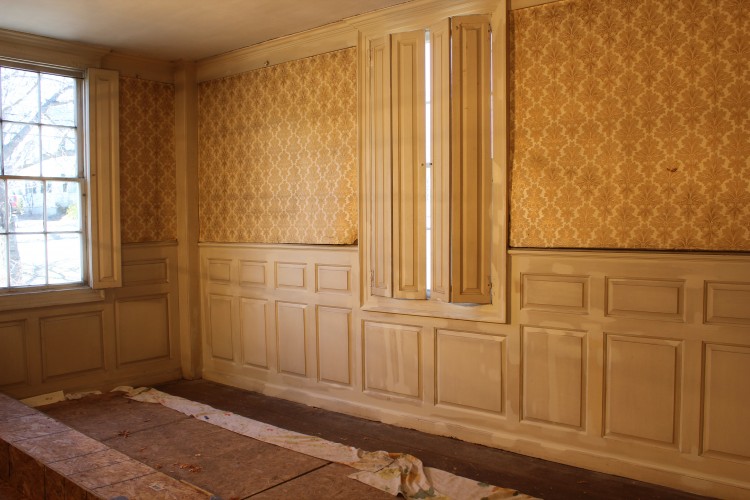
    Last week we assembled Marrett House‘s 15 foot frame and panel wall and installed it.  The day felt like a mini-crane day, with shoulders instead of cranes, and a mini-rush of adrenaline.  When the day was over, and we’d reversed the effects of last April’s drunken car crash, I realized that time machines are not made from plutonium and flux capacitors, but patience and the right epoxy.

    Shawn, administering a B-72 injection
    Shawn, administering a B-72 injection

    The broken panels and stiles were glued together using Araldite, an epoxy filler, over B-72 as a release agent.  A single piece required as many as three clamping stages and often requiring a custom clamping jig for each stage.  For instance, in the case of a panel split down the middle, we needed to make a jig that protected the beveled, feather edges of the panels, and use cauls to ensure that the panel glued up flat.

    Panel 10, epoxied and clamped
    Panel 10, epoxied and clamped

    That same jig was much too large to be used to repair breaks in the bevel edge itself, and too narrow to repair the broken thumbnail on a stile.  Each clamping jig needed to be large enough to distribute pressure evenly, but refined enough to allow us to observe the joint as we applied pressure.    Because it was essential that we preserve the paint on either side of the break, if the pieces shifted even 1/32 of an inch during glue up, it would be too much, and the paint lines would not align.

    Paint patch test, latex and light filler
    Paint patch test, latex primer, then light filler

    The client’s goal was to preserve as much material as possible, and for those repairs to be invisible on the surface.  Where paint had flaked as a result of impact, we were asked to use fillers to even the painted surface, erasing ubiquitous paint “craters”.  This phase of panel repair was best approximated in Paula Abdul’s song “Opposites Attract” featuring DJ Skat Cat; as we approached the right combination of barrier, epoxy and filler, it required a process of two steps forward and one step back.  We completed a series of test swatches with using araldite, Dap filler and oil paint to determine which best produces an even surface.  Ultimately, we settled on ready patch, a medium-weight spackling compound that dries almost too quickly.

    When it was finally time to install the panel, it was so long that we couldn’t carry it though the building.  It was so long that it would have been impossible to assemble in the room itself with the added length of clamps and human bodies.  So we went through the front window.  Scott, Lee, Shawn and I packed the assembled wall carefully in a cage of 2x lumber, carried it from the barn and passed it though the front wall.

    Panel assembly, inside, from behind
    Panel assembly, inside, from behind

    Preserving the existing paint surface was important to the curators at the Marrett House, and they requested that we infill paint only.  After three attempts of trying to approximate the color, I wish I could say that we found a paint that blended perfectly, but that would require more than just one color.  There were more than six different shades of cream along the panels due to fading, dirt accumulation and previous attempts to clean the wall.  Fortunately, the curators were pleased with the even surface and invisible seams and weren’t interested in us finding the right shade of dinge with which to wash parts of the wall.  For right now, they are happy with the way the primer patches help them to tell the story of this wall’s ordeal.

    As self-aggrandizing as it seems (this is a company blog, after all) I can’t recommend a tour of the Marrett House this summer highly enough.  As much as I would like you readers to visit the North parlor and exclaim, “I can’t believe a drunk driver drove through that!” It is even more exciting to learn about the Marrett sisters and the history of preserving their family home.  One sister taught Helen Keller at the Baxter School for the Deaf on Mackworth Island and you can read Keller’s letters upstairs.  There is a likely story about how the locks on doors of the front parlor protected Portland’s gold during the War of 1812.  If you are lucky and intrepid visitor, you can puzzle over the attic framing, the whole of which was lifted 2′ during the mid-18th century.

    Sill repair, brace repair and stud repair
    Sill repair, brace repair and stud repair

    It’s too bad that Scott, Shawn and Lee’s meticulous frame fixes will be invisible to the visiting public, but more photos are available to the public visiting our Flickr page, and an upcoming blog post focusing on the frame repairs.

    Frame repairs, laps and sisters
    Frame repairs, laps and sisters

    I know in my head that it is a terrible shame that a careless criminal drunk drove a stolen car through the parlor of a 220-year-old impeccably preserved home, but in my heart I feel fortunate for the opportunity to work closely with such fine craftsmanship.

    Finished panel, finally installed
    Finished panel, finally installed

    More Marrett photos, here.

  • Marrett House Panels Cope with Dismantling

    Shawn, showing his pin extraction method.
    Shawn, showing his pin extraction method. Photos by author

    Yesterday we began the dismantling the Marrett House panels in order to repair the broken stiles and rails.  Above, Shawn shows his method for extracting the pins.  He drills a tiny hole through the center of the pin, then threads a screw into the hole until it just bites, and then uses a hammer claw and a lot of padding to pry the pin out.  This method prevents the blowout and denting that might occur from trying to knock the pin all the way through the joint.

    Wedging the underside of the joint to avoid denting the wood.
    Wedging the underside of the joint to avoid denting the wood.

    Unbelievably tight joinery made the dismantling process both frustrating and inspiring.  We softly tapped a handful of soft-wood wedges into the backside of the joint between stile and rail, and checked again and again to make sure that there were no pins or tiny nails or frass creating the unholy friction that prevented the stile from moving more than 1/32 per tap.

    Panel Joinery, with end stile removed
    Panel Joinery, with end stile finally removed

    Once we got the stile off, we thought we’d find a fox wedge, but there was none, just incredibly tight joinery, and stunning coping.  The interior edge of stiles and rails are decorated with a thumbnail profile, and the thumbnails are coped to one another rather than mitered.  Coping is the process by which the negative profile of one molding is cut into the backside of another.  Good carpenters cope crown and other moldings when they meet at right angles to one another so that when the joint moves with humidity changes, the molding beneath the cope is revealed, rather than a gap.  Some carpenters do it better than others, and this guy was among the neatest I have seen.

    Coping detail, stile to rail
    Coping detail, stile to rail

    I took a lot of photos of the process; click on the slideshow below for more.

  • Marrett House Survives the Insults of a Drunken Car Thief

    Marrett House Panels, laid out, from loft above
    Marrett House Panels, laid out, from loft above. Photos by author

    A year ago last April,  just after rush hour, a man stole a Suburu in Cape Elizabeth, drunk-drove it to Standish, crossed two lanes of traffic, surfed a lawn and crashed into the Marrett House, coming to rest in its historic parlor.  The stout framing members were fractured and the frame and panel wainscot splintered, but the wall’s 12-lite window survived.  Not a single pane of original glass was broken.  The plaster wall adjacent the window was thrust inwards and the split lath separated from the broken studs, but the 1847 wallpaper pasted to it remains intact.  It’s wacky that, out of all the buildings along the way, the driver hit a well-preserved relic of the late 18th century, set well back from the road.   And I can’t decide whether that’s good fortune or bad.  Route 25 is a well-traveled road, and at least that part of the Marrett House is uninhabited.

    Broken stile, just below window.  Photo by Shawn Perry
    Broken stile, just below window. Photo by Shawn Perry

    The night of the crash, employees of Historic New England worked late into the night stabilizing and weatherizing the wall.  In the following weeks, conservators carefully collected and organized the shards of woodwork and PTF assisted with flashing and estimated the repairs.  When PTF came back to site three weeks ago, nearly every piece of splintered woodwork was inventoried and accounted for.  Half of the paneled wall was still ajar, in place, and the other half lay in the barn loft, spread out like an exploded schematic.

    Broken framing, shoved wall. Photo by Shawn Perry
    Broken framing, shoved wall. Photo by Shawn Perry

    This is an exciting and challenging project for us.  The specifications are detailed and Historic New England requires strict oversight, but the process allows us to learn about other conservation technologies and refine our methodology.  Museum clients prioritize conserving material and reversibility more than private clients.  Where a private client might want a dutchman repair to a broken stile or rail, well-cemented to the original material, Historic New England wants to preserve the shards of original material, and a barrier layer of Paraloid B-72 between the epoxy and the original wood.  While we usually would use West System, a brand of epoxy that has good adhesion, penetration and permanance, here the client requested Araldite, an epoxy that doesn’t penetrate the surface and, with a barrier layer, is ultimately reversible.  Ultimately, it is much nicer to work with a client who really cares about their property rather than one who doesn’t really care what we do or how we do it.  Fortunately, clients who don’t care about their building don’t choose PTF.

    Shawn, the left stile, and mortising chisel marks from a hand-chopped mortise.
    Shawn, the left stile, and mortising chisel marks from a hand-chopped mortise.

    For me, the exciting part of this project is fitting together the shards of wood like a jigsaw puzzle.  The task allows me to connect with the mind of the original builder, and explore his methods of construction, as well as reminisce about the 1000-piece jigsaw puzzles my aunt, my mother and I used to construct every Christmas.  With all the work that Historic New England completed before we got there, I think the Christmas puzzles might have been harder.

    Split lath with the quality of stain-grade trim
    Riven lath with the quality of stain-grade trim

    The plaster hangs on individual riven lath, which fell out of fashion soon after the Marrett House was built.  By 1800, most houses were built with split-board, or accordian lath, in which a single wide board, of low quality, is split and stretched down the studs.  The riven lath at Marrett House is perfectly clear with impossibly straight, tight-grain; the kind of wood that many carpenters lament can’t be found today to be used for interior trim and parlor reproductions.

    The quality of lath may have contributed to the survival of the plaster and wallpaper that hung on it.  In the third photo, above, one can see the degree to which the wall was pushed into the room, and the damage to the studs.  It should be noted that the original studs and sill were in unusually sound condition, and showed no signs of rot.  The car hit the wall with enough force to completely sever the studs from their joinery.

    The Marrett House project is already well on its way to completion.  The stud repairs have been fit, the B-72 and epoxy arrived yesterday, and we will begin test-gluing the panels tomorrow.  It’s a shame that such an historic artifact suffered from the random recklessness of a drunk driver, but the very qualities that lent this building its longevity allowed it to survive such an injury.  Many of our historic buildings have suffered far worse from roof leaks and poor maintenance.

    Marriage marks in stud and sill
    Marriage marks in stud and sill

    I hadn’t seen before marriage marks like the ones used to align framing members in the west wall; I wonder whether they might be unique to the builder or to the region.  Has anyone out there wandering the interwebs come across this type of marriage mark before?

    For more photos of the marriage marks, riven lath and the rest of our process, click on the slideshow, below:

Think we can help? Get in touch.