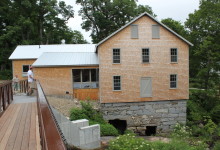
…Take a quick left on Main Street, and there’s The Mill at Freedom Falls—The Lost Kitchen’s once crumbling, now beautifully renovated home. Cross a narrow bridge over a rushing stream, and you’re there.
The dining room has sanded plank floors, exposed beams and suspended mill trestles. A wall of windows looks out onto the stream and bridge. Upstairs is a school for local kids; downstairs, a stone-walled wine store with bottles carefully curated by The Lost Kitchen’s sommelier
This isn’t the first press the Lost Kitchen has received. In addition to a favorable review in the New York Times last fall, the Bangor Daily News published a story last summer that covered even more of the restaurant’s, and the mill’s, history.
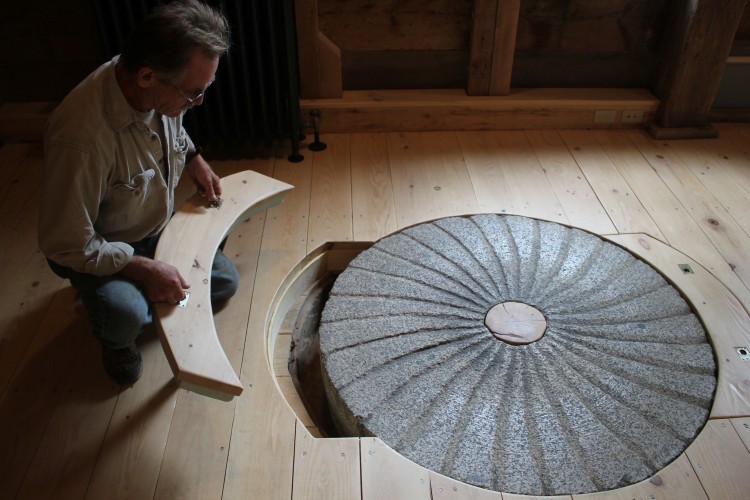
Chuck pulls up the access hatch and examines a millstone
If you grew up in Freedom, ME you’ve probably already toured the Freedom Mill, in high school, under the cover of darkness, at risk to life and limb. At its height during the 19th century, the mill had served as an economic engine for the area, using the water power at Freedom Falls to process grain and manufacture wooden dowels. By the 21st century, the mill was filled with piles of rotting sawdust, and teenagers who had nothing better to do and a misplaced trust in the floor framing. In 2011, Tony and Sally Grassi bought the property, seeing in the detritus an opportunity to preserve an historic landmark while stimulating the local economy.
Jesse Turgeon’s first post fix
The mill’s place in Maine’s history made this restoration especially meaningful for the crew at PTF. Our work places us within the long history of New England building craft, which includes its water-powered mills and early industry. PTF’s Northern Contingent had the pleasure of touring the nearly finished mill last week. A restaurant and an independent school are moving in. What the renovated mill now lacks in mischief and sheer danger, it makes up for by interpreting the industrial history of Maine, and creating a space for people to incorporate that history into their daily lives. We recommend heading up and taking a tour, before classes begin.
Foundations, old and new
Repairing the frame posed a number of unique challenges. The undercarriage needed full replacement, and because the mill was water-powered, it was built more than sixteen feet above a rushing stream. The crew rebuilt the undercarriage exactly as it was originally framed, threading 12″ x 16″ x 22′ joists through the building and over a complicated network of staging.
Scott marvels at the massive floor framing
In addition to the exposed wall framing and the antique mill-works hanging from the ceiling, view hatches throughout the building allow visitors to discover how the building functioned as an industrial space. In the main space, a hatch allows visitors to get a close look at an old mill wheel (see first photo, above). In the main entrance, the dowel drying racks were preserved, and a viewing window shows the series of radiator pipes over which they were built.
Lee points out a detail of the mill works
A small school is moving into one of the upper floors of the mill, the exposed framing surrounding the classroom and steeping students in their heritage. It is on these upper levels where the brace repairs are best observed, right at eye level.
Marriage Marks
The crew also dismantled, repaired and rebuilt an original ell addition. The roof framing is visible as students climb the stairs to their classroom, and in the commercial kitchen.
Preserved framing in rebuilt ell
Over lunch, we saw but a small slice of the work that has been completed at Freedom Mill. The Grassi’s website offers a lot more information on the history, the restoration, and opportunities to visit. It stands out among restoration-project-websites in its simple design and readability.
Since April, Ed, Lee, Reese, Chuck, Jesse, Shawn and Arron have been laboring to restore the undercarriage of the Mill at Freedom Falls (c. 1834). The crew faced a number of obstacles: one corner of the building had dropped more than 10 inches out of level, and a stream that once powered the turbine still runs between the granite walls of the foundation. Stabilization of the structure required building staging around and on top of the works of the turbine, 16-20 feet above the rushing water. After stabilizing the building and the cutting the repairs, the crew was tasked with installing 12″ x 16″ hemlock timbers of lengths up to 22 feet over this:
PTF has recently embarked upon a worthy away job to preserve a mill in Freedom, ME. Originally a grist mill, it was later converted into a wood turning mill, which closed in 1967. The building has lain dormant since. When the project is completed, the water turbines in the basement of the mill will generate electricity. Those of us yet to visit are eager to see the building and its progress, Ed Bell was happy to oblige. See his photos, below: