Tag: Research

  • True-Randall Farm: A Quintessential Maine Connected Farmstead

    True-Randall Farm: A Quintessential Maine Connected Farmstead

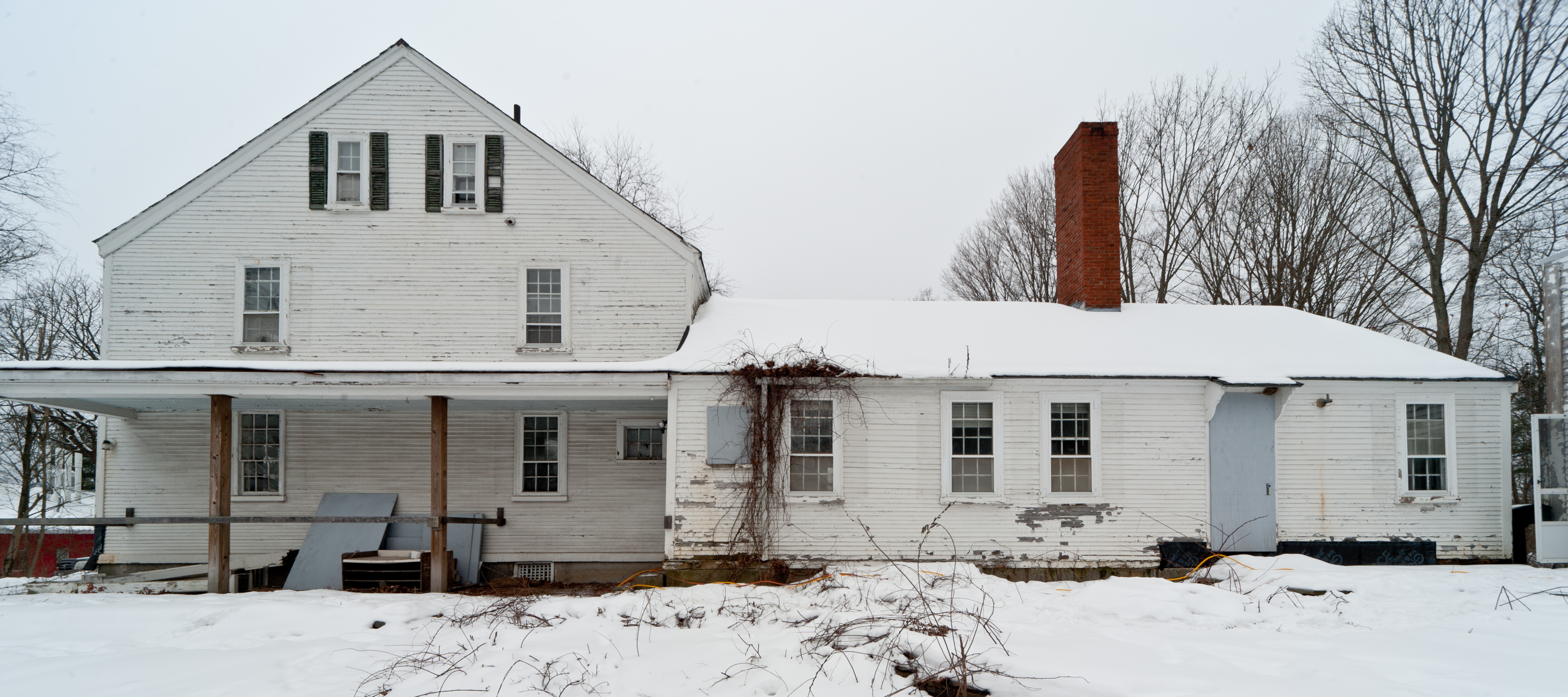
    PTF began work on the undercarriage of the True-Randall barn in November 2012, and recently completed a comprehensive timber frame repair of the house, barn and ell. George and Karin Look, owners and custodians of the True-Randall Farmstead, researched the history of their property extensively and are deeply committed to ensuring its preservation.  The following account is a summary of their findings, which they’ve graciously allowed me to publish here.

    Barn from below
    True-Randall Barn, from below

    True-Randall Farm: A Quintessential Maine Connected Farmstead

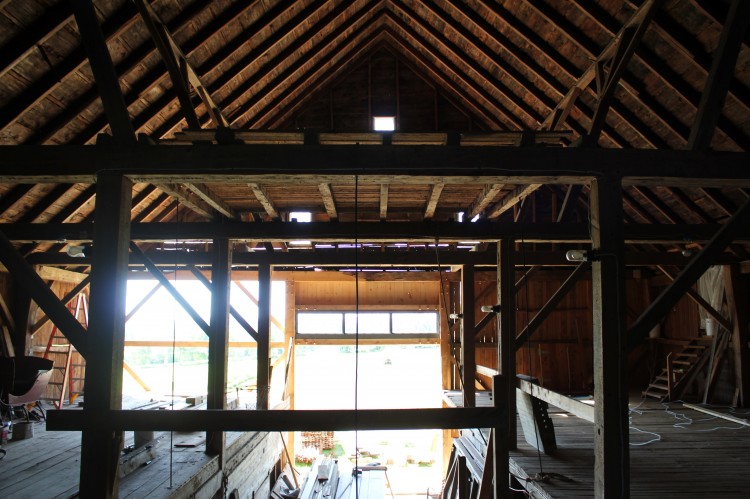
    In 1813 Deacon Ezekiel True’s twin sons, Moses and Paul, built him a “house on the hill” above his mills on the St. Georges River, in what is now South Montville, Maine. A barn, which has the same timber frame construction as the house, was built for the farm across the road in 1814. Its largest timbers, primarily second growth hemlock, were hand hewn, most likely on the farm. They include 60 foot long continuous timbers for the plates. The farm passed by marriage from the True to the Randall family in the mid 1830s and remained in that family until 1984.

    Barn bent framing, from loft
    Barn bent framing, from loft

    In 1889 the barn was moved to its current position and connected to the house by an ell. Local history indicates that it was rolled across the road using oxen and logs and that a small American Elm run over during the move stood back up and grew into a giant tree in front of the barn. The roof was removed before the move and roof elements, including the purlins, were used in building the deck for the barn, which was converted into a bank barn. At the time of the move an original eve wall was moved to the east 6 feet to increase the size of the milking parlor to accommodate the new, larger breeds of dairy cows that were becoming popular at the time. Also, the new roof was built with higher pitch to allow for storage of more hay. The barn was in use in a dairy operation until the 1970s.

    Another of Deacon True’s sons, John, built the Mill at Freedom Falls (Maine), in 1834. PTF was intimately involved in the restoration of that Mill in 2012.

    -George and Karin Look

    Read our first post about True-Randall farm, about leveling the barn, here.  In upcoming blog posts, we will describe our process for repairing the timber posts in house and barn, and in-place tie beam repair.

  • O’Kane-Demeritt Notebook XII: A Fine House

    Nathaniel Demeritt's Signature
    Nathaniel Demeritt's Signature

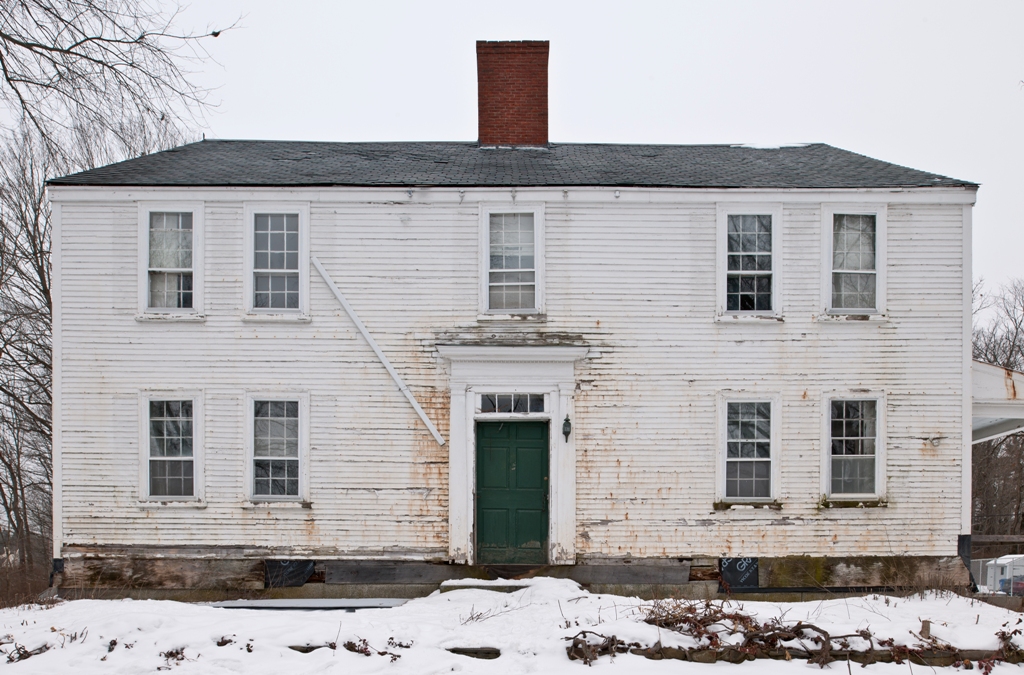
    Yesterday, I went to the New Hampshire Historical Society to look at photos of the O’Kane-Demeritt House taken by Doug Armsden in 1955 for a Demeritt “Home of the Month” Feature in New Hampshire Profiles magazine.  The 5″ x 7″ negatives show the original interior fireplaces in all their glory, and I will share the scans with you folks of the internet as soon as we receive them.

    While at the library, I asked Librarian Bill Copeley to see the 1798 second edition of Asher Benjamin’s The Country Builder’s Assistant containing the signature of Nathaniel Demeritt.  There are two other signatures in the book, Samuel Furber, dated 1816, and Gorden Demeritt, dated 1826.  We could tell that much of the trim in the house was derived from Benjamin’s designs, but it would seem that they were derived from this very book.  I was especially interested in the penciled notes in the margins.  On the back of a plate with an example of a front elevation, someone wrote, “A Fine House.”  More photos, below:

  • Dismantling the O’Kane Farmhouse

    O'Kane Farmhouse, Full Frontal
    O'Kane Farmhouse, South Face, photo by John Butler

    Preservation Timber Framing has been involved in a number of museum projects in the past.  We reconstructed the Brown-Pearl and Manning Rooms for the Boston MFA, rebuilt the Moffatt-Ladd coachhouse in Portsmouth, and dismantled 16th c.  Carved Ceiling Beams for the Fogg Museum at Harvard, to name a few.  We are honored to have been a part of these prestigious projects, but where does this leave the many historic houses that remain on the chopping block?  There are a number of legitimate reasons that a historic building cannot be, and should not be, preserved on its original site and usually this results in the building being demolished.  Is it possible to take the standards used in a museum setting and apply them towards preservation in the private sector?

    O'Kane East Face, photo by John Butler
    O'Kane East Face, photo by John Butler

    The O’Kane farmhouse, c. 1790, typifies this dilemma.  It is currently located across from the Child Study and Development Center on the UNH campus in Durham, NH.  Thanks to the university’s stewardship, the farmhouse retains many original or early features, including indian shutters in many of the rooms, and very nearly its original room layout and partitions.  Much of the panelling is likely original, and the trim elements appear to have been hung during a Federal-era renovation.  But the Child Development Center needs to expand, and the Farmhouse is wildly inappropriate for that use.  Firstly, the original trim retains its original lead paint, and many decades of lead chips saturate the surrounding soil.  Secondly, even if the lead were abated, the building would need to be renovated for the Center’s needs, and in the process we would lose much of the building’s architectural history.

    O'Kane Cape Fireplace
    O'Kane Cape Fireplace, by John Butler

    When UNH decided to sell the building to a responsible buyer who could dismantle the building, and re-erect it faithfully elsewhere, it presented an incredible opportunity, and a unique challenge.  In a museum, we are usually working on one or two rooms, long ago removed from their frames.  The O’Kane farmhouse is a two-story house, with attached cape ell.  In addition to its hewn, white oak frame, it has original wide-panel partitions and a fireplace surround in every room.  Could we apply a curator’s techniques for careful removal and inventorying and apply it to an entire farmhouse, frame and all?

    To guide us in this endeavor, we have looked to John Butler, a man with unparalleled expertise in the field of historic documentation and assessment.  A long time colleague, Arron most recently worked with John on the MFA project.  Since then, Butler has refined his inventory and documentation techniques still further at the Yale University Art Museum.  In the past couple of weeks, Butler has completed the initial photo documentation of the building’s interior walls.  His cameras are capable of capturing an entire wall, without distorting the plumb and level lines of architectural elements.  After first marking a level datum line around the entire room, Butler is able to rectify the photos to an astounding level of accuracy.  Using the datum, and other grid lines, we will be able to measure off of the photos, greatly saving drafting time.  The photos will also be used during dismantling.  Each element will be carefully removed using softwood wedges.  The element will be then be traced on a large photograph, and given a number, brief description and initial assessment.  The room number, wall letter, and item number will be marked in Sharpie on a patch of white shellac on the back of the piece, in the upper left hand corner. A pair of inventoriers will work with a pair of dismantlers for each room.

    O'Kane Floor Plan
    O'Kane Floor Plan

    This past week, I have been working on measuring and drawing a simplified SketchUp model that records the rough layout of architectural elements.  I measured and drew all the floorboards so that we can have a map of their item numbers, as well.

    On Friday, our client, Charlie, is coming down to Durham to help with the removal of the first of the plaster layers.  Some of the plaster appears to have been added later, obscuring Georgian Era partition walls.  We can’t wait to see what we will find.

  • HABS to Watch Out For

    Hill Fireplace
    Hill Fireplace

    Tomorrow we embark on the building of the Hill fireplace.  The Hill house is a turn of the 19th century farmhouse, with all the attendant revisions and additions.  The owner wants to restore her fireplace to reflect the time period it was built and the building trends in her region.

    Through her own research, she believes the original building may have been constructed by John Cram, a prolific local builder.  Fortunately, the John Cram farmstead, also in Hampton Falls, NH, was documented by the Historic American Building Survey, and was available through its database online.  The Historic American buildings Survey was a program of the National Parks Service, that was developed in 1933 to provide work for architects, draftsmen and photographers left jobless by the Great Depression.  Not only are the drawings and photos an incredible resource for our work, browsing through them leaves one with an incredible sense of patriotism.  They document the best work of craftsmen throughout America, and are evidence with our abiding connection with history.  Not only that, but one happens upon some pretty great photography.

    John Cram Fireplace
    John Cram Fireplace

    So, the John Cram Farmstead.  Out of the three documented fireplaces, the design above best fit the bare hearth that we are working with.  We experimented in SketchUp with a number of pilaster designs.  The others were faithful to classical elements and proportion, with a proper capital, and entablature.  We kept coming back to this John Cram design, however, with its unorthodox use of crown incorporated into the capital.  Though purists might reject it, the John Cram pilaster is simpler, and more appropriate to a vernacular building.  This pilaster may not have been found in Greece, but it was found here, in Hampton Falls, NH.  It makes sense, given the house’s location and style, but more importantly, because of HABS, we have good evidence that this was what was built in this area at that time.

    Hill Molding Profiles, from Cram
    Hill Molding Profiles, from Cram

    The John Cram HABS drawings also gave us detailed molding profiles.  Using a Williams and Hussey molder shaper, we will mill custom crown, bolection, and bed moldings based on the HABS details.  The client wanted to make one significant change to the John Cram style, instead of the raised panels, she wanted flat panels with a bolection molding, which would accommodate a painting to be hung above the fireplace.  In A Building History of Northern New England, by James Garvin (pg 137), we found a bolection molding that was identical to the astragal found at the top of the John Cram pilaster.  The only difference is in the millling of a rabbet on the back of the bolection molding stock. Utilizing HABS, we were able to design a fireplace surround that not only fits the house’s age and vernacular style, but adjusts to the needs of its contemporary homeowner.

    Tomorrow, we will lay out the framing around the hearth.  Dave and Brian will prepare a plumb and level wall, while Tom and I will mill the stock, and cut and fit the joinery back at the shop.  I can’t wait to get started on the frame and panels, but I’ll pause to post about our progress along the way.

Think we can help? Get in touch.