
We completed a major, multi-phase project for a beautiful school building last year. Sitting atop a grassy hillock in a quiet agricultural town, Atkinson Academy is partly shrouded by mature trees from the road. As we approached the horseshoe-shaped driveway from Academy Avenue, we got a better sense of this grand structure.

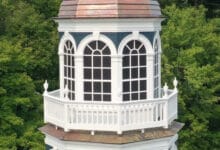
The real attention grabber is the tower. From the exterior, you’ll see a neatly clapboarded box at the base followed by an open belfry with semi-elliptical arched trim and keystones. Above the belfry, we see a lantern enclosed with false windows, a stepped dome roof clad in copper, and finally a central mast that supports a gilded finial. Built in 1803, the school building is a two-story, hip-roofed structure framed almost entirely with white oak. The façade features a slightly projecting central pediment that was added later.
We spent a little under a year at the school and in that time we touched just about every area of the roof and the tower above. We started by stabilizing the purlins on both sides of a failing king post truss. After the stabilization, we carefully removed the damaged truss. Fortunately, we were able to reuse the original king post in our like-for-like replacement and scribe in a new white oak tie beam along with rafters and struts.

Both the framing and the exterior of the octagonal tower were in rough shape when we found them. The upper sections of the five-sided belfry posts had sustained significant water damage and were in need of substantial fixes. After removing the lantern with a crane, we cut the tops of the belfry posts down to good wood and set about laying out bridle joints for our fixes.


While we worked on the belfry framing, Victor Wright of Heritage Co Coppersmiths did a tremendous job replacing the weather-worn stepped copper roof of the lantern. Our gregarious feline visitor approved.

With the belfry post tops cut to height, it was time to return the lantern to its proper perch and get to work remaking the trim elements and two sets of railings, or balustrades, that adorn the tower. We favored mahogany for the balustrade posts and handrails owing to its stability and rot resistance. After working on the heavy framing of the roof system and tower, the mortise and tenon joinery of the balustrades felt like a scale model. The small vertical elements that form the screen of the balustrade are called balusters. Each baluster has a tenon at both ends to fit into a row of mortises on the upper and lower rails of the balustrade.


For the false windows of the lantern, we fashioned a custom router jig to cut the radial elements while being cautious to minimize short grain—areas of potential weakness where the straw-like fibers in a piece of wood are short and separate easily along the grain.


In addition to the structural repairs of the tower, we cut and installed a replacement bell cradle to enable the school to ring the bell once again. The timbers of the old cradle were sagging and bolted into the posts with rusty fasteners that were doing a lot of work. To help resist the horizontal forces generated by the swinging of the bell, we added stout braces to the new cradle.
During the course of the repairs, our project lead gave a series of lectures and interactive demonstrations to students and staff. The lectures covered topics such as the history of timber framing, tools and techniques, and detailed explanations about our repairs on the 1803 school building. Before we installed our replacement king post truss, each student was invited to sign their name on the tie beam and thus leave their mark on the history of the building.
We thank the teachers and students of the school along with the local community for their interest in our work and hope that they continue to enjoy this beautiful historic structure for many years to come!
