After a piece of trim is removed from an O’Kane wall, it is taken over to a photograph of that wall and traced with a fine tip marker. The dis-assembler then writes a description of the piece on the item list for that wall and assigns it an item number. The room number, wall letter and item number are written on a piece of masking tape, which is affixed to the upper left, backhand corner of the piece. The piece is carefully de-nailed, and then a final “acquisition” number is etched into a patch of white shellac using a Dremel tool. The piece is wrapped in shrink wrap with his cohorts, and tightly stacked in an assiduously organized, and mapped trailer. I have just finished re-tracing all the photographs of those walls which have been completely denuded. The results, below:
Before it was dismantled, the fireplace in O’Kane’s Blue Parlor got a lot of attention. It is a simple-looking surround, with a single large panel above and an applied mantle, but it’s a good representation of the vernacular style from its era. Aside from a little bit of backband added in a Greek Revival-era renovation, the surround was intact, and allowed a visitor to feel transported in time. While I found the piece pleasing aesthetically, I didn’t fully appreciate the workmanship until it was dismantled, revealing another chapter in the story of this building.
After Scott removed the adjacent paneling, and had cut or pulled the wrought nails attaching it to the wooden lintels, we realized that removing the surround wouldn’t be so easy. The stiles on either side of the panel and fireplace opening extended past the first layer of brick, but we could never have guessed just how deeply. After removing a piece of subfloor and digging into crumbled clay mortar, we found that the stiles extended below the surface of the subfloor by 8 inches. Eight Inches!
We haven’t found anything like this elsewhere in the building, and, based on the adjacent wall paneling, which went no deeper than the first layer of flooring, there is no reason to think that the original floor was eight inches lower. My theory is this: while the frame was being fit, joiners were cutting this and the other frame & panel walls (joinery shots, below). As soon as the frame was erected and sheathed, joiners installed this surround first so that this hearth could warm and feed the carpenters as they finished the rest of the house.
After digging out the stiles, we carefully laid the surround onto a specialized piece of preservation equipment called a Trash Can, and then we discovered something AWESOME.
A Pulvinated Panel! I have a thing for pulvinated, or “breasted” panels (would an analyst draw some connection between my interest and being a woman in a male-dominated field?) I have loved them ever since I first encountered them at Hancock Shaker Village on a NBSS class trip. At Hancock, the technique is seen on the front of the panel, and elsewhere, it seems to refer largely to friezes. I just think it is The Number One Most Elegant Way to field a panel, and ought to be used more often, and visibly. It is appealing to me how present the crafts-person is in this method of shaping a panel. The curve is shaped by his eye and hand, rather than a combination square. To me, the process is nearer to the construction of a chair than that of the austere wall panel.
Pulvinated Panel at Hancock Shaker Village
Given that the back of the panel we found was mostly rough, and totally invisible, the gently curved backside was not really where this crafts-person showed his stuff. That was in the triple stub tenon we found in the wide bottom rail, and the double tenon up top. The joinery involved is partly what leads us to believe that the surround may have been made ahead of time, off-site.
To see more photos of our process click on the slideshow, below
Blue Parlor Wall, Dismantled. Photo by John Butler
One of the first treasures we uncovered at O’Kane was a wall of horizontal featheredge sheathing painted in bright yellow. It was hidden behind plaster in the Blue Parlor, and had shadow lines delineating where once there were shelves. Where the boards terminate, on the left side, we think there was originally a wall, creating three rooms in the back half of the house. Two smaller rooms flanked the Blue Parlor with its large central hearth. The yellow paneling probably turned the corner, creating a pantry in what was originally the kitchen, given the large fireplace. Throughout the house, we have continued to find boards and shards in the same chrome yellow, used as padding and strapping. This helps to the date those walls, and solve the mystery of the house’s original layout.
Pictured above is the paneled wall that we uncovered in the room directly above the Blue Parlor. The right portion of the paneled wall is original, and you can make out the hinges from the original door opening on the second panel from the right. The door opening was filled with one wide, nondescript board and a board with the same chrome yellow paint and shadow lines. During one period of renovation, this yellow pantry board was probably taken from the partition wall downstairs and installed upstairs to create what became a UNH student’s bedroom.
We have found other pieces of this doorway elsewhere in that upstairs bedroom. In the closet, the head casing was being used as a shelf cleat, allowing us to determine the width of the original door. Time and again during the dismantling process, we are reminded to be thankful for that Yankee thrift.
We’ve been using softwood wedges, made from 2x stock, to carefully remove delicate moldings and wide wall panels. Either the wedges loosen the nails completely, or they provide use with enough room to slip a sawblade behind to cut the nail. Like ziploc tupperware, they can be reused, but eventually the edges get grungy, and need to be thrown away. Using a sled on the tablesaw, I can safely make buckets of fine, sharp wedges.
Some of the wedge templates are pictured above. The larger wedges, 15″ x 1 1/2″, and 12″ x 1″, are used for flooring , and wide wall panels. Smaller wedges in 5″, 7″ and 9″ by 1/2″ sizes help with smaller, more delicate moldings.
This is a photo of the template after it has been screwed to the tablesaw sled. I added a fence (pine, left) whose top is co-planar with the top of the stock to be ripped (pine, right). Then I screw a cap onto the fence which covers the stock and holds it down as it is pushed through the blade. This allows me to cut the wedge safely, my fingers far from the blade. The sled is then retracted, the wedge popped out from beneath the cap, and the next blank squeezed in.
Jig with the cap screwed in place, above.
Profile view of jig, devoid of stock.
I know that some people use a bandsaw to make wedges. That method has the benefit of a thinner kerf and less waste, but for us, this method was safe, speedy and accurate.
Over the past week, we have been using up our supply of softwood wedges at the O’Kane House. In the effort to gently remove the delicate, hand-planed moldings, we tap narrow wedges in along the paint lines, crushing the wedges with repeated use (and saving the edges of the trim). It is a slow, thoughtful process and along the way, we speculate about what the original carpenters of 1790 might have been thinking.
There is strong evidence that the trim carpenter who finished the front hall and the upstairs bedrooms was thinking, “OMG, Can’t get enuf of this sweet, new reeding plane!” The pattern of five 3/16 inch half round “reeds” is used to create a variety of decorations around the room. So far, all of this molding has been hung with wrought nails. The accordian lath behind it was hung with a combination of cut and wrought nails. This was typical for the time period, according to A Building History of Northern New England, by James Garvin. Cut nails broke more, but were less expensive to make, so a few wrought nails were used to hold the lath in place, and then the field was filled in with cut nails. It makes sense to me that the carpenter wouldn’t risk breaking a cut nail as he hung his precious, hand-milled moldings. It was worth it to stick with the more trusted technology, the wrought nail.
He used it in multiple runs adjacent one another to adorn the echinus of the pilasters next to the front door.
And he ran multiple passes on one 6 or 7 inch board that he then cut on the diagonal and reassembled to dress up the simple fireplace surround.
We get sort of excited when we see mistakes like this one. When we turned the board over, we saw the knot that caused the plane to go off-track. I like to imagine commiserating with the post-colonial carpenter around the horse trough. It’s evidence like this that will remind the client that he lives in a wholly handmade house. There are some moldings that we may have to reproduce, and for short sections, it is easier to do by hand. If anyone out there has seen a plane like this one, please let us know.
For more photos on the process, check out the photos below, updated regularly with our daily finds.
We’ve begun in earnest the dismantling of the O’Kane House, in Durham, NH. It began with a training day with John Butler, a photographer and carpenter who has worked with us on a number of museum de-installations. He showed us how to remove trim without damaging the surface using a variety of softwood wedges, and other specialty tools. He has also been working with us to develop a streamlined process for labeling and documenting all of the parts we will remove.
As we dismantle the house, I hope to keep the blog up to date with a series of posts and pictures of the neat stuff we find. Consider the following the first:
Look at that enormous Chimney Girt!
The interior door jambs were rabbeted into the casing. Those dadoes and rabbets were all plowed by hand!
When the carpenter who milled this piece of baseboard ran into some squirelly grain, or screwed up and ran off the edge of the board, he just flipped the piece over, and ran the molding on the opposite edge of the opposite face. We revel in connecting to other carpenters in this way. We all make mistakes, it’s the good carpenters who know how to fix them.
On Friday, we peeled plaster from the walls of the Blue Parlor, in the O’Kane Farmhouse. Scott was Bill and I, Ted, as we traveled in our proverbial telephone booth through layers of plaster, lath, wallpaper and time.
There were clues to some of what we might find. Surrounding the door openings were wooden strips, wedge-shaped in profile, that served as plaster grounds. They were a little over an inch thick, and were nailed four inches away from the opening itself, creating a border around the door opening that looked like a recessed casing. The application of these plaster grounds became popular in the mid-18th century, and allowed the plasterer to create a flat wall plane within the borders of the ground (Much of this initial dating information comes from James Garvin’s A Building History of Northern New England, pp 65-71). In most cases, the chair rail, baseboard, and door and window casings were applied directly to the frame, and served as the plaster ground. In Shaker buildings, for example, the casing is nearly flush with the plane of plaster. But in this wall, the plaster plane was an inch proud of the recessed door border, due to the applied ground, and there was a vertical, beaded joint between the side sections of the border and the top. It looked like a larger section of beaded paneled wall was peeking through.
As we carefully peeled the plaster from the lath, we paid attention to the composition of the plaster. Older plasters have a higher concentration of goat hair, and regularly one will uncover a multi-colored tuft that was was never fully mixed in. Older plasters were applied in three coats, a base coat, a straightening, or “brown” coat, and a skim coat. The base coat is thickly applied and creates the keys that lock the plaster onto the lath. The base coat squeezes through the slits between the pieces of lath, and droops behind. A skilled plasterer will use the right amount of pressure to create an even pattern of keys, enough pressure to create a key big enough to hold, but not so much that the plaster breaks off and splooges into the wall cavity. After the base coat has dried to a leather hard consistency, the brown coat is applied, and the plasterer drags a long straight-edged board, or screed, over the surface, flattening the wall plane between the grounds. The brown coat is usually where you see the most goat hair. The skim coat is the last, thinly applied coat, devoid of hair and leaving that hard, cured, eggshell finish. On the first two sections of wall, we found sawn lath behind the plaster, hung with machine-cut nails. This dates the added plaster surface to sometime after the mid-19th century, as we suspected (Garvin, p. 67).
One Wall, Many Coverings
Behind the lath we found beautiful, psychedelic wallpaper. The profile of beaded paneling telegraphed through, and punched vertical lines in the wallpaper at each panel’s joint. On the wall, one could see three different periods all at once. The horizontal shadow lines left behind by the lath, the lively geometric pattern of the wallpaper, and the vertical beads poking their noses through the surface.
Scott, Salvage Detective
So I liked that, but the most exciting discoveries were yet to come. So far, all we could determine in terms of dates was that the plaster was applied before the advent of wire nails during the late-1800’s, leaving no real indication of the date of the beaded paneling. Farther along the north wall, to the west, was a section that appeared to have once been partitioned off into a different room (according to a long joint in the floorboards). When Scott began dismantling this section, the wall cavity was different. There was a void behind the lath, and in its depths he could see the horizontal, bevelled profile characteristic of feather-edged paneling, and shiny, chrome yellow paint. The paneled wall he uncovered was was hung horizontally, and it had a feather-edged profile, where the edge of the board is beveled to a thin tongue that slips into a groove on the adjacent board. Conversely, beaded tongue and groove has a bead with an edge perpendicular to a quarter inch tongue. The joints in such boards are typically tighter. Both styles were used and re-used during the first half of the 18th century, but the feather-edged stuff is reminiscent of an earlier era.
Across the face of the older, yellow paneling, we saw the regular shadow lines of shelving, leading us to believe that this section of wall had been obscured by pantry storage and left alone when the rest of the room was upgraded. The wall plane of the beaded section is sufficiently proud of the feather-edged wall plane that the beaded paneling could be hiding more yellow feather-edged paneling–but this is only one of a number of possible scenarios. The beaded paneling could be contemporary with the feather-edged paneling; the feather-edged paneling might have been recycled from elsewhere, or simply used to delineate a different room in the house. In most homes, we’d never know the answer to these queries, because we wouldn’t dismantle the wall any more than was needed to make repairs, but the O’Kane house will be completely dismantled, and it is exciting to know that as we proceed, some questions will be answered, and even more created.
Three Walls in One
Adjacent the feather-edged paneling was the most exciting section yet. A section so exciting as to make the author flap her arms in an improvised, peacock-like dance. Behind the plaster Scott found accordian, or split board lath, hung with wrought nails. Accordian lath is hung using a wide, rough, knotty board. The first edge is nailed to the studs, and then the board is split along the grain and checks are stretched open and nailed, creating voids for the plaster to “key” into. This kind of lath supplanted the use of split, or riven lath around 1800. It was used until the mid-19th century, with the introduction of sawn lath.
Wrought Nail Detail
Wrought nails were used until the advent of machine-cut nails, invented in 1790. So we were finding a relatively newer lath style with an older nail technology allowing us to date the wall to sometime between 1790 and 1800 (Garvin, p 66). Dating a building without recorded documentation is a fuzzy practice. Often, the invention of a technology allows us to bracket a building’s date into “well, we know it wasn’t built before such-and-such,” and this is an unsatisfactory conclusion. Most technologies were in favor for at least fifty years. We use all these time brackets, and the popularity of certain styles throughout the house, to come up with an approximate date. It is unusual, and thrilling, to uncover a wall that so neatly falls between the advent of one technology and the extinction of another–and that was why I found myself flapping my arms, wildly.
Please peruse the photos below for more information about our process, and stay-tuned for more exciting discoveries.
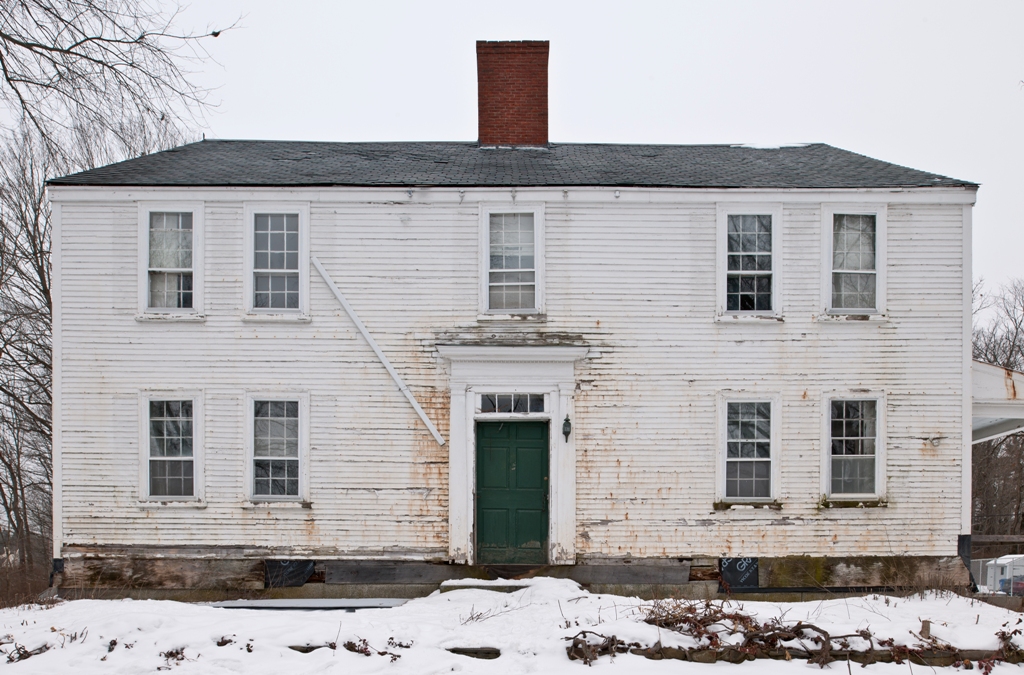
O'Kane Farmhouse, South Face, photo by John Butler
Preservation Timber Framing has been involved in a number of museum projects in the past. We reconstructed the Brown-Pearl and Manning Rooms for the Boston MFA, rebuilt the Moffatt-Ladd coachhouse in Portsmouth, and dismantled 16th c. Carved Ceiling Beams for the Fogg Museum at Harvard, to name a few. We are honored to have been a part of these prestigious projects, but where does this leave the many historic houses that remain on the chopping block? There are a number of legitimate reasons that a historic building cannot be, and should not be, preserved on its original site and usually this results in the building being demolished. Is it possible to take the standards used in a museum setting and apply them towards preservation in the private sector?
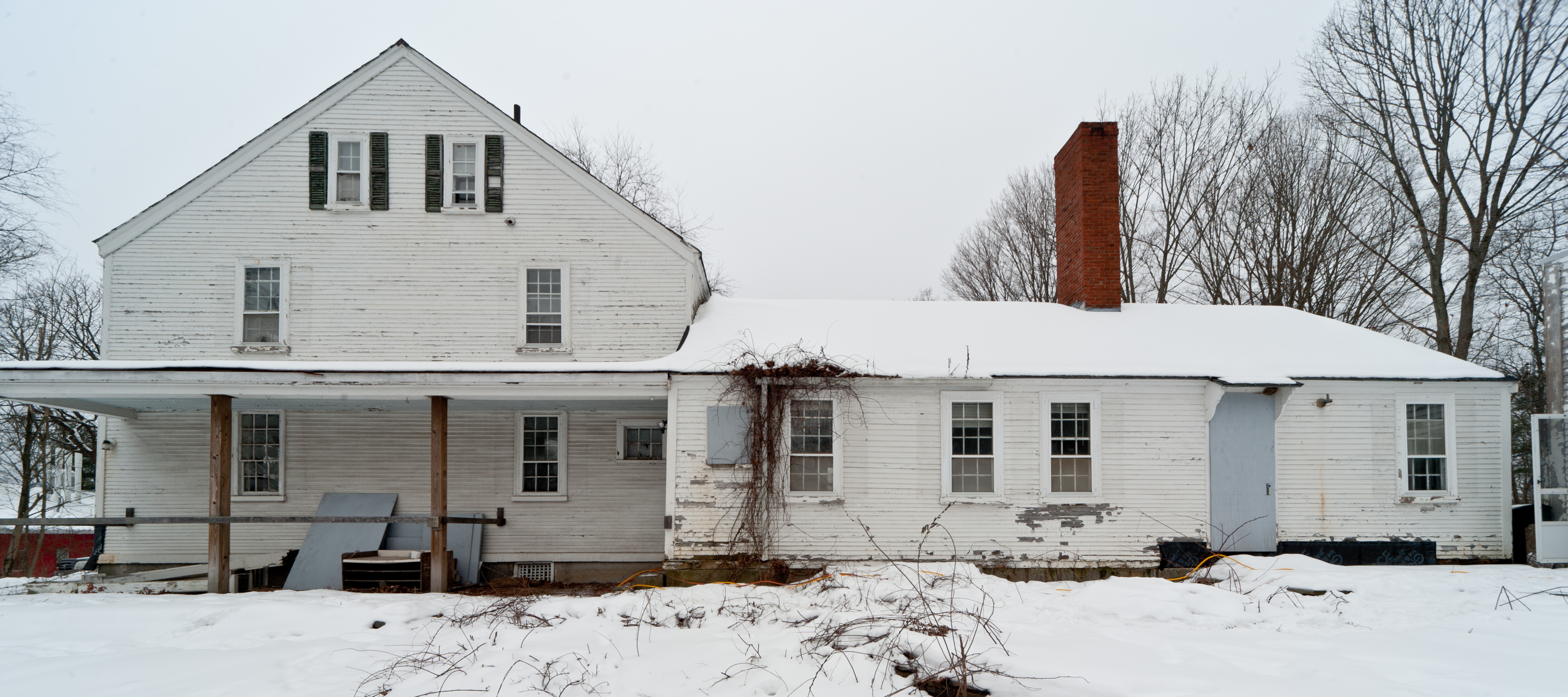
O'Kane East Face, photo by John Butler
The O’Kane farmhouse, c. 1790, typifies this dilemma. It is currently located across from the Child Study and Development Center on the UNH campus in Durham, NH. Thanks to the university’s stewardship, the farmhouse retains many original or early features, including indian shutters in many of the rooms, and very nearly its original room layout and partitions. Much of the panelling is likely original, and the trim elements appear to have been hung during a Federal-erarenovation. But the Child Development Center needs to expand, and the Farmhouse is wildly inappropriate for that use. Firstly, the original trim retains its original lead paint, and many decades of lead chips saturate the surrounding soil. Secondly, even if the lead were abated, the building would need to be renovated for the Center’s needs, and in the process we would lose much of the building’s architectural history.
O'Kane Cape Fireplace, by John Butler
When UNH decided to sell the building to a responsible buyer who could dismantle the building, and re-erect it faithfully elsewhere, it presented an incredible opportunity, and a unique challenge. In a museum, we are usually working on one or two rooms, long ago removed from their frames. The O’Kane farmhouse is a two-story house, with attached cape ell. In addition to its hewn, white oak frame, it has original wide-panel partitions and a fireplace surround in every room. Could we apply a curator’s techniques for careful removal and inventorying and apply it to an entire farmhouse, frame and all?
To guide us in this endeavor, we have looked to John Butler, a man with unparalleled expertise in the field of historic documentation and assessment. A long time colleague, Arron most recently worked with John on the MFA project. Since then, Butler has refined his inventory and documentation techniques still further at the Yale University Art Museum. In the past couple of weeks, Butler has completed the initial photo documentation of the building’s interior walls. His cameras are capable of capturing an entire wall, without distorting the plumb and level lines of architectural elements. After first marking a level datum line around the entire room, Butler is able to rectify the photos to an astounding level of accuracy. Using the datum, and other grid lines, we will be able to measure off of the photos, greatly saving drafting time. The photos will also be used during dismantling. Each element will be carefully removed using softwood wedges. The element will be then be traced on a large photograph, and given a number, brief description and initial assessment. The room number, wall letter, and item number will be marked in Sharpie on a patch of white shellac on the back of the piece, in the upper left hand corner. A pair of inventoriers will work with a pair of dismantlers for each room.
O'Kane Floor Plan
This past week, I have been working on measuring and drawing a simplified SketchUp model that records the rough layout of architectural elements. I measured and drew all the floorboards so that we can have a map of their item numbers, as well.
On Friday, our client, Charlie, is coming down to Durham to help with the removal of the first of the plaster layers. Some of the plaster appears to have been added later, obscuring Georgian Era partition walls. We can’t wait to see what we will find.