Tag: Preservation

  • East Derry Derring-do

    East Derry Derring-do

    Steeple and Meetinghouse
    Steeple and Meetinghouse

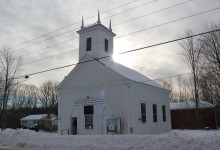
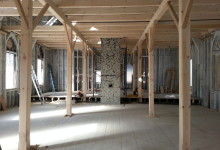
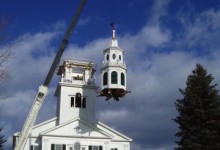
    The First Parish Meetinghouse of East Derry, NH is preparing for a big anniversary, its tricentennial. What does one even get for a church on its 300th? Wood? Copper? Both, as it turns out. Beginning with a thorough assessment and rehabilitation plan in 2011, the congregation has been working steadily to repair extensive damage throughout the steeple and undercarriage. This past fall, we extracted the belfry and lanterns from the steeple stack. After the new year, we documented the upper sections from a woman-lift and dismantled them from finish to frame.

    Lower lantern roof, crowned with urns
    Lower lantern roof, crowned with urns

    As we surgically removed trim, we encountered earlier salvage efforts. Dan and Rod peeled back the gracefully curved roof between the upper and lower lanterns and revealed an oiled sailcloth roofing. The sheathing below was labeled November 1916.

    Lower Lantern Posts
    Lower Lantern Posts

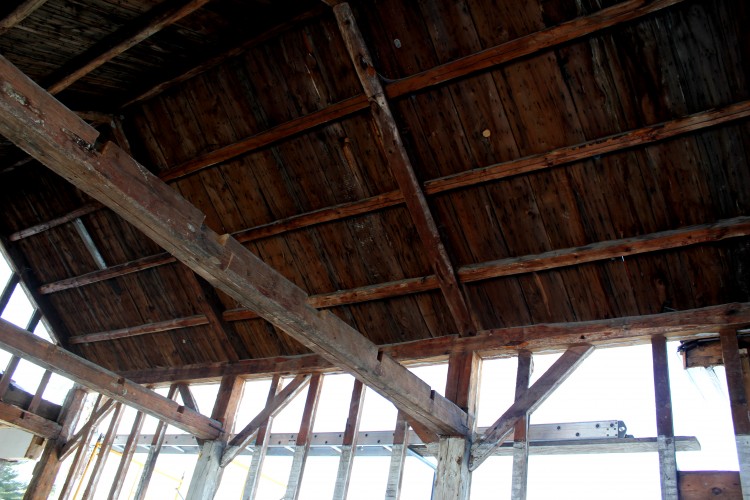
    The frame was in far worse shape than we expected. Years of roof leaks and patchy repairs had finally overtaken the stout timbers. Once the lower lantern posts were exposed, we wondered how the structure was still standing and realized too late the bravery of dismantling it. Above, you can see that the six of the eight posts were hollow or non-existent at the top. An extensive repair campaign in the 1990s consisted of bolting channel steel and L-brackets to the crossing crab members (a “crab” is a horizontal web of timbers that spans the posts of a lower level and support inboard posts above). Looking at this picture, stiffening the crab fell far from the root of the problem.

    Lower lantern crab above belfry ceiling

    The crew struggled to free the timbers from their steel cages only to discover a corpse. It’s tragic that this rot wasn’t addressed when the church raised money for its repair two decades ago. A comprehensive, traditional approach at that time would have prevented the wholesale replacement necessary today.

    Truss spread

    In 1719, Scotch-Irish immigrants, fleeing religious persecution in Northern Ireland, settled the area that became East Derry. In 1722, they built their first meetinghouse on this site. The present structure was built in 1769. By its centennial, in 1822, the congregation had so grown that they cleaved the building in two and dragged one end 24 feet to the east. Above, you can see the first additional bay, indicated by the absent strainer beam and braces.

    East Derry Wall D
    East Derry Wall D

    In our assessment drawing above, the strainers and bracing between the trussses in bents 3 and 4 and bents 5 and 6 are non-typical. The strainers and bracing in bright green are non-existent; that is the bay in the photograph above. The yellow strainers and bracing between bents 5 and 6 do not quite reach bent 5, they are connected by a series of sisters and scabs. The evidence in the frame complies with the history: our hypothesis is that in 1822 the building was split between bents 3 and 6, (originally bents 3 and 4). Bents 6 through 9 were dragged to their current position, and bents 4 and 5 were built as exact reproductions of the originals. The strainer and braces that used to connect bent 6 (originally 4) to bent 3 were sistered to bent 5, and the strainer between bents 3 and 4 was deemed unnecessary. We are curious to uncover more of the eave wall framing, specifically the plates and the sill scarfs, to see whether there is more evidence to support our theory.

    Parallel rafter chord truss

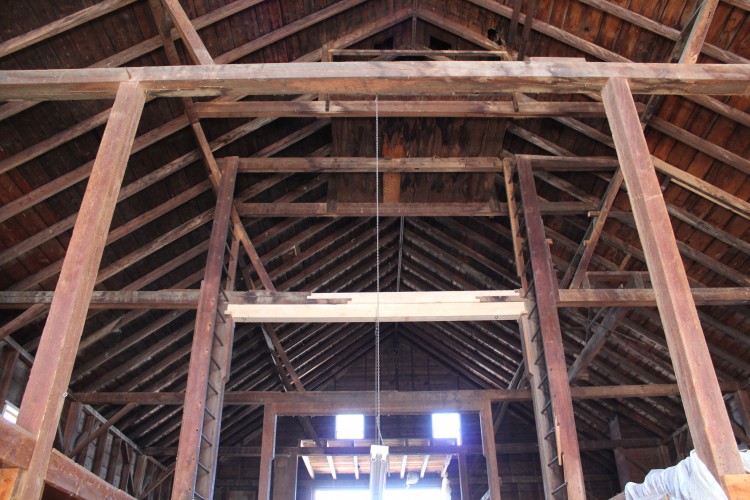
    The East Derry First Parish truss is iconic. It has a king post in the center, with parallel rafter-chords and crossing pairs of ascending and descending struts. The king post is in tension, picking up the tie beam at the middle of its span, and the ascending struts rise from the king post and prevent the rafter from sagging. In the Timber Framing series, “Historic American Roof Trusses,” Jan Lewandowski explains:

    Outward pressure on the walls can be eliminated entirely by affixing the feet of each rafter couple to their own tie beam. The problem of sag can then be addressed by hanging a joggled vertical member, or kingpost, from these rafters and using it in tension to support the midspan of the tie beam… By a less obvious intuitive leap, it might be realized that the midspan of the long rafters can be kept from bending by struts rising from lower joggles on the suspended kingpost.

    East Derry Bents 1-4
    East Derry Bents 1-4

    The parallel rafter-chord is an innovation that protects the Achille’s heel of the king post truss. The casual observer often assumes that the joint between tie and king post is where we would most frequently see failure over time. I’ve seen many iron stirrups that attest to the builder’s concern for this joint. But most trusses fail at the rafter heel, where the upper rafter-chord intersects the tie beam. Of this foot joint, Lewandowski writes:

    Those we can inspect seem more prone to failure and impairment than most other connections in the truss, for a combination of reasons: the lack of relish beyond the mortise and the large forces involved, coupled with the low angle of attack of rafter to tie, all exacerbated by a high incidence of leaky eaves. The significance of the roof slope is that the geometry of low-pitch roofs channels more horizontal force against potential long-grain shear failure in the tie at the foot joint than it does comparable vertical breakout load on the kingpost at the peak (see TF 72, 19). The point: on both empirical and theoretical grounds, the principal rafter-to-tie beam joint is the likely weak sister in the mix.

    In Sedgwick, we saw the foot of the upper chord shear a 2″ x 12″ x 22″ block clear off the end of the tie beam (It was about the size of a hefty wedding-present-breadboard). With a parallel rafter-chord truss, the duties of principal rafter and upper chord are separated. The principal rafter, the top angled timber, carries the roof, while the upper chord, the inner angled timber, carries the compressive loads created by the truss. The upper chord intersects the tie beam farther from the end of the beam, thereby protecting the relish just past the joint from shear. We so liked this truss that we reproduced it in a building where it will be on grand display: the Lewis Conservation Center.
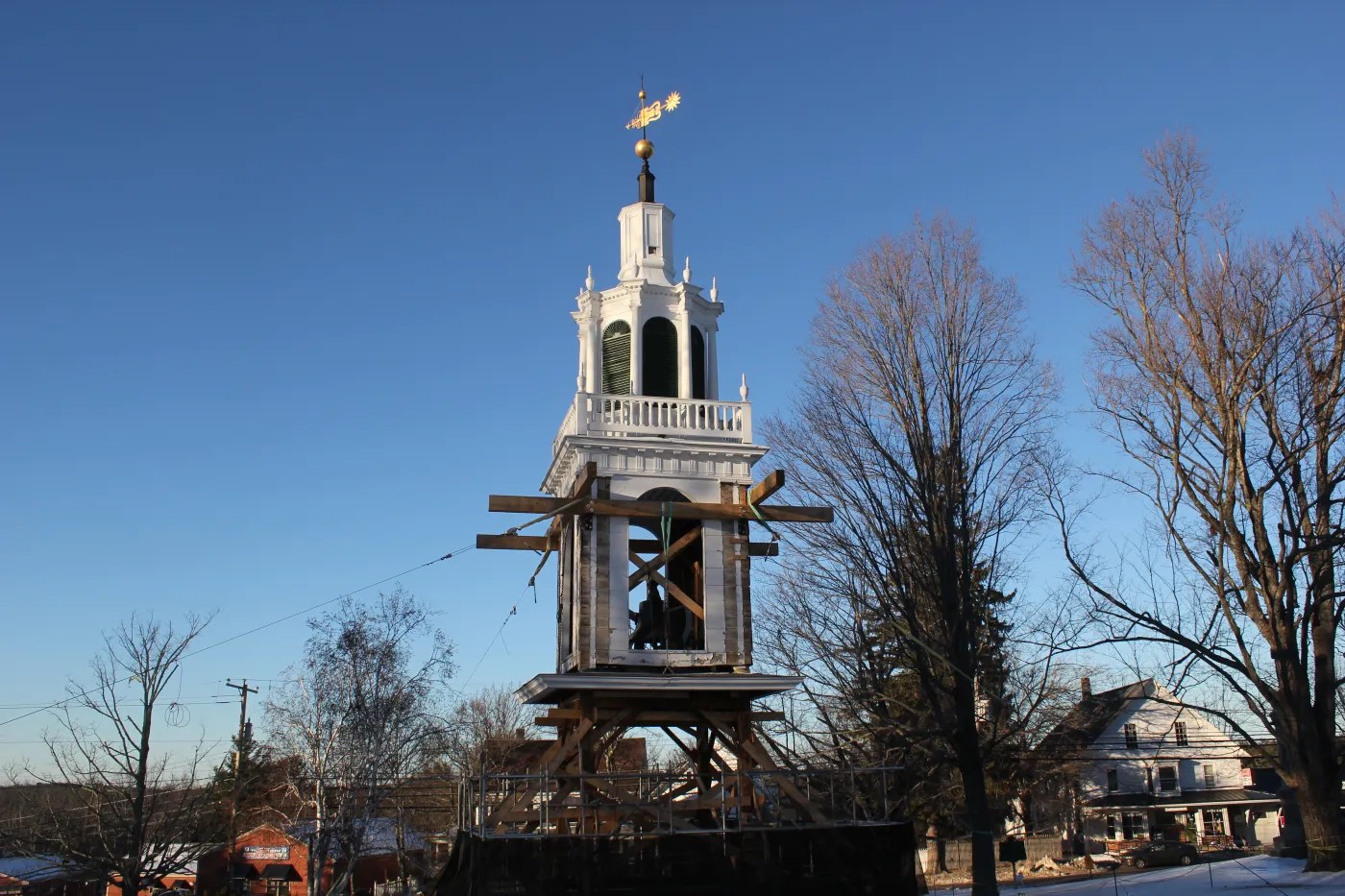
    Steeple extracted

    Paul Lindemann, East Derry historian and devoted parishioner, keeps a detailed website documenting the history of the church and their repair process. The Nutfield History blog is a fascinating read for anyone interested in New Hampshire history or building history in general. The blog also benefits from Lindemann’s web design skills, something that doesn’t always attend the dual callings of historian and parishioner.

    The vigor and ingenuity of the immigrants who built this Meetinghouse is evident in its frame. We honor their labor with our efforts to preserve it. In 300 years, what will historians write about the immigrants seeking refuge in the United States today?
  • Hard Work, Adaptation, and Love

    Hard Work, Adaptation, and Love

    Bents stacked on Thursday afternoon

    The client’s wedding was in a week, and the barn in which he’d marry was in pieces on the ground. It was crane day, and a Friday, two things that don’t usually go together. In the worst case, a crane day on Friday means you don’t have an additional weekday in case you hit a bad snag; in the best case, it means the crane operator wants to get home, and the roof frame flies in fast and loose. In a week we’d complete a job started almost exactly four years earlier. Back then, Arron was patrolling the net, looking for a barn in need of saving, and spotted a damsel in West Poland, ME. That Saturday, he dragged his teen-aged son with him to visit the barn and get some driving practice. The frame was for sale, but not the land beneath it. It would need to be documented, disassembled, repaired and rebuilt elsewhere. When Arron arrived, another potential buyer was already poking around.

    Before (September 2011)
    Before (September 2011)

    Arron wanted to repair the barn, but needed a buyer; Charley wanted the barn, but needed someone to repair it. It was a good match. Since then, PTF has embarked upon a number of projects with Charley, most notably the disassembly, repair and rebuild of his Carpenter’s Shop two winters ago. The West Poland barn was neatly stacked in a Dairy barn at his home, awaiting its turn on a long to-do list. This fall, as Arron’s son prepared for his sophomore year in college, PTF erected a barn that had spent four years being designed and refined in Charley’s head.

    Barn Frame Iso with transparent grade
    Barn Frame Iso with transparent grade

    Charley needs the barn to house his three draft horses, donkey and a flock of sheep. The draft horses wouldn’t fit under the barn’s original girts, 6′ 4″ above the sills, about 6 inches shorter than your standard doorway. He designed a foundation that raised the posts 2′ 8″ above grade, creating 9′ of clearance for the horses. The perimeter posts are each tenoned into a sill, which rests on a foundation wall. Each drive post lands directly on a 8″ x 8″ granite pier. Precisely 7′ tall, the piers rest directly on two longitudinal footers, 4′ below grade. A frost wall was poured between the posts; it’s top level with grade. Each post is point loaded upon a foundation wall that extends below the frost line and rests on a connected footer. This will prevent the posts from moving due to annual freeze and thaw. Ensuring that each drive post landed on its granite post required precise cutting, measuring and measuring again.

    The barn we took down was built in the mid-19th century; it has hewn posts and both sawn and hewn girts. The center drive posts are more than 24′ tall, and are joined directly to the rafters. The ties are discontinuous, the outer tie mortises over the eave post, and tenons into the drive post. The plate is also discontinuous and is dropped eight inches below the top of the post. The original barn was almost square in plan, 38′ x 39′. With all that livestock, Charley needed larger bays, and decided to extend the length of each bay from 9′ to over 13′; the rebuilt barn is 38′ x 56′.

    Tie Girt Scarf Fix
    Tie Girt Scarf Fix

    In early August, our first task was to repair the bents. Eighteen of twenty original posts could be reused or repaired, and thirteen of the original tie girts were salvageable, most requiring face fixes to their outer ends. All of the original braces were nailed, and we replaced them throughout with mortise-and-tenoned braces. Originally, the barn contained no loft girts within the bent beneath the ties; the loft joists had rested on top of eave and drive girts. We inserted loft girts into the bents, to better connect the eave and drive posts. Each drive post was 24′ long, hand-hewn, and twisty. We used the traditional scribe rule method to install the new framing members. Using a transit, we built a level “table” on which to assemble the bents. The “table” is eleven stacks of 6″ x 7″ cribbing laid out to support the post feet, the joint between tie girt and post, the joint between tie beam and post, and the rafter apex. We laid out each post and shimmed it level. Considering the twist of the posts, we leveled by measuring off the arris. On each timber, the two best faces are established as “reference” and the corner where they intersect is called the arris. The handhewn surface may vary, but this way, our posts will still line up on the foundation. We fit the tie beams and checked measurements, squaring the bent by measuring across diagonal corners. Then we laid the new loft girts and braces out on top of the bent and used a level and combination square to scribe their shoulders to the associated post or tie girt. Not one of the original rafters could be salvaged, except maybe for use as a dugout canoe. We increased the size of the rafters to  7″ x 9″ and used string lines to scribe them to the bents. Due to the time restraint, we weren’t able to scribe the actual rafter timbers to the bents until their final fitting before crane day, and this ultimately pushed our crane day from Thursday to Friday. Next time, we’ll go slower and scribe rafters while we’re fitting the rest of the bent.

    Mortise in sill to accept twisted post

    By the time the bents were fit, the foundation was poured, and sill timbers cut. We were able to use the foundation as our “table” while we fit the eaves. This was ideal, because the drive posts could be laid directly over their granite piers. After the posts were laid out and square, the new, longer eave girts and plates were laid out and scribed. This is where the use of reference faces becomes essential. During assembly, reference face is always up. When fitting the eave walls, the reference face is 90 degrees to the reference face that was used to fit the bents. By consistently measuring and laying out the timbers to the same point along the arris, we can ensure that the eave joinery will fit tightly when the building is standing.

    Fitting the Final Rafter
    Fitting the Final Rafter

    Crane Day required the entire crew. Placing the barn on a high foundation wall meant the loft girts were high, 9′ above grade, and the plates were 7′ above that. For each timber, there needed to be a crew member on the ground and two more up high. We used blue frame staging along each eave and a scissor lift in the drive. After bent one was raised, a dozen more timbers needed to be placed (loft girts, drive girts, interior post and braces) before bent two could be flown in and connected. When the bents were all standing, the 7″ x 9″ x 25′ rafters were each flown in and fitted over the drive posts. Lastly, the crane set the purlins. It was 3:00 pm on a Friday, and they came in fast.

    Sheathing the Roof
    Sheathing the Roof

    Sheathing the roof that Monday was exhausting, the boards were hemlock, and green. But we finished with a couple days to spare. This barn has had a long life. Like marriage, it is the product of hard work, thoughtful attention, adaptation and love. We wish Charley and his bride the very best.

    Foley Horse Barn
    Foley Horse Barn, photo by Charles Foley

    For more photos, explore our Flickr album.

    Foley Horse Barn
  • Kung Fu Timber Framing

    Kung Fu Timber Framing

    Time to Lean
    Time to Lean

    Troy Union Church was built in 1840, in a vernacular style that combines elements of Greek and Gothic Revival. It is a modest building, 34′ x 42′, built to host the small town’s various Christian denominations, hence the “Union”. Caught up in that communal spirit, the bell tower is preparing to take a trust fall onto the back of the church. I’ve photographed a lot of buildings, and capturing a slumping wall, or humped roof can be challenging. This steeple has a model’s slouch. In fact, the center of the tie beam supporting the rear tower sags 7″ below eave height. The 10 x 10 tie beam is 34′ long, which means that there is a 7″ deflection over 17′.

    Bent 2, rear tower wall. Yellow string represents height of tie beam at eaves
    Bent 2, rear tower wall. Yellow string represents height of tie beam at eaves

    Typically, we also have trouble photographing center rot in a beam. The timber will be hollow, but look perfectly sound on its face, the only visible evidence seen through the pin’s hole in a mortise. At Troy, there is a crevass in the top of this tie beam, a 3″ x 12″ valley of rot. PTF stabilized the steeple in 2011; building a cross braced KD wall to support the failing truss. The fact that the timber was able to deteriorate that far, without dropping the entire tower, is a marvel.

    Rot Crevass
    Rot Crevass

    The design of most New England steeples is idiosyncratic. Vernacular church design is informed by regional tradition, availability of materials, individual ingenuity and a shared copy of an Asher Benjamin book. Entering a church attic can feel like entering the builder’s brain. Especially so at Troy Union Church. The main timbers are hand hewn, and the design is uncomplicated, braced wherever possible. The king post truss is without flourish, straight-sided, no flare at the head, or shoulder at the struts. The rear tower wall is a common adaptation of the queen post truss, where the tower posts take the place of the queens. Occasionally, such an adaptation can be successful, like the queen post truss in the United Church of Craftsbury Common, VT. Unfortunately, at Troy, the revised truss misses the mark. The large braces running from tie to tower post aren’t large enough to serve as upper chords, and the girt isn’t located properly to function as a strainer. That said, its hard to fault a design that supported the bell tower for more than 170 years.

    King Post Trusses Bents 3-5
    King Post Trusses Bents 3-5

    The restoration effort is led by Norma Rossel, one of 12 remaining members of the congregation. Soft-spoken, Rossel challenges one’s expectations of leadership. She is as determined as she is doe-eyed. In the Kennebec Journal, Rossel explained, “”The ladies of the church got together and said, ‘It’s up to us.’” With a population of 1000, Troy faces a challenge shared by many of Maine’s rural communities: they are in possession of a historically significant building but lack the resources to repair it. The Maine Steeples Project, of the Maine Communities Foundation, was established to address just this need. In 2011, the church was elected to the National Register of Historic Places, and received from the Steeples Project a $2,500 grant for assessment and stabilization. The church received an additional $15,000 grant from the Belvedere fund, in total raising nearly $40,000 to re-build the trusses.

    Still, it wasn’t feasible for the church to hire PTF outright. The congregation is tiny, the budget is tight, and the travel costs would be prohibitory. It will take double the funding they’ve raised already to place the trusses and complete the restoration. Fortunately, what the community lacks in local funding, it makes up for in skilled neighbor. Through connections made at a longstanding monthly potluck, Rossel found Marvin Daugherty, a caregiver and swordmaker, and Scott Pfeiffer, a farmer at the Garcelon House, a cottage industry incubator. Pfeiffer recruited Adam Joy, who raises goats at his farm and has some timber-framing experience with an uncle at Red Suspender Timber Frames, to join the restoration effort. Troy used to be called Joy, ME, and Adam descends from its founders.

    Pfeiffer and Joy sighting plumb for Daugherty, drilling pin holes
    Pfeiffer (left) and Joy (foreground) sighting plumb for Daugherty drilling pin holes

    Pfeiffer is a busy man, he and his partner sell eggs, produce wool, and maintain an organization that runs like a communal homestead. He says he is a farmer in every sense of the word, in that he farms himself out to the work that needs doing. He cannot afford to volunteer through the winter months, and neither can his fellow crewmembers. Following the model used to restore the Acworth Meetinghouse, Preservation Timber Framing will provide documentation, a repair plan, training and on-going guidance to the crew. The crew receives training and is paid a fair hourly rate that saves the church money, while spending fundraising dollars locally.

    Bent 2 frame elevation
    Bent 2 frame elevation

    In March, we visited the church to document existing conditions and develop construction drawings. Daugherty and Pfeiffer had already removed the sanctuary ceiling, allowing light into the attic space and making documentation much easier. We try to preserve the original design of a frame wherever possible, but the modified queen post truss at Bent 2 was under-engineered for its task: supporting half of the bell tower over an open span of 32′ (there is a 1′ overhang past either plate). We recommended rebuilding Bent 2 as originally arranged, with slightly larger timbers, and inserting a king post truss directly behind it. The new truss would be a replica of the king post trusses in Bents 3 and 4. Two bed timbers will run directly beneath the tower posts, and span from the front gable to the new truss, spreading the tower load over three tie beams (Bents 1, 2 and 3). We drew up detailed construction drawings of the repair plan, and assembled the crew in Troy.

    Fitting and Filming
    Fitting and Filming

    Timber Framing isn’t particularly complicated, but it is a rare skill, unlikely to be encountered on contemporary job sites. Working with large, un-dried timbers requires a completely different conception of layout, relying on reference faces to account for variation and shrinkage. It also requires a furniture-maker’s attention to detail, a basic understanding of the forces that put beams into tension or compression, and willingness to use hand tools. Scott Lewis and Lee Hoagland met the crew at the Garcelon House, in Troy, which Pfeiffer graciously offered as a cutting yard. The crew was accompanied by sheep, goats, pigs and geese in an adjacent barn, along with their spring lambs, kids and piglets. They spent a day organizing the yard, spreading out and labeling posts, rafters, struts, braces and tie beams. They showed the crew how to establish and use reference faces and arrises, how to lay out a line and carry it around the timber, and how to lay out joinery from cut drawings. Scott and Lee laid out mortises and tenons while the crew cut. They wielded 16″ circular saws and chainsaw mortisers fearlessly. It took the crew about two weeks to complete the cutting. As soon as the weather cooperated, Scott, Lee and I returned to Troy to fit the pieces together.

    Assembling the king post truss
    Assembling the king post truss

    We were met there by two local TV crews and the Kennebec Journal. Rossel will use the completed frame to raise the money needed for a crane to put it in place. WABI Channel 5’s coverage focused on the repair process and the timber framing itself, while ABC 7/Fox 22’s coverage shows more of the church. The Kennebec Journal wrote a great article detailing the history of the building, and Rossel’s efforts with the community to raise the restoration money.

    Scott Lewis checks the fit of the half dovetail joint
    Scott Lewis checks the fit of the half dovetail joint

    Marvin Daugherty speaks in the sort of aphorisms you’d expect from a practitioner of Kung Fu and maker of samurai swords. When asked how his skills working with metal transfer to working in wood, he responded, “skill is skill and either you have the touch or you don’t” and that “it’s just being sensitive to things.” He says, “If you can be good at one thing, you can be good at a lot of things.” Talking to Daugherty, I learned that a person can have Kung Fu in any craft that requires training over time, and that the singular association with martial arts is an American invention. I must not have a good appreciation of Kung Fu, because what impressed me, visiting the jobsite in Troy, was how quickly Daugherty and the rest of the crew had picked up timber framing. After training with Scott and Lee a handful of times, Pfeiffer, Joy and Daugherty had re-constructed the entire rear wall of the bell tower and a beautiful king post truss. If you are interested in the efforts to complete the restoration, please visit the Troy Union website.

    More photos, below:

  • After Fire, a Family Doubles Down on Preservation

    After Fire, a Family Doubles Down on Preservation

    Restoring an historic building takes a lot of stamina. The sense of warmth and meaning one feels within a restored structure comes from the labor invested by the craftspeople who built it and the experiences of the community that used it. Once complete, the Steiner-Truesdale residence in Newfields, N.H.,will reflect not only a century of life as a church, but also the owners’ dedication to restore it as a family home, twice. In April, a fire destroyed much of the interior, an 8-year long labor of love for owners Jack Steiner and Kimberly Truesdale. In November, PTF began its role in the home’s re-restoration.

    Ribs and Roof system
    Ribs and Roof system. Photos by Brian Cox

    Newfields’ Sacred Heart Church was built in the 1880’s — a transition frame, 40′ wide by 80′ long. Five interior timber bents were constructed from a pair of posts, a pair of steeply pitched rafters, two pairs of ribs and a collar tie. The lower ribs brace the posts to the rafters and the upper ribs brace the rafters to the collar tie. The ribs are let-in and bolted, rather than mortise-and-tenoned, reflecting the dominant technology of the period. A tie rod takes the place of a tie beam, tying the eave walls together. Had the church had been built in stone, in the original Gothic style, buttresses would have provided the support necessary to counter the outward thrust of the rafters. The roof system is substantial, consisting of the principal rafters let in with principal purlins and infilled with common rafters. The balloon studs run from sill to plate, and are spaced approximately 20 inches on center. The plate consists of doubled 2x stock, which is mortised and fit onto a tenon at the top of each of the posts.

    Stopped chamfer detail
    Stopped chamfer detail

    PTF was hired to rebuild a second floor that had been destroyed in the fire. The height of the floor was determined by the tie rods, so that the rods could be enclosed between the 10″ high floor joists. Two 8″ x 10″ x 60′ floor girts run parallel to the eaves, supporting the joists. Five pairs of posts, in line with the bents, support the girts. The posts rest on first-floor girts, or carrying timbers, parallel to the girts above. The carrying timbers rest on masonry piers set directly beneath the posts, point-loading the interior structure to ground. Ultimately, the entire frame will be exhibited within the living space. The timbers were planed, and the crew matched a chamfer detail from work that Jack completed: a 1″ chamfer on all posts and girts, a 5/8″ chamfer on joists and braces, stopped 1 1/2″ from joinery.

    Once onsite, Brian and the crew’s first step was to unload and organize the stock. In addition to the six 8″ x 10″ x 20+” stock required to create the second floor girts, there were more than seventy-five 4″ x 10″ x 12′ joists, ten posts, and sixteen white oak braces. The crew, Brian, Shawn and Seth, took half a day to lug lumber, moving the timbers along a pick through the window, and another day just to organize it all. Organizing timbers is like sharpening chisels –t ain’t romantic, but it’s necessary to a well-run job. A clean and well-organized job site makes a big difference in the efficiency and accuracy of the good stuff, such as cutting joinery.

    Shawn, girt timbers, and Shawn's breath
    Shawn, girt timbers, and Shawn’s breath

    All the joinery was cut and test-fit on sawhorses prior to installation. Each 60′ second floor girt was made up of three 20+’ sticks joined with two bladed scarf joints. Cutting a frame indoors in November sounds like a pretty cushy job, but because the floor girts and joists were so long and still green, the crew wanted to do everything possible to prevent them from corkscrewing, and this meant working without heat. With the heat off, the timbers would dry more slowly, ensuring their stability. Furniture makers will sometimes avoid kiln-dried wood, instead stacking freshly-cut boards evenly; plenty of air flow lets the boards dry naturally over the course of years.

    Thanks, Grandma! the scarf fits perfectly.
    Thanks, Grandma! the scarf fits perfectly.

    Each of the posts was connected to the floor girt by two braces. After cutting, all of the brace joinery, as well as the six scarves, were fit and laid out on sawhorses. In order to prevent the joinery from opening as the timbers dried, the crew decided to draw-bore all the joinery. Draw-boring is a joinery technique in which the pin hole in the tenon is placed 1/8″ closer to the shoulder of the joint than the pin hole in the mortised piece. A tapered pin is driven through the holes, squeezing the mortise and tenoned pieces closer together.

    Lee and Scott assist with assembly
    Lee and Scott assist with assembly

    After the pinholes were drilled, the crew erected two towers of staging along the center of the church. Using a chain fall, they lifted the three pieces of one girt into place, and re-assembled and pinned the girt on the staging. Next, they righted the posts and threaded their feet through holes in the first floor, maneuvering the posts into mortises on the carrying timbers below. Due to variation in floor depth, the posts were buried 9 1/2″ – 22″ below the surface of the first floor. The crew squared and plumbed the posts and temporarily braced them to the exterior walls with 2x lumber. Then the oak braces were fit into their mortises and pinned.

    Second floor girt in position, and blurry
    Second floor girt in position, and blurry

    Three one-ton chain hoists were needed to raise the assembled 50′ floor girt into position, 4 1/2″ above the post shoulders (and 1/2″ above the ends of the tenons). The girt just kissed the 1″ round tie rods, which ultimately run between the 10″ high floor joists. When the weight was released from the staging ledgers, those ledgers sprung up, and as the ledgers were removed, their wedges popped out with a “ping.” Coordinating efforts, the crew released the chain falls and slowly lowered the girt onto the five post and eight brace tenons. Then they pinned the joinery. For the second girt: rinse, and repeat.

    Floor framing, resurrected
    Floor framing, header visible near window, far left

    The second floor is supported by more than seventy-five 4″ x 10″ x 12′ joists, which were lifted into place using a winch. At each of the eight windows, the crew created a window well by inserting a 6″ x 10″ header between the joists adjacent to the window, so the top of the window and the arched trim can be seen from the first floor. The header fit into a pocket into the adjacent full-length joists, and the short joist sits in a pocket in the header.

    With the framing now complete, the Steiner-Truesdale family can finish their adaptive re-use of this Gothic Revival beauty. We were truly saddened to hear of the fire, and now we are honored to be part of this building’s journey.

    Completed framing, from below
    Floor framing, from below

  • Kitchen of the Community

    Kitchen of the Community

    New Hampshire Preservation Alliance recently released an inspiring video about the restoration of the Acworth Meetinghouse. Built by Elias Carter in 1821, the Acworth Meetinghouse, with its double lantern spire, is a masterful representation of historic building craft. In 2008, the steeple and undercarriage were repaired by local craftspeople trained and supervised by PTF in techniques unique to steeple repair, and timber framing. In 2011, the Acworth model won a Preservation Honor Award from the National Trust for Historic PreservationNHPA’s video is an inspiring glimpse into the effort invested to repair this “kitchen of the community.” Next year, we’ll be drawing upon lessons learned in Acworth to help the community of Troy restore the trusses of the Troy Union Church (fb). 

    Feature photo courtesy Acworth Meetinghouse Restoration Project


  • Stylish Scarfs for Summer

    Stylish Scarfs for Summer

    Joe McAllister, fitting Bent 6. Welcome back, Joe!
    Joe McAllister, fitting Bent 6. Welcome back, Joe!

    On Monday, the Pennell crew erected the ell by hand. They had a roustabout on-site, which is like a more portable, telescoping gin pole, but the bents were light enough to raise with a crew of four. The ell, a drop-tie frame built in the mid-1800s, was dismantled earlier this spring during the first phase of Pennell House repair. The frame parts were transported back to the shop in Berwick, repaired, and test fit. Our most recent North Bennet Street School intern, and newest employee, Joe McAllister devoted his final school project to the cutting and joining of two additional bents to prepare the frame for re-use as a contemporary kitchen.

    East gable, dismantled
    East gable, dismantled

    Following the ell, repairs to the house were extensive. The frame was lifted on steel I-beams in order to replace the foundation and completely rebuild the undercarriage.  Seven of the eight house posts needed repairs, two of which required full replacement. The first floor studs of the north, south and east walls all required lap repair or replacement. Along the north eave, all three second floor girts and eight of their associated braces were replaced. Ultimately, the entire east gable bent was completely dismantled, repaired, and rebuilt, while the rest of the building was left standing. See “before” picture, above, and “after”, below.

    East gable attic, reassembled
    East gable attic, reassembled

    Revisiting the job-site this week, I realized that the diversity of joinery matched the broad scope of repairs. The decision to use a particular scarf, spline or lap joint is dependent on a number of factors including location, level of deterioration, difficulty of installation, historic significance, and whether or not the joint will be in tension, compression, or subject to twisting. For joinery enthusiasts, I’ve recommended Historic American Timber Joinery, by Jack Sobon, and I’ll recommend it again; it is the definitive reference manual for those pursuing traditional repair of historic timber framed buildings (I’ve linked to a PDF, if you want a hard copy, it’s worth ordering one from the Timber Framer’s Guild). On a hybrid job like this one, combining preservation, energy retrofitting and adaptive re-use, we used both traditional scarf techniques like those in Sobon’s book, and contemporary approaches, like splines and free tenons. Paradoxically, sometimes the newer repair techniques are able to preserve the most original material.

    Bladed scarf, you old so-n-so
    Bladed scarf, you old so-n-so

    If you visited our site before, job or web, you’ll know that our bladed scarf is an old standby.  It works well for post fixes, because the keys prevent the joint from slipping or twisting under outward pressure. The outward thrust of the rafters from above, in combination with the possibility of a rolled sill, and the inward tension of the tie beams and tie girts, means that a post scarf should have some means of “locking” to prevent slippage.  This could also take the form of an under-squint (see below) but in this instance, we prefer the square-bottomed keys of the bladed scarf. These multi-directional forces are what make a simple lap joint inappropriate for post repairs. We expect our repairs to last for as long as the building has already been standing. Over the course of 150 or 200 years, there may be shifting in the foundation, or deterioration in a sill, that would complicate the pressures acting on our post fix.  A bladed scarf joint is designed to withstand those forces, so that in 100 years, if a sill needs to be replaced, the post foot and associated repair can remain intact. (I hope Athena, protector of woodworkers, notices that we strive only to double the lifespan of a building, we don’t expect to triple it.)

    Halved and bladed scarf in the undercarriage
    Halved and bladed scarf in the undercarriage

    A bladed scarf is also used to repair an unsupported section of sill.  When a sill, summer beam or floor girt is supported on posts or piers, rather than a full foundation wall, it needs a repair that can support itself and prevent sagging without introducing metal brackets or plates. The introduction of big plates of metal, especially in potentially moist environments, like a basement, risks the danger of condensation and its dreaded associate, rot. While a lap joint may be sufficient for many sills, on stable, continuous foundations, the keys in a bladed scarf give it compressive strength perpendicular to the joint.

    True-Randall Tie Beams
    True-Randall Tie Beams

    In a timber under considerable tension, such as a tie beam, a bladed scarf joint may not be appropriate. The joint has considerable resistance to compression and twisting, but relies on pins and friction to prevent spreading. We’ve long used a tabled, wedged joint to prevent spreading in tie beam repairs, but at the True-Randall Farm in Montville, we encountered a stop-splayed, under-squinted and wedged scarf that had been used to extend the length of tie beams by more than ten feet. The barn was moved over a hundred years ago, and the joints had loosened, but held up considerably well under the strain of a crumbling mid-century concrete block foundation. The biggest threat to a barn’s frame is water infiltration. When tying joints fail, allowing plates and rafters to spread, roof leaks can result, leading to water infiltration that will accumulate on any available horizontal surface: plates, girts and, often, all the way to the bottom of the frame, at the sill.

    Stop-splayed, undersquinted and wedged scarf in the east gable tie girt
    Stop-splayed, undersquinted and wedged scarf in the east gable tie girt

    We used this stop-splayed, under-squinted, and wedged scarf joint to repair the east gable tie girt. The east gable bent contained two tying timbers: a tie beam above, which runs from plate to plate and required full replacement, and this tie girt, which supports the second floor joists, and is fully supported by studs from below. The under-squinting is the little angled cut two inches from the top and bottom faces of the timber; this angled cut also helps to mechanically “lock” the joint, and prevent twisting.

    Slope-shouldered and under-squinted bolster.  Note free tenon in second story girt, above.
    Slope-shouldered and under-squinted bolster. Note free tenon in second story girt, above.

    Elsewhere in the house, we found another instance of under-squinting, in a slope-shouldered bolster used to repair a post. This was a really cool fix that was probably installed sometime after a renovation that involved hacking out the interior faces of the posts, so that they wouldn’t intrude on the interior wall plane (how dowdy and old-fashioned!).

    Mortises: Exposed!
    Mortises: Exposed!

    This assault on the frame resulted in some posts being sliced in half, immodestly revealing their joinery. Unfortunately, this hackery also removed the bearing shoulder of the post which formerly supported the ends of the second story floor girts. The bolster above was installed around 100 years ago to support the end of one of these girts.

    North eave, center girt, before.
    North eave, center girt, before.

    Three second-story girts along the north eave were rotted and needed full replacement. The second floor joists fit into cogs cut into the interior faces of the girts, and stayed put during installation of the repairs. Likewise, the four north eave posts could not be moved (the east gable post was replaced in full, but needed to be installed before we replaced the girts). The conditions created by a standing frame required that we use a free tenon or spline connection to repair these elements. We cut the girt to length, shoulder to shoulder, and cut a slot in the underside of the timber the full length of the free tenon.

    Free tenon repair between girt and post. Extended mortise in post is plugged.
    Free tenon repair between girt and post. Extended mortise in post is plugged.

    We install the girt between the standing posts, and then insert a free tenon into the slot. Then we slide, or pry, the tenon laterally so that in engages with the accompanying mortise in the post. Lastly, we plug the gap that is left in the girt. In those instances where the posts are in better condition, the post mortise can be extended. The free tenon is inserted below the girt and slid up into the slot. Then the extended mortise in the post receives a plug (see above).

    Half lap, and partial bladed scarf joint
    Half lap, and partial bladed scarf joint

    Seven of the house’s eight posts required repair or replacement. In each case, we preserved as much original post material as possible, resulting in some fairly idiosyncratic fixes. In the one pictured above, an interior corner of the post had been removed in the previous “renovation” and required a slightly more complicated version of the bladed scarf joint.

    Bridled half lap repair in south plate
    Halved and bridled scarf repair in south plate

    The twin threats of squirrels and rot wreaked havoc on the east ends of the north and south plates, requiring a scarf repair for each of them.  Plates endure considerable torque, created by the outward thrust of the rafters and inward tension of the tie beams. Lee used a halved and bridled scarf on the ends of these timbers in order to retain the most material, and prevent twisting or rolling.

    Splining the ell plates
    Splining the ell plates

    The original ell plate was full length, and in good condition.  The plans required an extension of the ell by two bents to accommodate a contemporary kitchen, but we didn’t want to remove any more original material from the plate than was necessary. The plate had its own interesting joinery, worth preserving, in the form of a rabbet along the top interior edge, that caught the birdsmouth on the rafter tails. A traditional scarf joint would have required the plate to be cut back as much as two feet. Instead, Ed designed a spline-joint, that connected the original plate, the new plate extension, and the post, all in one (above).

    South eave stud repairs
    South eave stud repairs

    Three quarters of the first story studs required repair or replacement. Where feasible, we used a simple half-lap repair on the athlete’s feet of rotten studs. The half lap, instead of a full length stud replacement, allowed us to replace studs with tenons on either end, even when the stick was captured by a sill below and second-story girt above.

    Rafter foot and tie connection. This one wins worst.
    Rafter foot and tie connection. This one wins worst.

    Often, we encounter bolts and L-brackets employed to little effect. Sometimes, these metal band-aids do more harm than good, due to the introduction of large plates of metal, against which water can condense and be held against the timber, or by creating a tensive or compressive force where it does not belong. There are instances, however, where a metal bolt or bracket is the best solution. The tie beam ends at the Pennell House were one such case. Each of the 5 remaining tie beams showed various levels of rot at either end, outside of the plate and the rafters’ birdsmouth. Other than the east gable tie, none of ties were rotted enough to require a scarf repair. However, the joinery on the end of the tie, the angled cog capturing the rafter’s birdsmouth, needs to resist considerable force, especially from the rafters that carry the cupola.

    Rafter tie connection, repaired with bracket and bolt
    Rafter tie connection, repaired with bracket and bolt

    We wanted to ensure that the tie beams would continue to prevent the bottoms of the rafters from spreading. Ultimately, we used a combination of 3/4″ threaded rod, and Simpson-brand L-brackets to create an economical solution to this pervasive, but relatively minor, problem.

    Preservation work can be frustrating, because every building is unique, and every problem is interconnected with others. The lack of a universal solution makes preservation work almost as difficult to estimate as it is to execute. Fortunately, it is the very same combination of variety, unpredictability and creative problem-solving that makes this work so much fun.

    Teamwork! Look what fun Joe, Lee and Scott are having!
    Teamwork! Look at what fun Joe, Lee and Scott are having!

    For more photos of our process at Pennell; please visit our Flickr page.

  • Natural woods, their individuality and friendliness*

    Natural woods, their individuality and friendliness*

    Tom pets his pine
    Tom pets his pine

    There exists in wood a quality so satisfying that the proper use of it in the structural features of a house produces an effect of completeness which does away with the need of elaborate furnishings or decoration.

    – Gustav Stickley, The Craftsman, July 1905

    Every now and then, I encounter a windbag who wants to tell me how I can no longer find the wood needed to properly restore 18th-century buildings.  And he’s partly right, as windbags unfortunately are. Wainscot found in the Demeritt-O’Kane house was composed of a single clear panel 26″ wide and 17′ long. It is difficult, and not even always ethical, to obtain boards of that quality, and that is just one reason we preserve and repair original material whenever feasible. But sourcing wide, clear, heartwood pine (as well as large timbers) is challenging, not impossible. If one sources further afield than the local lumberyard and invests in good relationships with a variety of sawyers, it is possible to obtain wood qualified to our task.

    Shawn Perry is one such partner with which PTF is fortunate to work.  Most clients know him as the stout and skilled joiner found on jobs that range from a cylindrical water tower in Boxford, MA to a steeple in Castine, ME.  With his wife Rebecca, Shawn manages their homestead in Lebanon, NH and often supplies PTF with black locust pulled from his woodlot by Judy and Aurora, their draft horses. Shawn, neighbor Steve Collins, of Belgian Meadows Farm and Les Burden, of Burden Tree Farm in Farmington, are three off-the-beaten path suppliers who help us source the wood required for especially discriminating jobs. Through these relationships, Shawn was able to procure pine logs 27-30 inches in diameter, knowing immediately their value if not their ultimate destination.  He milled the logs to 1″ boards and stickered and seasoned them, slowly, over years. The resulting boards were almost entirely heartwood, very nearly clear, and 16-22″ wide.

    Fireplace wall, evened to the eye
    Fireplace wall, evened to the eye

    The boards were destined for the interior of the c.1790 farmhouse at iFarm. The client and architect specified a simple fireplace surround appropriate to the date and station of the original house.  It consists of a beaded panel wall with a beaded, horizontal lintel. The tongue and groove boards serve both as wall paneling and as trim at the door openings (rather than an applied door casing). The lines are clean, and, for all their traditional authenticity, modern-looking. Fine carpenters will recognize that this austerity of line leads to the most demanding construction. From our perspective, the real purpose of casings and moldings is not to add ornament, but to hide the joints at borders; without it, every cut must be perfect.

    Flush door "casing"
    Flush door “casing”

    Dan, Dave and Tom milled the boards at the shop and finished preparing the surface with careful hand-planing. They used a very sharp and very shallow blade, in order to prevent tear-out. Progressing slowly and incrementally, they were able to identify a change of grain before the plane dug in, and would duly switch direction. Many people recognize the fine scallops associated with a traditionally hand-planed surface, but don’t know that a sharp hand-plane also leaves pine with an iridescent sheen. Side-by-side, the crisply cut fibers of a hand-planed surface is an obvious improvement over the hazy, abraded surface left by fine sandpaper (even without the scallops, which should be shallow, and whisper rather than shout).

    Tom cut the beaded edge with a tablesaw cutter with a 1/4″ round bead and a quirk that comes to a point. Usually, he’d cut the bead with his selection of molding planes but their flat-bottomed quirks did not match the original profile found at iFarm.

    Back on the iFarm, the fireplace wall in the living room was slightly curved and well out of plumb. Before fitting the paneling, Tom strung a series of mason lines along its length and furred out the wall to within 1/2″ of flat.  If he had attempted to make the wall perfectly plumb and true, the wall would have appeared drastically uneven at the corners, at the door openings and worst, in the middle of the room, where the wall intersects the masonry of the fireplace.

    Wall paneling scribed to original joists and second story floorboards
    Wall paneling scribed to original joists and second story floorboards

    A final challenge awaited Tom at installation.  The wide pine paneling runs full length, from floor to ceiling. Each board needed to be scribed to both the new floor and to the original second story floorboards that create the ceiling. The undersides of the second floor boards were rough and uneven, and not one of the original oak joists was square. When necessary, Tom first cut a pattern out of 1/4″ luan, and fit that before using the pattern to cut the pine.

    Tom and the wall, if only the photographer had been as careful with her focus as tom was with his carpentry
    Tom and the wall – if only the photographer was as careful with her focus as Tom is with his carpentry.

    The results are impressive.  Even as construction continues, the room is very pleasant to be in. The raw pine is warm, and even though the design is very simple, the fine craftsmanship is evident. As I was admiring his work, I asked Tom if, after all that effort, this wood was perfect, and he said, “No.”  Which is true, and evidence of his standards as much as his loquacity. I was reminded of Robert Adam, our teacher at North Bennet, who taught us to choose sticks of Eastern White Pine that are devoid of sapwood and tightly vertical grained, even if they contain pin knots. These are highly preferable to the clear flat-grained stock often found in “Select” piles.  The rot-repellent extractives that give Eastern White Pine heartwood its pinkish hue are why we still find 200-year old trim on New England’s capes – trim which is often “marred” by tiny pin knots. In a 1909 article in the Craftsman, Gustav Stickley addresses the selection for perfection in wood. He wrote:

    …We are too apt, when we are choosing wood for the interior of our houses or for the making of our furniture, to put a money value on it rather than to allow ourselves to appreciate its natural beauty. For it is a fact that the greatest beauty often lies in wood that is faulty and comparatively valueless from a commercial point of view, and that by throwing this aside we sacrifice the most interesting characteristic of the woodwork.  When we do strive for the effects produced by crooked growth and irregular grain, we go to the other extreme and instead of studying each particular piece of wood and using it exactly where it belongs with relation to the rest, we hunt out deliberately the most gnarled and knotted pieces, so that the result instead of being interesting a natural and inevitable way, is eccentric and artificial.

    This is the greater pity because, after all, it requires only a little interest, care and discrimination to give to the woodwork of a room just the kind of interest and beauty that belong to it. Instead of that we are apt either to imitate the wealthy man who built a cottage in the Adirondacks and paneled it throughout with spruce so carefully selected that not a single knot appeared throughout the entire house, or else we go to the opposite extreme and deliberately select the wood of irregular and faulty grain for the entire house, instead of letting it appear here and there as natural

    – Gustav Stickley, The Craftsman, May 1909

    For more photos of iFarm, please visit our Flickr album.

    *The title for this post was taken from an article by Gustav Stickley, in his journal The Craftsman: “Home training in cabinet work: the texture and quality of natural woods, their individuality and friendliness.”

  • Dismantling the Pennell Ell

    Dismantling the Pennell Ell


    Pennell Ell Frame
    Pennell Ell Frame

    Over this long spring, we’ve been so elbow deep at the Pennell project in Brunswick that I’ve been remiss in writing about it. The James Pennell House, on Pennellville rd., is a two-story Greek Revival house built in 1838. It is a high-style home, with the later addition of cupola and ell. The project is a collaboration with Taggart Construction, which specializes in green building, and the architect Elizabeth Newman. PTF was hired to repair extensive damage to the timber frame, and we are glad for the opportunity to work on another project that combines historic preservation and high performance energy efficiency.

    Another post, with a wedged half dovetail
    Another post, with a wedged half dovetail

    After an initial assessment, our first step was to document, tag and dismantle the attached cape ell.  The damage to the ell, and to the undercarriage of the house it was attached to, led to the conclusion that the ell would be most efficiently repaired on the bench.

    Ell, being prepared for crane day
    Ell, being prepared for crane day

    Bent 2 post-tie connection, wedge removed, note original label
    Bent 2 post-tie connection, wedge removed, note original label, “2 East,” written in crayon

    Both the house and ell reflect later developments in timber frame design. Regular readers of this blog will recognize the drop tie secured with a wedged half dovetail like the one found in the carpenter’s shop.  Unlike the carpenter’s shop, however, the eave walls are studded, rather than framed with horizontal nailers.

    Gable end, note rafter-plate connection
    Gable end, note rafter-plate connection

    The undercarriage was badly rotted and required complete replacement, in addition to the repair of a couple post feet and replacement of two tie beams. The plates, however, were full length, 32′ and in good condition. The rafters had a birdsmouth at the foot which fit into a rabbet cut along the interior edge of the plate.

    Crane removal of full-length plate
    Crane removal of full-length plate

    Crane day went smoothly, largely due to our ability to dismantle the purlins and rafters by hand the afternoon beforehand. The purlins were full length, but thin, and could be slid down the rafters and lowered to the ground on ropes.  The rafters were short and could be reached by a pick that was laid across the tie beams.

    Butterfly bolt detail, wedged end inside ell
    Butterfly bolt detail, wedged end inside ell

    The most unusual feature of the frame was the hardware connecting the ell to the main house frame. The ell’s bent one tie beam was bolted to an eave girt in the main house and one of the ell rafters was bolted sequentially to the adjacent studs on the house’s second floor. The hardware was an older style, consisting of a long bolt which was drilled through the two framing members, with a head on the house side and the other end extending a couple inches into the ell.  A slot mortise was cut into this tail end, and a wedge was driven through the slot and peened over. The adjacent ell gable sill and eave house sill were also bolted together in this manner. Arron referred to this as a butterfly bolt, and noted that it was an older technology in comparison with the design of the rest of the frame. Removing these bolts was a process of delicately straightening the wedge, knocking it back through the slot mortise, and then slamming the bolt back into the house. I remember the sound of the bolt falling to the concrete foundation inside the house as a terrifically satisfying clatter.

    Giggling guys
    Giggling guys

    After the ell was fully dismantled and transported back to the shop for repair, the crew cut two additional, identical, bents that will extend the ell by 22′ for use as a contemporary kitchen. The combination of renovation, frame preservation and green building technologies has been a fascinating learning experience. Repairs to the main house have been complicated, intensive and are good fodder for future blog posts.

    For more photos of the Pennell House and the ell frame dismantling, visit our Flickr album.

  • Todd Farm Barn: Guest post by Brian Cox

    Todd Farm Barn: Guest post by Brian Cox

    Todd Farm Barn.  Photo Jessica MilNeil
    Todd Farm Barn. Photo Jessica MilNeil

    With spring in sight, it’s easy now to look back with pride at the frigid months spent repairing the frame of the Todd Farm Barn. Shawn Perry, Jesse Turgeon, Reese Crotteau and Brian Cox worked diligently to repair posts, tie beams and undercarriage of this large transitional frame in Rowley, MA. When all contractors have completed their repairs, the barn will expand space for Todd Farm antiques. Todd Farm flea market opens this Sunday, April 13th (experienced treasure hunters recommend getting there early, 6 am early). Below, Brian illustrates and describes PTF’s repairs, including photos of some sweet tie beam scarfs.

    The Todd barn measures approximately 45’ x 65’.  It dates from the early twentieth century and is a transitional frame, with little joinery.  With the exception of the girts in the undercarriage, most frame elements are nailed.  It has doubled top plates of nominal lumber, nailed together, studded eave walls, and as you would expect, studded gable walls above the tie beam.  PTF was contracted to complete structural work, illustrated in the images below.

    North eave looking west. Photo by Brian Cox
    North eave looking west. Photo by Brian Cox

    Lifting brackets were placed on each of the seven posts along the north eave, as the entire length of sill needed to be replaced due to extensive rot.  Cribbing piles were placed under the center of the lifting brackets and jacks and jack posts were installed.  The barn was lifted only a minimal amount in order to cut the nails holding the studs at the sill level.

    North eave sill, one half of a bladed scarf joint.  Photo by Brian Cox
    North eave sill, one half of a bladed scarf joint. Photo by Brian Cox

    The existing sills along the north eave were approximately 6”x 8”, with a 2” ledger on the inside face, which supported the joists. We repaired this sill using a bladed scarf joint, with the blade, or table, being 24”. The sill timber measures 8”x 9”. We chose to install an 8”x 9” based on the dimensions of sills in place in the remainder of the barn.

    North eave scarf, where sill timber #2 meets sill timber #3.  Photo by Brian Cox
    North eave scarf, where sill timber #2 meets sill timber #3. Photo by Brian Cox

    There were a total of five sill timbers cut and installed along the north eave.  A marriage mark made in pencil was used for easy identification purposes.  Upon completion of the sills being cut, they were fit and drilled with a 1” ships auger bit. Hardwood pins were driven after stringing the face of the sills and a straight line on all five timbers was achieved. Mallet marks are visible, where gentle coaxing was needed to drive the timbers into position.  Knots prove to be great driving locations, when available. 

    Cribbing piles in basement.  Photo by Brian Cox
    Cribbing piles in basement. Photo by Brian Cox

    We built piles of 6”x 7” hemlock cribbing to support steel I-beams, which were used to hold the joists and girts off of the foundation while a new foundation wall was built. The new foundation was a poured concrete wall topped and finished with brick. Hydraulic jacks placed beneath the steel were used to level each bay while eave posts were lifted using jacks, brackets and dead men.  A 2″x 6″ ledger was fastened across the posts, and timber-locked to each stud in between. This ensured that the studs were lifted along with the posts and girts.  Where viable, we left sheathing and clapboards in place.  This makes the wall a little more difficult to lift because the sheathing and clapboards hinder fine tuning.

    East gable tie beam, from exterior.  Photo by Brian Cox
    East gable tie beam, from exterior. Photo by Brian Cox

    On the east gable, we built wedgelock scaffolding to the tie beam level. Upon labeling and demo of sheathing and clapboards, we discovered what an old colleague of mine would refer to as “termites holding hands”, or in this case, ants holding hands. We found, as illustrated in this image, significant ant damage. Many braces and studs above the tie beam no longer reached the tie beam and, where they did, there was no structural surface remaining that could accept any compression forces. At this level of rot, the sheathing in this area was structural. This damaged material was removed and, where sound material was encountered, a 24” bladed scarf was cut and a new corresponding bladed fix was installed.    

    East gable tie beam fix, from inside.  Photo by Jessica MilNeil
    East gable tie beam fix, from inside. Photo by Jessica MilNeil

    One end of the fix and original material shown in above image.  The studs in this gable were cut away and compression blocks and sisters were added.  Similarly dimensioned fixes and sisters were installed.

    Bent #4 floor girt repair.  Photo by Brian Cox
    Bent #4 floor girt repair. Photo by Brian Cox

    We uncovered additional rot in the floor girts in the barn. The girts running eave-to-eave were continuous and the drive girts were discontinuous.  Temporary deadmen were used to stabilize the joists adjacent to the girt repair.  The drive girt between bents #4 and #3 was replaced concurrently.  Beneath the girt, we installed a permanent dead man, topped with two crossed oak bolsters. This configuration was placed beneath each drive post point load.  A lead barrier was placed between the concrete footer and the post bottom at each of these locations.

    Bent #5 tie beam fix.  Photo by Jessica MilNeil
    Bent #5 tie beam fix. Photo by Jessica MilNeil

    Water infiltration at the cupola lead to deterioration of the tie beam at bent #5. A tie beam fix, with a bladed scarf on each end, replaced the center segment of the existing tie. A 6” x 7″ bolster was then placed under the tie beam fix. This bolster is also in place at bent #4.  There was a loft above this area that was removed prior to work commencing. Note the lack of bracing from drive post to tie.  There are braces from the eave posts to the tie, and these are nailed in place, rather than connected by mortise and tenon. The rafters are full length from peak to eave.

  • NH EXPOnential Success

    NH EXPOnential Success

    At the Expo
    At the Expo

    The NH Old House and Barn Expo was a great success.  To be honest, I expected what I’d seen at other “old home” trade shows: booths hawking fiberglass steeples and plastic decking.  Instead, I was inspired by the level of craftsmanship and care on exhibit.  Sometimes it can feel like we are alone in the wilderness, caring about a level of preservation that gets ignored by those who care only about an historic “look.”  We were fortunate to speak with like-minded individuals at the expo, who care deeply about their old homes, and are proud of their building’s age and authenticity (whether it be an 18th century vernacular farmhouse, or mid-century modern).  We were surrounded by folks who cut moldings by hand, and insist on appropriate joinery.

    Arron and I gave a talk on comprehensive assessment and documentation that focussed on the Middleton Old Town Hall assessment and the dismantling of the Demeritt-O’Kane house.  We had a full room at the talk and a great response from the audience, another delightful surprise.  I’ve posted the PowerPoint, with notes, here.

    NHPA Expo 2014 ppoint


Think we can help? Get in touch.