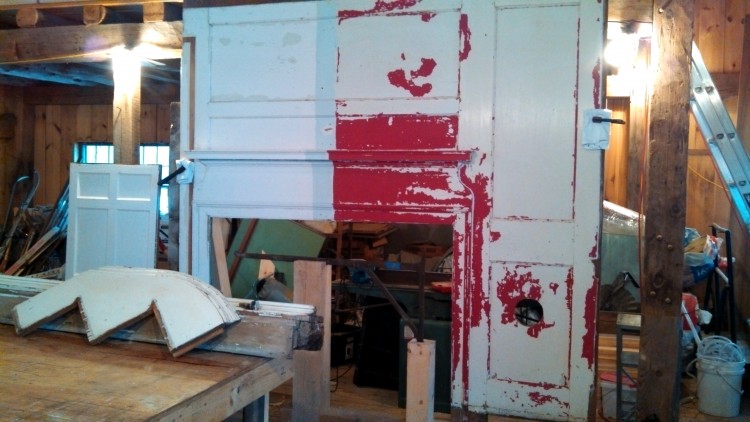
Less-Pink Parlor Surround, all cleaned up for the NHPA EXPO
This weekend, we’ll be sharing a few choice parts and pieces of the Israel Demeritt-O’Kane house with visitors to the NHPA Expo. We’ll be at the Radisson in Manchester, NH soaking up good talks ranging from “Old Home/New Technology: Explore Solar Energy for your Home!” to “The Masonry Detective: Exploring Chimneys, Bake Ovens and Fireplaces” (there’s a surprising amount of exploration in preservation). We are especially excited to be giving a talk on Sunday, at 1:00p; “Comprehensive Assessment of Your Barn and Home, Case Study: the Demeritt-O’Kane House.” We’ll be talking a little about assessments in general, and a lot about the specifics of the Demeritt-O’Kane house. If our series of journal entries about the complete dismantling of this Federal-era farmhouse piqued your interest, you won’t want to miss the talk. Our booth will showcase a few pieces of the house, including the fireplace surround from the “Pink Room.” We’ll be inviting folks to inspect examples of various intricate molding profiles, and see if they can identify the Asher Benjamin pattern from which they came. Hope to see you there.
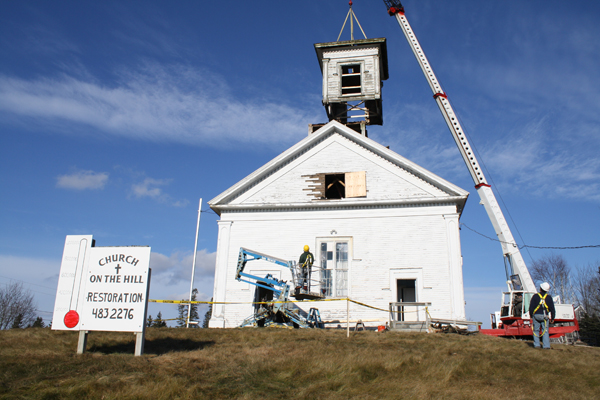
Church on the Hill – photo credit Maine Steeples Project
The Maine Steeples Project provides crucial support to the communities that are preserving Maine’s most iconic structures. A collaborative effort of Maine Preservation, the Maine Community Foundation, and a donor-advised fund, the foundation matches community-raised funds and provides professional guidance. From their newly-updated website:
The Maine Steeples Project supports local efforts to assess and restore church steeples of historic, cultural, and community significance to cities and towns in Maine. The program seeks to match local resources devoted to restoring steeples. Its priority is to support efforts to restore existing steeples, but reconstruction requests may be considered in unique circumstances.
For those interested in preserving a steeple in their community (or steeple-enthusiasts in general), we encourage you to visit their fresh website with information about the program, and eligibility requirements.
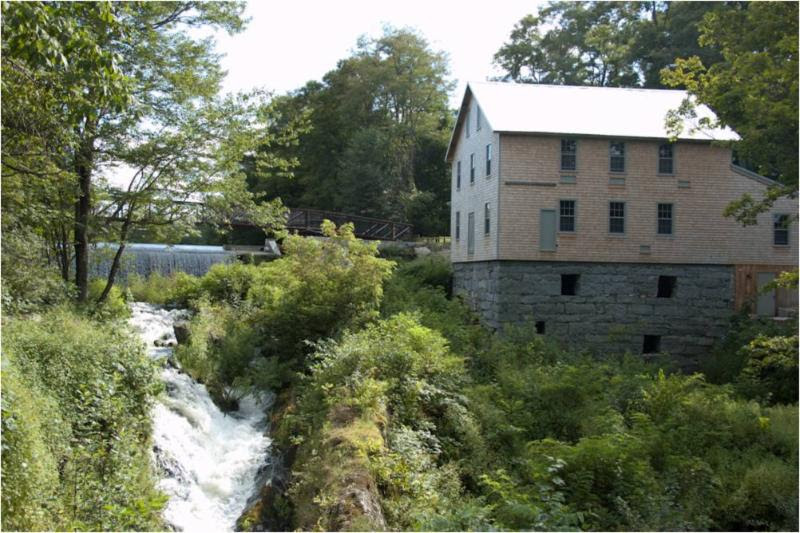
When Tony Grassi takes a crazy gamble to rehab an abandoned mill, he inspires both skepticism and hope that its revived bond with the river will breathe new life into the town of Freedom, Maine.
With the help of a colorful team of builders, masons, engineers and architects, he sets out to reconstruct a forgotten historic treasure. Can his 21st century vision of preservation re-power this rural community, which is now welcoming a new generation of young farmers?
Watch “Reviving the Freedom Mill” on your local MPBN station on Thursday evening, March 6, at 10:15 pm. This was one of PTF’s biggest and most inspiring projects in the past few years. A significant portion of the crew devoted their time and energy to the project, staying in Freedom, away from their families, during the months spent on the project. We were honored that the project was a recipient of the 2013 Maine Preservation Honor Award and are especially thrilled that the crew’s efforts were captured in such an engaging documentary.
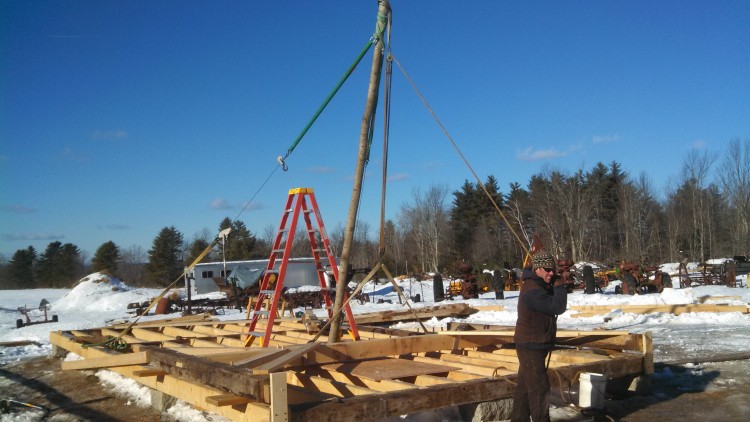
Here’s one to please our 11-year-old selves, and the folks over at Low-Tech Magazine: we raised the Carpenter’s Shop using a gin pole. This is a simple and traditional method for raising a timber frame by hand, and straightforward solution to a site with little crane access. It’s constructed from a long, straight pole with a block and tackle hanging from the top, and two guy lines (in our case, come-alongs) that help to counter the weight of the pole and the timbers, and locate the posts in their mortises.
This is an eave assembled on the deck. A bent assembly isn’t pictured, but looks similar, rotated 90 degrees
After test-fitting the eaves, we assembled the first bent (like a bread slice of the timber frame, parallel with the gable) flat on the deck so that the post tenons were hanging over their corresponding mortises – so that, when rotated to vertical, the tenons would “tip” into their holes. The pieces of the bent were fit together so that the tie beam was placed towards the center of the deck and all the exterior reference faces were facing up. The bent was fit, measured, bound, remeasured, and then pinned and wedged. Each bent has two ascending and two descending braces, creating an especially stable and sturdy frame. What original wedges couldn’t be reused were cut from seasoned white oak. It was satisfying to knock the wedges in tight, locking the half dovetail tenon at the end of the tie beam to the sloped shoulder of the post’s complimentary mortise. Ah, wedged half dovetails. We screwed stop blocks to the corners of the sill so that the post feet couldn’t slip off the deck as the bent was raised. We also screwed two 2x8x16′ pieces of KD to the exterior face of posts, at the top of the post, so that they could be used as kickstands once the bent was nearly vertical. That completed the first bent assembly.
Lee cut a maple sapling that was at least 18′ long, which is half again as tall as our posts (we realized through trial and error that this could have even been a little longer, but you could realize that sooner using a physics textbook). He attached a block and tackle to the top end of the sapling (again, if one was so inclined, we could calculate the exact number of pulleys needed to create the mechanical advantage to pull the bent up using human-power, but we had a tractor, so we used the block and tackle that Lee had). Directly beneath the block and tackle connection, we attached two 24′ come-alongs. That completed the gin pole assembly.
Gin Pole in Tension
We screwed a U-shaped block to the deck at the foot of the gin pole, near the center of the frame, to keep the foot from slipping out of place. The opposite ends of the come-longs were secured to the rear corners of the deck, so that the gin pole come-alongs and block and tackle created a peace sign on the deck (a peace sign without a circle, and with two extra long come-along legs). Scott and I lifted the gin-pole into a nearly vertical position, while Lee loped back and forth, tightening the come-alongs as we raised the pole. Working the come-alongs allowed Lee to center the top of the pole precisely over the bent. When the pole was leaning forward so that the block and tackle hung directly over the center of the tie beam, Scott pulled down tight on the block and tackle, connected the hook at its base to the center of the tie beam, and pulled down on the free end of the rope (pictured above). This created a stable triangle of opposing forces (block and tackle, come-along and come-along), securing the gin pole in place about 10 degrees from vertical. This completed the raising of the gin pole.
Scott pulled down on the raising rope, and, nothing happened. If we had not had the tractor at our disposal, we would have needed a block and tackle with more pulleys, and a rope with less stretch. As it was, we hooked that sucker up to a tractor, corrupting the purity of a hand-raising. For shame! Anyways. We attached the rope to the front of the tractor as high and as close to the top of the gin pole as feasible. I reversed the tractor and lowered the arm with all the grace of Kevin Bacon in Footloose as Scott monitored the post feet and Lee let out the cable on the come-alongs, incrementally.
First Bent, raised
Once the bent was lifted past 45 degrees, I set the brake, re-tied my shoelaces, and Scott and I used the 16′ pieces of KD attached to the tops of the posts to lift the bent to vertical, and seat the tenons in their mortises. We screwed the KD kickstands into the eave sills, and stopped to admire our work. With the kickstands in place, we were able to plumb the bent precisely. When we satisfied with the bent’s location, we moved the gin pole, and prepared to raise the second bent.
Lee in Tee at 10 degrees
The gin pole was not the only low tech technology employed at the Carpenter’s shop. Lee used an adze to cut the tenons of the first floor joists, allowing him to work in a tee shirt in single digit temperatures. After the bents were raised, we used a water level to level them. On sunny sites, it’s sometimes easier to use a water level than a laser. If you want to know more about either of these methods, please let me know.
New blue water level hung at reference corner
Sometimes the oldest technologies provide the best solution for the job at hand. From wedges and ramps to pulleys, I am surprised at how right my physics teachers were about the ubiquity of simple machines. When applied purposefully, with careful consideration, these approaches can be safer, simpler and cheaper. While I appreciate the romance associated with historic contraptions, ultimately, romance is not the reason we employ them. These technologies are selected when they are the most functional option for the job at hand. We were just lucky to have some fun with them up in Poland.
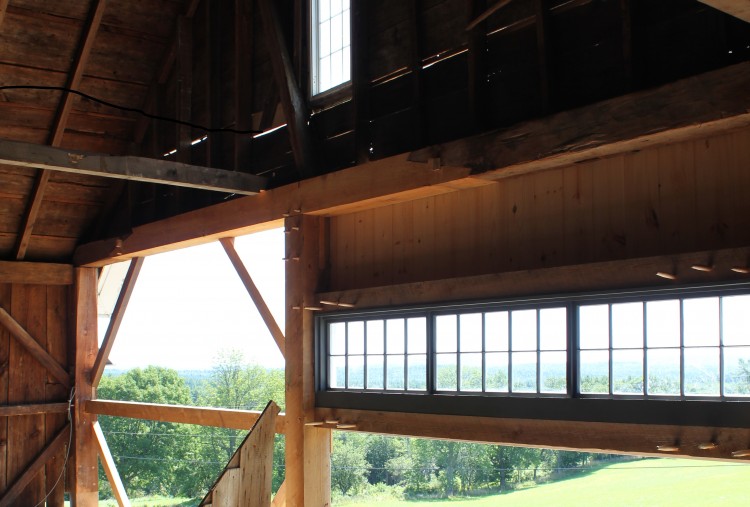
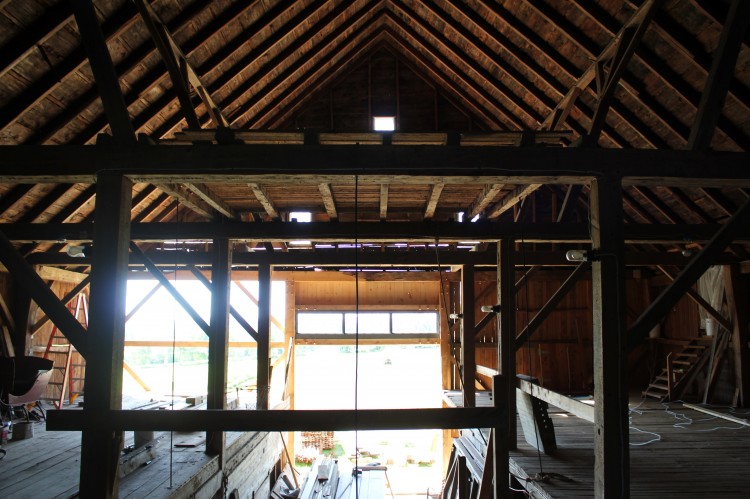
True-Randall Farm Barn, roof system from rear loft
Tie Beams are the defining component of a timber frame. They tie a barn together better than The Dude’s rug ever could. A tie beam crosses the gable at or below the plate (eave) level, and prevents the eave walls from spreading under the outward pressure of the rafters. Tie beams, more than any other element, identify the style of timber frame, be it English-tie, drop-tie, or interrupted. While a tie beam alone can’t date a building, these designs are associated with particular time periods; the English tie with the 18th and early-19th century, and the drop-tie with the 19th century (in Maine). I’ve written elsewhere about these impressive framing members, and the relative pros and cons to their design (Historic American Timber Joinery, by Jack Sobon, and made available by the Timber Framers Guild, is a fascinating and exhaustive source of joinery information). Below, I’m going to describe what goes into repairing one, in a standing building.
The owners of True-Randall Farm have a strong preservation ethic, combined with a desire to have their property serve their contemporary needs. They walked a fine line throughout the project, preserving every original, functional framing member, while installing a clean, contemporary kitchen in a long re-muddled connecting ell (preserving any remaining original framing even here, even though invisible). The house and barn on either side retain their original design and artifacts, as well as transitioning beautifully into a functional modern kitchen. The barn is visible through a sliding glass wall in the kitchen, where the expansive timber frame and associated repairs can be admired during meals.
Scott and Lee, laying out fixes
The repairs to the barn were extensive. We replaced sills, foundation and drainage, and shored up the undercarriage. Two posts were replaced, along with their adjacent loft girts. Unfortunately, pernicious rot in the tie beam was invisible until exterior sheathing was removed to replace one of the drive posts. One of the advantages to timber frames is that a beam can rot extensively before losing functionality, or before the damage becomes visible. This is also one of the disadvantages.
The True-Randall barn has endured a history of alteration and adaptive reuse long before PTF or the current owners arrived. According to the history researched and written by owners George and Karin Look:
In 1889 the barn was moved to its current position and connected to the house by an ell. Local history indicates that it was rolled across the road using oxen and logs and that a small American Elm run over during the move stood back up and grew into a giant tree in front of the barn. The roof was removed before the move and roof elements, including the purlins, were used in building the deck for the barn, which was converted into a bank barn. At the time of the move an original eave wall was moved to the east 6 feet to increase the size of the milking parlor to accommodate the new, larger breeds of dairy cows that were becoming popular at the time. Also, the new roof was built with higher pitch to allow for storage of more hay. The barn was in use in a dairy operation until the 1970s.
Series of c.1899 stop-splayed, undersquinted and wedged tie beam extension scarf
In order to extend the barn 6′ east, a scarf joint was cut into the east end of each of the tie beams. As its name suggests, a tie beam functions in tension and any scarf along its length must equally resist those forces as any link in a chain. PTF’s commonly used halved-and-bladed scarf joint (p. 47, Sobon) is a great joint, but wouldn’t necessarily be effective here. The barn-wrights in 1889 used a stop-splayed, undersquinted and wedged scarf joint (p. 49, Sobon) to extend the tie beams by six feet and accommodate a new milking parlor. The two inch wedges in this scarf push the two halves of the joint together, countering the outward thrust of the rafters. This wedged key resists that force better than the shear strength of one inch pins (as would be used in other scarves). Additionally, the wedges can be driven into the key with seasonal and yearly wood shrinkage. This adaptive quality of wedges is employed elsewhere in timber-framing, such as the wedged-half-dovetail joint used at the ends of the Carpenter shop’s drop-ties, and in the wedged-half dovetail at the bottom of the king post in the Abyssinian Meetinghouse. The beauty of the wedge in a king post truss is that, being oriented vertically, the wedge drops deeper into the joint as the wood shrinks, automatically tightening the joint, like a glacially-paced Rube Goldberg contraption.
Lee, Chuck and Scott strategizing on staging
The front gable tie beam was badly rotten due to water infiltration. Located at the top of Randall’s hill, the front of this barn endures an inordinate amount of wind-driven rain, indicating the window directly above as the most likely culprit. The 18′ section of punky, rotten wood extended from the center of the drive to within 8′ of the rafter-tie-plate connection. We were fortunate that the rot didn’t extend to the English tying joint at the eave, as the repair would have required more complicated rigging and joint-cutting.
One scarf half, on the existing tie beam
As it was, we built 3 levels of structural, wedge-lock staging across the plane of the front gable, extending from 7′ of lawn adjacent the gable into 7′ of the first bay of the barn. By crossing the upper ledgers of the staging with heavy, 8×8 rigging timbers, we were able to pick up the tie at two points, directly outside of the rot. The studs above were stabilized with a 2×10 hemlock ledger screwed across their faces. After the rigging securely supported the tie beam and framing above it, we carefully began to excise the rot. When we reached sound wood, we laid out half of a stop-splayed, under-squinted and wedged scarf on each of the two remaining ends of the tie beam. On the ground, we cut the analogous scarf halves on a piece of 9″ x 9″ x 18′ Eastern White Pine (we are currently avoiding the use of hemlock due to the preponderance of white mold).
Tie fix rising
We used a 1-ton chainfall, mallets and muscle to lift the repair into place and engage both scarves. The two hydraulic jacks allowed us to adjust the height either end of the existing tie beam separately, allowing us to dial into each scarf connection relatively independently. When each scarf was snugly fit, opposing wedges were driven in from each side, driving the halves of the scarf together and locking the repair in place.
Stop-splayed undersquinted wedged scarf repair, c. 2013
Repairs of this level require extensive stripping of sheathing and clapboards. In the case of this barn, the clapboards badly needed replacement anyways. Some had been replaced ten or so years prior, with low-quality claps; others had been “repaired” with a spray of drywall screws. Inevitably, the replacement of sheathing, clapboards and trim takes as much, if not more, time than the timber frame repair itself.
Completed tie beam repair
While the condition of this tie beam was an unfortunate surprise, we were happy to be able to amend the damage with a traditional repair that blended seamlessly with the history of the barn, and its previous alterations. I can only hope that next month, the full replacement of a tie beam in a two-story Greek Revival in Brunswick goes as smoothly.
I think most people on the crew have come across a frame that made them stop, and think, “Man, that’s the frame I’d build for myself.” I think I’ve found mine. It’s one of what will be three barns on a piece of property in Poland, ME – a horse barn, dairy barn and carpenter’s shop. We dismantled the horse barn over a year ago, on another property in West Poland; we’ll rebuild it next, and it’ll become a home for the client’s draft horses. The dairy barn is stabilized currently, and will need a complete undercarriage repair at a later phase. The dairy has some of the finest trim details I’ve seen on a barn yet, but it’s the carpenter’s shop that I love. It is a re-used frame, 17 x 30, with a drop tie, and purlin roof.
Dairy Barn, ain’t she precious?
To a lot of folks, the English tying joint is the pinnacle of tying joints, but the drop tie in this shop is pretty charming to me. In any barn, the tie beam is the timber located at or near the top of the posts, parallel to the gable; it prevents the eave walls from spreading under outward thrust of the rafters. In an English tie, the tie beam crosses over the tops of the eave plate and posts; it is connected to the plate by a half dovetail joint (on the flat), and to the top of the post by a teasel tenon.
Corner post removed, Scott leaning on loft girt, end of tie beam exposed
A drop tie beam is an early 19th century development, in which the tie beam is dropped below the plate by 2-5 feet and joined to the posts, directly. A collar tie is necessary to help prevent rafter spread, and the height of that collar tie is integral to it’s function.
Exterior of post, showing wide end of half dovetail and end of wedge on top
In this shop, the drop tie is connected to the posts with a wedged half dovetail. An extended mortise is cut into the post, with a sloped bottom. The tenon on the tie beam is cut with a half dovetail (on edge), which drops over the sloped face at the bottom of the post mortise. After the tie beam is inserted into the post, a wedge is driven through the top of the mortise, above the tie beam, to help lock the joinery into place. A major difference between these two tying joints is how it affects the raising of the barn; an English tie would require an eave raising, and a drop tie requires a bent raising.
Scott safely stripping
The benefit of a drop tie is that is provides higher head room in the attic story. In this shop, I thought the proportion of the room created at the attic level will be perfect for the client’s bench tools and hand work. The first floor will be used for machine work – the client plans to use the shop to restore antique sleighs. Both floors have enough headroom to spin things around and enough length to rip something as long as you’d like. It’s small enough to heat easily, and I especially like the way the light comes through the windows at the floor of the loft level.
Scott a-prying
Anyways, the carpenter’s shop was attached to the dairy, and was propping up its rear end. We dismantled the shop fully, both to repair it, and to move it away from the Dairy barn, which worked better for the site, and allows one to appreciate the beauty of the dairy more fully. It was a big help to have the client’s tractors on site.
Cutting in the snow is much better than cutting in the rain
Scott and Lee cut the replacement sill and post timbers quickly, and in the snow, too. They left for me the tie beams with the half dovetails that I love so. Lee followed his post work by cutting eighteen oak braces. The down braces at the loft level are part of what makes this drop-tie frame so durable.
Check out those down bracesOak replacement braces
Last week, we used our 8th grade geometry skills to lay out the frost posts. With the help of an enormous excavator, and a little mason’s line, it was a breeze to lay out the posts to the dimension of the shop’s footprint, but we needed to use the Pythagorean theorem to figure out what our diagonals should be, and make sure that the frost posts were laid at right corners to one another. It is a great joy of my job to get to use the theorems I learned in geometry class.
Scott, plunges cog mortises into a floor girt with the chain- mortiser
Next week, we’ll be topping the frost piers with granite capstones, and laying and fitting the sills over the granite. Lee has his adze sharpened, and we’ll be using it to cut the first floor joists. We’ll cut the joists to length and drop them upside-down into their associated cog-mortises in the tops of the sills and floor girts. Sitting in the cog upside-down, the rough floor joist will be 4-5 inches proud of the surface of the floor girts. We’ll then use an adze to cut an angled shoulder in line with the inside edge of the floor girt and to cut a tenon on the end of the joist that is perfectly level with the top of the sills. After the tenon is smooth, we’ll turn the joists over, and they’ll create a perfectly leveled floor.
Scott and Lee surveying the site, that’s the barn frame stacked in the piles in the foreground
We hope to raise the Carpenter’s shop frame in time for Christmas, and then our client can start sheathing it over the Holidays. I hope he thinks it’s an awesome present, because I would.
Maine Preservation held their annual honor awards ceremony last Thursday, to “recognize owners, developers, professionals and leaders responsible for transformative historic preservation efforts throughout the state.” We were proud to be part of the team honored for the restoration of The Mill at Freedom Falls. Read the full list of honorees, here.
Chris Glass, Tony Grassi, Carmen Bombeke, Jay Fischer and Arron Sturgis accept a Maine Preservation Honor Award
This project was a true collaboration between client, architect, architectural historian, general contractor and ourselves, the traditional timber framers. There are so many folks who should be proud of their participation, who gave their time, energy, intelligence and passion to completing a very challenging project. Thank you Ed Bell, Reese Crotteau, Shawn Perry, Lee Hoagland, Chuck Michalek, Tom Glynn, Scott Lewis, Jesse Turgeon and Rod Bishop. Read more about the finished project, here.
Nov. 15, 2013 – When I tell people what I do, I sometimes run into the misconception that preservationists are single-minded, inflexible, and uninterested in innovation and design. It’s true that at Preservation Timber Framing we think that if a frame stands strong for 200 years, it probably has good design to thank, and that time-tested building details last longer. We also think it’s possible to combine contemporary design with the stewardship of a historic property, and achieve successful results. True-Randall Farm was just such an example. The connected farmstead required repairs to house, barn and ell. The clients have a strong preservation ethic and want to preserve the original framing members but they also wanted a functional kitchen with clean, modern lines. The ell had been extensively renovated by previous owners, and the clients decided to dedicate that portion of the house to the new kitchen. They preserved any original framing within the ell (and without) that remained.
Even working within a strict preservation ethos requires adaptability. The house and barn at Randall’s Hill retained most of their original elements and were repaired traditionally, with in-kind materials. Both house and barn had rotten corner posts, but the repairs to each post were entirely different in scope and in design.
Barn corner post removed, from interior
The barn repair was a more typical, and traditional, fix. It was also more extensive, because the rot extended above the girt that supports the right loft bay, and the frame was more accessible to repair. In order to get access to the post, we stripped the corner of trim, clapboards and sheathing. We affixed an L-shaped bracket, custom-made for lifting, to the exterior of the post, and built a cribbing pile beneath and just to the outside of it. Beneath the bracket and on top of the cribbing pile, we inserted a dead man (temporary post) and hydraulic jack, which would be used to level the corner, and support the weight of the post and roof above it (See first photo, above). We also inserted a deadman beneath the loft girts to pick up the weight of the loft (See “Barn corner post removed…,” center of photo).
Corner post, with center mortise repair
Lee carefully cut away the post where it was rotted, and removed the braces. With a circular saw, auger bit and timber framing chisel, he cut the female half of a center tenon scarf joint onto the part of the post that remained. We used a center-tenon scarf on this post to preserve both the reference (outside) face of the post and the inside face that was most visible. The fix was also oriented to resist any outward thrust that was transferred from the rafters.
Lee and his corner fixes, (the center tenon post repair is on the bottom, a repaired nailer is on the top)
Lee cut the second half of the post out of a large 10 x 10 timber, the same dimension and species of the piece that was removed. In order to fit the post fix into place, we used a free tenon at the bottom of the post fix (see diagram, below).
Installation of a free tenon
Lee cut an extended mortise into the front gable sill and a long open slot on the adjacent face of the post fix. After the post fix was installed, and the center tenon scarf was fit and pinned, a free tenon was inserted vertically into the extended mortise in the sill and slid into the slot in the post. The remaining mortise space in the sill was plugged with a wedge, and the free tenon was pinned into the post.
Barn front gable, rebuilt in place
After the post was fixed, I replaced the loft girt in the front gable, and neighboring braces, door post, and nailer. Unfortunately, this barn typified the worst case scenario involving hidden rot. Working in preservation we face a harsh reality in which, sometimes, significant rot can be completely hidden, and once rot is uncovered, it can’t be re-sheathed until repaired.
Open house
We also performed a post repair on the Federal-style house and, in contrast with the barn, we could disturb none of the interior surfaces. In this way, the repair was similar to the timber frame repair at the Marrett House in Standish, where the framing had become detached from the plaster and lath, but the plaster and lath still needed to be preserved, with early 19th century wallpaper left intact.
House corner post repair, installed.
The post requiring repair was located at the front-right corner of the house. We first noticed that the front eave and right gable sills were punky. The rot in this post did not extend upwards past the second floor girts, or inward throughout the post thickness, except at the very bottom. This fortuitous turn of events allowed us to repair the post with a three-stepped lap joint – cutting away the exterior surface of the post to the depth of the rot, and using epoxy and fasteners to install a new-in-kind repair that fills the negative space left by the rot. Relative to the post repair in the barn, this was a non-traditional fix, utilizing modern epoxy and fastener technology. It was the appropriate fix for the level of rot and its context.
House corner, post repair.
The contrast between these two methods of post foot repair, and the combination of traditional repair and contemporary use in the ell, shows that the best preservation is adaptable. Our process is developed from traditional methods, but it isn’t staid or prescriptive. Part of the reason we document the multitude of barns we come across is that they provide us with a greater variety of long-lasting approaches to repair. We’re always eager to learn a design solution that is new to us, it’s just that the best solutions we’ve found have been proven over 200 years.
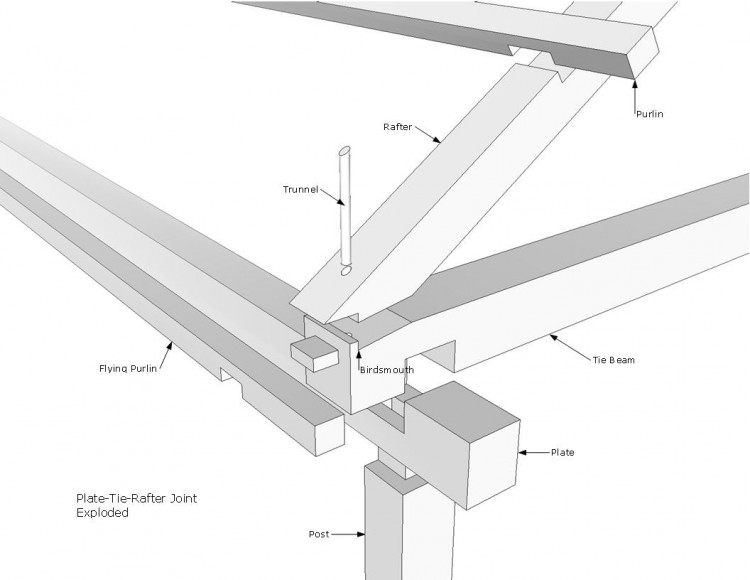
Last week, Arron and I saw a neat roof framing detail at a Greek Revival home in Brunswick. The rafter was joined to the tie beam with a birdsmouth and pinned with a trunnel, the tie overlapped the plate and supported a flying purlin, and the plate ran past the gable end post to create the overhang for the return.
Roof frame detail at return
There were areas that were badly deteriorated by critters and leaks, but the tie-plate joints were as tight as the day they were assembled. The relish at the ends of the tie beams, after the birdsmouth, were all still intact, probably due to the work of the trunnel, pinning the rafter foot in place. This was the first time I’d seen this particular joinery in a roof assembly; it’s always nice to see how well timber frame joinery withstands the pressures of weather and time.
PTF began work on the undercarriage of the True-Randall barn in November 2012, and recently completed a comprehensive timber frame repair of the house, barn and ell. George and Karin Look, owners and custodians of the True-Randall Farmstead, researched the history of their property extensively and are deeply committed to ensuring its preservation. The following account is a summary of their findings, which they’ve graciously allowed me to publish here.
True-Randall Barn, from below
True-Randall Farm: A Quintessential Maine Connected Farmstead
In 1813 Deacon Ezekiel True’s twin sons, Moses and Paul, built him a “house on the hill” above his mills on the St. Georges River, in what is now South Montville, Maine. A barn, which has the same timber frame construction as the house, was built for the farm across the road in 1814. Its largest timbers, primarily second growth hemlock, were hand hewn, most likely on the farm. They include 60 foot long continuous timbers for the plates. The farm passed by marriage from the True to the Randall family in the mid 1830s and remained in that family until 1984.
Barn bent framing, from loft
In 1889 the barn was moved to its current position and connected to the house by an ell. Local history indicates that it was rolled across the road using oxen and logs and that a small American Elm run over during the move stood back up and grew into a giant tree in front of the barn. The roof was removed before the move and roof elements, including the purlins, were used in building the deck for the barn, which was converted into a bank barn. At the time of the move an original eve wall was moved to the east 6 feet to increase the size of the milking parlor to accommodate the new, larger breeds of dairy cows that were becoming popular at the time. Also, the new roof was built with higher pitch to allow for storage of more hay. The barn was in use in a dairy operation until the 1970s.
Another of Deacon True’s sons, John, built the Mill at Freedom Falls (Maine), in 1834. PTF was intimately involved in the restoration of that Mill in 2012.
-George and Karin Look
Read our first post about True-Randall farm, about leveling the barn, here. In upcoming blog posts, we will describe our process for repairing the timber posts in house and barn, and in-place tie beam repair.