Tag: East Derry First Parish

  • The Sleet Hits the Fan

    The Sleet Hits the Fan

    Finished Fan. Photo by Brian Cox
    Finished Fan. Photo by Brian Cox

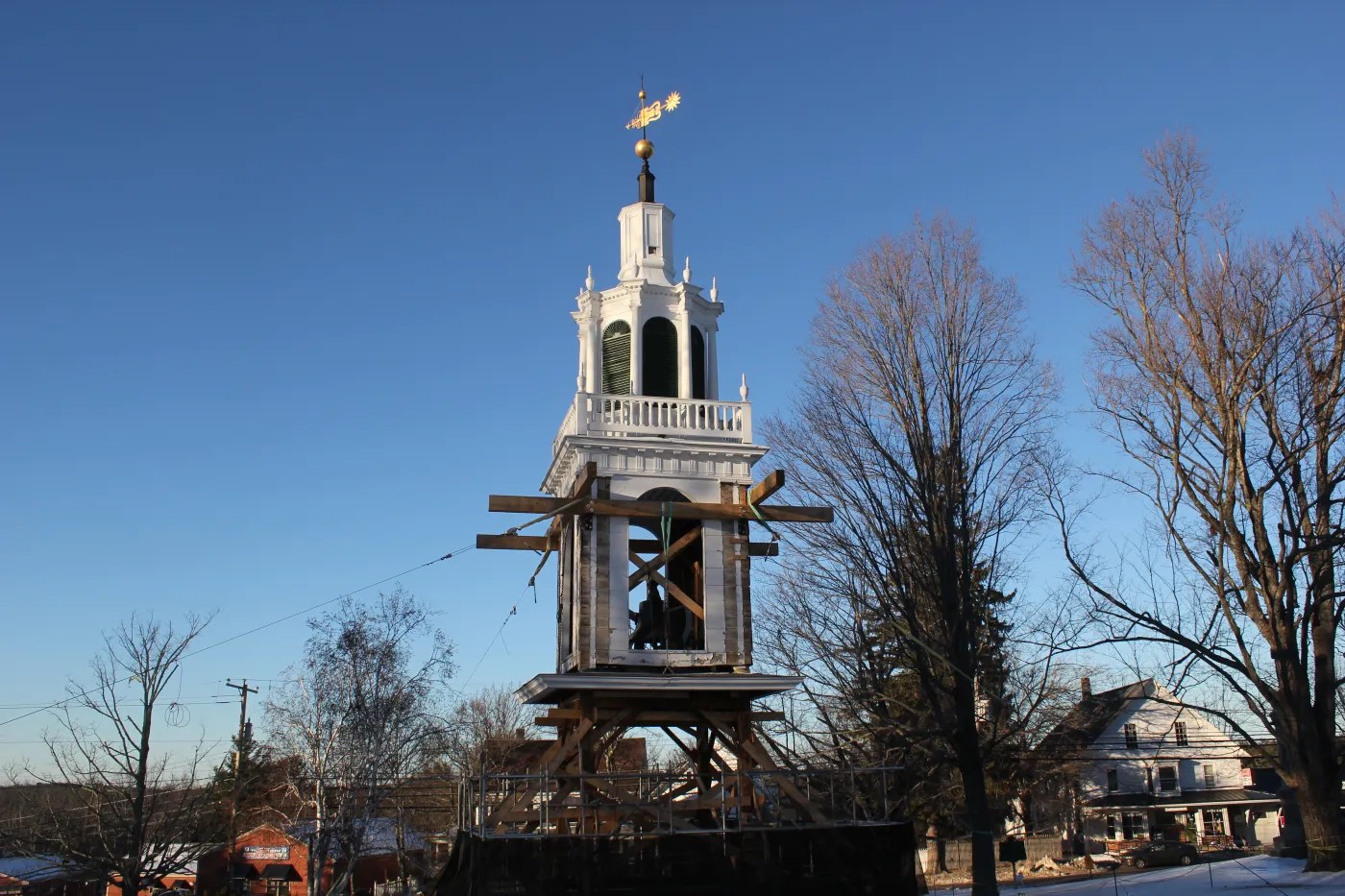
    On Friday, East Derry First Parish Church will be hosting a celebration in honor of the 300th anniversary of Nutfield, a Scotch-Irish settlement that was the precursor to today’s Derry, Londonderry, and Manchester, NH. The crew at East Derry has been hustling to finish the belfry in preparation for the event. For a bunch of timber framers, they’ve been doing an awful lot of finish work. A more accurate name for Preservation Timber Framing would include an “and”, but the name’s long enough already.

    Belfry Trim, Labeled
    Belfry Trim, Labeled. Photo and labelling by Brian Cox

    The crew was able to preserve some of the ample belfry and lantern trim, including the eight turned columns on the upper lantern. What they couldn’t restore, they reproduced. Every week, Brian creates a photo report to keep the building committee up to date, breaking this behemoth phase into bite-size pieces. It also serves as a documentary record of repair and this basis of this blog post. Between the mutules and the guttae (the swiss cheese and the sawtooths), I’ve been inspired by both the mass production and the attention to detail.

    Tom fastening slats. Photo by Brian Cox
    Tom fastening slats. Photo by Brian Cox

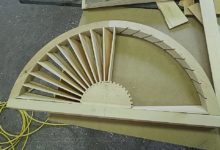
    In between enormous timbers and acres of primed trim, Tom has been quietly reproducing four of the arched fans at the top of the lower lantern louvers. In carpentry, fans are kind of a thing. Their arched tops require a choice between multiple joints, or extensive short grain. In the photo above, you can see that the curve of the arched top was cut out of two wide pine boards, their long grain oriented 45 degrees to the bottom rail. The fan’s slats are precisely twisted. This delicate assembly is then mounted to the side of the lantern and exposed to strafing wind, sun, rain and snow at the top of a hundred foot tower.

    Original Fan and MDF Template. Template by Tom Glynn, Photo by Brian Cox
    Original Fan and MDF Template. Template by Tom Glynn, Photo by Brian Cox

    Four of the fans were in good shape, and required “cosmetic” repairs, glueing and re-fastening. Four needed to be replaced completely. Tom started by transferring the measurements from one of the original fans to a sheet of MDF, creating a full size drawing. He used this template to begin cutting pieces from 2″ thick Eastern White Pine.

    Fan core, with blade angles laid out. Photo by Brian Cox
    Fan core, with blade angles laid out. Photo by Brian Cox

    Tom cut templates from luan on the bandsaw, and traced them out on the pine. He used the bandsaw to cut out his pieces and then laid out the dadoes carefully in pencil, copying the angles from the original fan. He used a dovetail saw and 1/4″ chisel to clean out each groove.

    Those dadoes are cut! Handiwork by Tom Glynn. Photo by Brian Cox
    Those dadoes are cut! Handiwork by Tom Glynn. Photo by Brian Cox

    Each fan blade is 3/16″ thick and was gently twisted as it was installed in its frame. The twist is created and held by the angled dadoes. The angle on the half round core is different than the exterior arch. At the core, the blade is more perpendicular to the face of the fan, which allows all the blades to fit, and gives the appearance that the rays are opening up like a sunburst.

    Fan blades. Photo by Brian Cox
    Fan blades. Photo by Brian Cox

    Fortunately, Tom was able to copy the angles from the original fan blades, rather than calculate the angles from scratch. A lot of folks think it’s easiest to scrap the old and start anew. On a piece like this, we were grateful to retain the knowledge of the old-timers from the evidence left in the original pieces.

    Half-finished. Photo by Brian Cox
    Half-finished. Photo by Brian Cox

    Once the fans were finished, they were primed with two coats of California alkyd primer and two more coats of California latex paint. Commonly, fans are decorative, which means that they were not always used for ventilation, and were applied over solid sheathing as was the case here.

    Fan fit with arched trim. Photo by Brian Cox
    Fan fit with arched trim. Photo by Brian Cox

    Still, each exterior element needs to shed water to protect the elements behind it. Each fan was fit with arched trim. The flush board trim projects 2″, while the frame and blades of the fan are only 1 3/4″ in thickness. This will protect the fan from wind driven rain running down the face of the flush board siding. Each vertical joint is backed with a spacer batten to prevent water from getting between the boards and penetrating into the frame.

    Louvers, Columns and Fans, installed. Photo by Brian Cox
    Louvers, Columns and Fans, installed. Photo by Brian Cox

    With every detail in this tower, the crew considered the path of rain water. We use tight fitting joints and carefully considered flashing details to keep water out, rather than caulking. Caulk is an important tool to stabilize deterioration and prevent further rot. Ultimately, though, it is a band-aid, which is promised to last 20 years, and starts to shrink and fail in the first season. This is why PTF goes beyond the frame and performs finish work. We work on buildings that have commonly withstood 200 years, and we want our repairs to last 200 more. When the bottom of the structure begins 60 feet from the ground, we know that the caulking won’t be re-applied every five years, and the building will be lucky if it gets repainted every twenty. Protecting the frame starts with the finish, and our trim is not only beautiful, it is functional.

    We love to share our work in person. We hope to see you at the Nutfield celebration this weekend! 
  • First Parish Church, East Derry: A Whole Host of Hollow Posts

    First Parish Church, East Derry: A Whole Host of Hollow Posts

    Lower lantern, outside
    Lower lantern, outside. Photo by author

    At East Derry, we knew the lantern was in bad shape, but we couldn’t know the full extent until we had it on the ground. Brian Cox was the job lead. He says, “The will of the church was holding that thing together, many layers of lead paint, and band-aid flashing details.” It was chilling to observe the extent of the damage, and know the structure was in this condition when it was still 80′ above the congregation.

    Lower lantern, inside
    Lower lantern, inside. Photo by author

    Once the frame was exposed, we documented and measured every piece. The design is both complex and well-balanced. Each post is connected to its opposite with an upper and lower girt, and a plate across the top. The eight posts hold hands like four couples in a square danceDavid Ewing produced cut drawings for each unique timber. To orient the crew, he provided a key alongside each drawing, highlighting the timber’s location within the frame. This helped the crew organize all the pieces, and to double-check their layout. The color-coded cut key is an innovation we’ll continue to use on all future drawing sets.

    Lantern Posts
    Lantern Posts C1 & B4. Drawing by David Ewing

    The lantern posts are five-sided; when the building is trimmed out, a turned column will adorn each point of the octagon. Four parallel bed timbers cross the belfry plates and support the eight posts. The bed timbers are crossed by a fifth perpendicular timber, which bears the foot of the mast. The plate level is co-planar and arranged like a hashtag. Two full length plates run parallel to the beds, and two interrupted plates run counter to them. The timber hashtag is connected by hefty mortise and tenon joinery.

    Lower Lantern, before. Photo by Arron Sturgis
    Lower Lantern, before. Photo by Arron Sturgis

    The lower lantern frame was test fit in our yard in Nottingham, NH. The assembly was smooth and painless thanks to thorough drawings, accurate cutting, and the lull. The doubled, overlapping girts make for a stout frame, capable of enduring high wind-loads at the top of the tower. In dimension, this lantern frame is similar to the one we built to support the Camden spire last year, but the design is very different. Camden was reinforced by an array of braces and had stacked, overlapping plates. The bed timbers there were a stacked hashtag, while the ones here are co-planar and parallel. One of the great joys of this job is seeing the ways in which builders solve the problem of constructing a steeple or spire. The vocabulary of design in a barn is much more consistent; I can accurately model a barn from a phone description. Steeples are not that way, every time I crawl through the hatch, I am greeted by a new, intricate design. Part of our mission, and others, is to protect this repository of proven designs.

    Lantern Fitting. Photo by Brian Cox
    Lantern Fitting. Photo by Brian Cox

    Obviously, there were aspects of the building that did not stand the test of time. The flashing between the upper lantern and the sweep roof was the most significant failure, and the extreme height limited the steeple’s overall maintenance. Brian was determined to minimize the plethora of tiny penetrations produced by face fastening. With every steeple restoration, we run into this conflict: it is much easier to mill and assemble trim elements in the comfort of our shop, allowing us the luxury of heat, and finely maintained cabinet tools. It is possible to work at the church, but then we have to contend with weather, job-site tools, commuting and staging. Brian decided to assemble the eight faces of the lantern in removeable panels that could be reapplied on-site.

    Rusty fasteners indicate where water has penetrated the finish. Photo by Brian Cox
    Rusty fasteners indicate where water has penetrated the finish. Photo by Brian Cox

    While the lantern was standing in the yard, the crew fit the sides with horizontal nailers, toe-screwing them to the inside of the frame. They sheathed each face with wide tongue and groove pine, blind-nailing through the tongue. Then they backed out the screws and removed each face as a solid panel. The louvers will be hung on top of the panel – they were never functional – and the panels will be craned in as a unit. This will limit the amount of time the crew has to spend working from a hundred foot staging tower as well as water penetration around the fasteners.

    Flute testing. Photo by Brian Cox
    Flute testing. Photo by Brian Cox

    The frame was decimated, but the most iconic trim details will remain in service. All sixteen urns will be reused, a handful will require new bases. All eight turned columns will be repaired and returned to new, well-flashed pedestals. The louvers and fans will be stripped and re-used, as will the weathervane, and both railings. Cornice trim was painstakingly documented. Sixteen distinct profiles were custom milled by Noah Tremblay and his crew from African Mahogany; the fluted panels and guttae were carved in house.

    Lower lantern and belfry railings. Photo by Brian Cox
    Lower lantern and belfry railings. Photo by Brian Cox

    We’d prefer that these buildings not need our help at all. But given their deteriorated circumstances, we’re grateful we get to do the fix. Next up: scarfing the belfry posts, and joining together the floor, in 12″ x 12″ white oak.


  • First Parish Church, East Derry: Repairing the Upper Lantern

    First Parish Church, East Derry: Repairing the Upper Lantern

    Upper Lantern, before. Photo by author

    The East Derry crew has been hard at work completely rebuilding the belfry, lantern and upper lantern. The framing is complicated, and heavy. Each lantern is a separate, eight-sided tier, connected by a sweeping skirt roof. Below the lanterns, the belfry may only have four sides, but the bell itself is supported on a hip-roof floor made out of woven grid of 12″ x 12″ oak. The entire frame needed to be rebuilt. We used white oak, the same species as the original; it clocks in at about 83 pounds per cubic foot.

    Stacked sweep
    Stacked sweep. Photo by author

    PTF specializes in traditional, in-kind repairs, which means we replicate the original design in the original species. While we believe in preservation, we make our decisions based on evidence. It is hard to argue with a design that has lasted 200 years. The sweep roof between the upper and lower lantern is one exception. Originally built out of stacked 2″ thick dimensional lumber, it certainly wasn’t constructed 200 years ago. The flashing failed, resulting in the catastrophic destruction of the framing below (next week on PTF blog – a whole host of hollow posts).

    Dave applies the original torus trim to the sweep
    Dave applies the original torus trim to the sweep. Photo by Brian Cox

    We carefully documented the sweep’s dimensions and radius, and constructed a new roof using radiused rafters. The resulting roof is precisely the same shape, but lighter, stronger and less susceptible to moisture infiltration. Above, Dave returns the original torus molding to the newly framed roof. It is hard enough getting miter joints to close on a four-sided building, and much harder at eight. The torus joints came together like they were going home, evidence that the crew achieved an exact replica.

    Have you ever seen such gorgeous sheathing?
    Have you ever seen such gorgeous sheathing? Photo by Brian Cox

    The upper lantern was completely assembled at our shop in Nottingham. It will be clad in wide Eastern White Pine, sourced locally, and trimmed in African Mahogany, which was a concession to the species’ superior consistency in milling, and comparable weather resistance. The sides were preassembled in panels and then removed so that the siding can be applied over the copper flashing at the connection with the sweeping roof.

    Wedding topper
    Wedding topper. Photo by Brian Cox

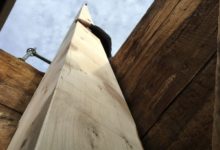
    The lantern is roofed with an octagonal wedding cake, which is penetrated by a mast that extends through the center of the frame and lands on the lower lantern’s bed timbers. The mast was originally scarfed together from three timbers. We reproduced that design, which will ease the assembly process and transport to the copper shop. The original lapped scarf is visible in the photo of the stacked roof.

    Soldering the skirt
    Soldering the skirt. Photo by Brian Cox

    In his report, Arron noted, “The sweeping roof is perhaps the most important roof on the entire tower. It is here that poor roofing allowed water to penetrate into the center of the tower and rot both the upper and lower lantern frames.” At the Heritage Company, in Waterboro, ME, Victor Wright and his crew redesigned the flashing details to ensure that they will be impervious to weather.

    Up next week: the consequences of poor flashing, and reproducing the lower lantern frame.

  • Inserting an Apatosaurus

    Inserting an Apatosaurus

    This blog leaves a lot out. We can’t give our projects their full due here while giving them their full due out there. I’ve been especially remiss with regards to East Derry. The First Parish Project has been in progress since 2012 and includes the replacement of the undercarriage, moving the building onto a new foundation and rebuilding a belfry, lantern and spire. In the video above, we are replacing two continuous 60 foot posts in the standing tower. There was a lot of back and forth about dismantling the tower, but ultimately, we left it up because housed inside are the intricate mechanics of a historic pipe organ. Reassembly of the organ rivaled reassembly of the tower for level of complexity and expense. While we’ve been remiss in coverage of this long hard road, Paul Lindemann, a dedicated leader of the building committee, has been documenting the process on his website: Nutfield History. Paul made this sweet time-lapse video of the posts being inserted. The video may condense the day into just over a minute, but the installation of these posts was the culmination of months of documentation, design, demolition and rigging. In order to stabilize the building, the crew essentially built a skeleton tower inside the existing tower. It was big. The entire crew should be commended for their hard work, determination and fortitude, but especially Brian Cox, Dave Ewing, Dan Boyle, Tom Glynn and Seth.

    It just so happens that the crew is delivering the belfry frame to the church today. Each of the full length belfry rafters are 12″x 12″x 14′ and weigh in at around 1200 lbs. We’ll keep you posted.

  • Good Day, Bad Blog

    Good Day, Bad Blog


    Sub net pier from the top of the Wood Island staging
    Sub net pier from the top of the Wood Island staging

    This blog goes dark when it’s sunniest. Seems like every day this summer has been a good day to be working outside. We’re installing the last repairs to the undercarriage at East Derry First Parish Church, installing electricity for the clock at Hampton Town Clock Tower, waiting for the last of the ceiling to be removed at the Winter St Church in Bath and finally hanging exterior trim at Wood Island. They’re all big jobs, with little updates.

    ext-t1-wall-b-iso-w-church
    East Derry First Parish Church and steeple

    The First Parish Church is the biggest, heaviest building that we’ve ever lifted (thanks to Rick Geddes of Geddes Building Movers). The building was estimated at 188 tons, but actually weighs 288 tons. For the first time in PTF history, we bent a lifting bracket, as well as the shaft on a hydraulic jack (which is why we always use redundant rigging, and shim hard to ground).  “It’s been quite a challenge,” says job lead Brian Cox. A poorly conceived connecting ell was dumping water and moisture onto the historic meetinghouse, resulting in a nearly complete undercarriage replacement. Almost a year ago, we removed the steeple from the building and placed it on the front lawn to await repairs. In the early spring, the building was lifted, a new 4’ basement was excavated and concrete foundation poured. In May, the church was lowered onto its new foundation. Throughout the summer, Brian Cox, Dan Boyle, Seth Richard and Kirk Hennequin have been working diligently to replace any rotten girts and floor joists. Paul Lindemann on the restoration committee has kept a thorough blog to document their process and progress, and the building’s history. Read more here.

    Hampton Town Clock Tower
    Hampton Town Clock Tower

    The small Northern contingent of Lee, Jake, Scott, Seth and Jess built the Hampton Town Clock Tower this Spring and Summer. The standalone clock tower is building-sized display case for Hampton’s historic Howard round top tower clock. The 8-day clock, with dials that read “M E M O R I A L G I F T” instead of numerals, was given to the town in 1897 and ticking in the Odd Fellows Block until the building was destroyed by fire in 1990. The building is a design departure for PTF, as it references the Odd Fellows Tower, but does not replicate it. The four gable roof, topped with a “witch’s hat” spire, and four corner pent roofs was taken from the original building. Below, the body of the building is much simpler than the Odd Fellows tower. The 10’ arched windows reference the original arches, but the elaborate corner trim was eliminated, allowing the historic clockworks to take center stage. The clock will stand on a low lofted floor above the bell, making the clockworks accessible to its civic owners for the first time in history. Phil D’Avanza is completing repairs on the clock, and Skip Heal, of Northeast lantern, donated an enormous reproduction of the original weathervane. Read more about history of this clock, from installation, through destruction, disappearance and ultimate restoration.

    Sagadahoc elevated timber deck, partially erected
    Sagadahoc elevated timber deck, partially erected

    In August 2015, high winds shook loose nearly a third of the coved ceiling at the Winter Street Center in Bath, ME. Enormous swaths of plaster and lath crashed onto the pews, and hung loosely from the trusses. Remediating and repairing the 26’ high ceilings posed a unique challenge. The sanctuary needed to be cleaned of hazardous debris, and the rest of the dangling plaster needed to be removed. Following the removal, Sagadahoc Preservation will need to raise the funds to make necessary truss repairs and ultimately reinstall the ceiling. The process is expected to take years, and a lot of staging. Given the original timber framed floor framing, with large, widely spaced girts and joists, and the time-span of the project, it made more sense to build a timber-framed deck 13’ above the floor, and cantilevered over the balcony. The deck is perfectly flat, and allows EnviroVantage to safely remove the ceiling where it is 6’ above the deck at the eaves, and from rolling baker’s staging at the center of the room. The timber deck even allows Sagadahoc to continue to use and show the sanctuary as they fundraise for the next phase. Jake Imlay wrote a great post describing the building and our approach there. Coming soon.

    Wood Island Life Saving Station boathouse and tower
    Wood Island Life Saving Station boathouse and tower

    The restoration of the Wood Island Life Saving Station, in Kittery Harbor, has had Arron and his salty crew of Tom, Dave, Jake, Tim, Scott, Jess, Gail and Kendall up to their armpits in work. The life saving station was built in 1908 for the U.S. life saving service and became part of the coast guard in 1915. The U.S. Navy used the site to defend Portsmouth Naval Shipyard against U-Boats during World War II. Since the early 1950’s, the life saving station has been unused. Although the island is a popular destination for kayakers launching at Fort Foster, the building fell into dangerous disrepair, with radiators dropping through the floors. The Wood Island Life Saving Station Association applied for National Register status based on the building’s historic significance, and the integrity of the original interior trim and cabinetry. Over the summer, the intrepid crew rebuilt the boathouse, porches and dormers. As ever, sheathing repairs revealed more extensive rot than expected, but we’re finally finished with taking things away, and can focus on rebuilding. This week, we commenced with hanging reproduction trim milled right in our shop in Berwick. I’ve worked in wind like that on one other job-site: Mount Washington. We hope to have the building roofed by the end of September, which will mark the completion of phase one. And we’ve had some good press, from the Portland Press Herald to the Associated Press. Read more here.

    As much as we’ve enjoyed these projects, we’re looking forward to Fall, continuing repairs at the Abyssinian Meetinghouse and Troy Union Church and commencing work at the New Harbor Methodist Church, among others. When it rains, check back for more.

  • East Derry Derring-do

    East Derry Derring-do

    Steeple and Meetinghouse
    Steeple and Meetinghouse

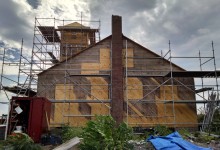
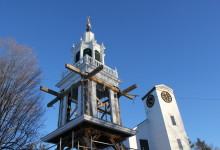
    The First Parish Meetinghouse of East Derry, NH is preparing for a big anniversary, its tricentennial. What does one even get for a church on its 300th? Wood? Copper? Both, as it turns out. Beginning with a thorough assessment and rehabilitation plan in 2011, the congregation has been working steadily to repair extensive damage throughout the steeple and undercarriage. This past fall, we extracted the belfry and lanterns from the steeple stack. After the new year, we documented the upper sections from a woman-lift and dismantled them from finish to frame.

    Lower lantern roof, crowned with urns
    Lower lantern roof, crowned with urns

    As we surgically removed trim, we encountered earlier salvage efforts. Dan and Rod peeled back the gracefully curved roof between the upper and lower lanterns and revealed an oiled sailcloth roofing. The sheathing below was labeled November 1916.

    Lower Lantern Posts
    Lower Lantern Posts

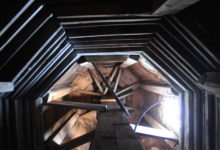
    The frame was in far worse shape than we expected. Years of roof leaks and patchy repairs had finally overtaken the stout timbers. Once the lower lantern posts were exposed, we wondered how the structure was still standing and realized too late the bravery of dismantling it. Above, you can see that the six of the eight posts were hollow or non-existent at the top. An extensive repair campaign in the 1990s consisted of bolting channel steel and L-brackets to the crossing crab members (a “crab” is a horizontal web of timbers that spans the posts of a lower level and support inboard posts above). Looking at this picture, stiffening the crab fell far from the root of the problem.

    Lower lantern crab above belfry ceiling

    The crew struggled to free the timbers from their steel cages only to discover a corpse. It’s tragic that this rot wasn’t addressed when the church raised money for its repair two decades ago. A comprehensive, traditional approach at that time would have prevented the wholesale replacement necessary today.

    Truss spread

    In 1719, Scotch-Irish immigrants, fleeing religious persecution in Northern Ireland, settled the area that became East Derry. In 1722, they built their first meetinghouse on this site. The present structure was built in 1769. By its centennial, in 1822, the congregation had so grown that they cleaved the building in two and dragged one end 24 feet to the east. Above, you can see the first additional bay, indicated by the absent strainer beam and braces.

    East Derry Wall D
    East Derry Wall D

    In our assessment drawing above, the strainers and bracing between the trussses in bents 3 and 4 and bents 5 and 6 are non-typical. The strainers and bracing in bright green are non-existent; that is the bay in the photograph above. The yellow strainers and bracing between bents 5 and 6 do not quite reach bent 5, they are connected by a series of sisters and scabs. The evidence in the frame complies with the history: our hypothesis is that in 1822 the building was split between bents 3 and 6, (originally bents 3 and 4). Bents 6 through 9 were dragged to their current position, and bents 4 and 5 were built as exact reproductions of the originals. The strainer and braces that used to connect bent 6 (originally 4) to bent 3 were sistered to bent 5, and the strainer between bents 3 and 4 was deemed unnecessary. We are curious to uncover more of the eave wall framing, specifically the plates and the sill scarfs, to see whether there is more evidence to support our theory.

    Parallel rafter chord truss

    The East Derry First Parish truss is iconic. It has a king post in the center, with parallel rafter-chords and crossing pairs of ascending and descending struts. The king post is in tension, picking up the tie beam at the middle of its span, and the ascending struts rise from the king post and prevent the rafter from sagging. In the Timber Framing series, “Historic American Roof Trusses,” Jan Lewandowski explains:

    Outward pressure on the walls can be eliminated entirely by affixing the feet of each rafter couple to their own tie beam. The problem of sag can then be addressed by hanging a joggled vertical member, or kingpost, from these rafters and using it in tension to support the midspan of the tie beam… By a less obvious intuitive leap, it might be realized that the midspan of the long rafters can be kept from bending by struts rising from lower joggles on the suspended kingpost.

    East Derry Bents 1-4
    East Derry Bents 1-4

    The parallel rafter-chord is an innovation that protects the Achille’s heel of the king post truss. The casual observer often assumes that the joint between tie and king post is where we would most frequently see failure over time. I’ve seen many iron stirrups that attest to the builder’s concern for this joint. But most trusses fail at the rafter heel, where the upper rafter-chord intersects the tie beam. Of this foot joint, Lewandowski writes:

    Those we can inspect seem more prone to failure and impairment than most other connections in the truss, for a combination of reasons: the lack of relish beyond the mortise and the large forces involved, coupled with the low angle of attack of rafter to tie, all exacerbated by a high incidence of leaky eaves. The significance of the roof slope is that the geometry of low-pitch roofs channels more horizontal force against potential long-grain shear failure in the tie at the foot joint than it does comparable vertical breakout load on the kingpost at the peak (see TF 72, 19). The point: on both empirical and theoretical grounds, the principal rafter-to-tie beam joint is the likely weak sister in the mix.

    In Sedgwick, we saw the foot of the upper chord shear a 2″ x 12″ x 22″ block clear off the end of the tie beam (It was about the size of a hefty wedding-present-breadboard). With a parallel rafter-chord truss, the duties of principal rafter and upper chord are separated. The principal rafter, the top angled timber, carries the roof, while the upper chord, the inner angled timber, carries the compressive loads created by the truss. The upper chord intersects the tie beam farther from the end of the beam, thereby protecting the relish just past the joint from shear. We so liked this truss that we reproduced it in a building where it will be on grand display: the Lewis Conservation Center.

    Steeple extracted

    Paul Lindemann, East Derry historian and devoted parishioner, keeps a detailed website documenting the history of the church and their repair process. The Nutfield History blog is a fascinating read for anyone interested in New Hampshire history or building history in general. The blog also benefits from Lindemann’s web design skills, something that doesn’t always attend the dual callings of historian and parishioner.

    The vigor and ingenuity of the immigrants who built this Meetinghouse is evident in its frame. We honor their labor with our efforts to preserve it. In 300 years, what will historians write about the immigrants seeking refuge in the United States today?

  • Meeting Housing

    Meeting Housing

    Installing meetinghouse truss on crane day. One of many (cranes days, and trusses)
    Installing meetinghouse truss on crane day. One of many (cranes days, and trusses)

    The Lewis Conservation Center will be made up of five connected timber frames, a “Big House, Little House, Back House, Barn” where the Big House is a reproduction of the 1722 East Derry Meetinghouse. One frame, the Gallery, re-uses the Green Barn, a scribe rule frame from the 1740s. The Education frame has the same exterior dimensions as the Gallery, but the interior has an open plan and a king post truss system. Similarly,the roof of the Meditation frame is supported by a king post truss, but with studded gable ends, and additional office space. The fifth frame, the Porch, is a relatively small frame, exposed to the weather, and constructed entirely in white oak. This is a big project, with a tight timeline. The frames are also mostly reproductions, built from new wood, which created opportunities to increase efficiency. Throughout the LewCon frame we used one efficient technique that we rarely find in old barns and churches. It’s called housing.

    Green Barn, with Education king post, behind
    Green Barn, with Education king post truss, behind

    The Green Barn determined the patina and surface pattern of the rest of the frames. The frame was hewn with adze and broadaxe, which gives the timbers a surface texture like hammered copper. They’ve patinaed to a silvery brown. The frame was cut with scribe-ruled, which is the method PTF must use for most in-kind repairs. In cutting a scribe rule, the framer arranges the timbers on the ground, and traces their intersections one onto the other. At each intersection, the framer uses a marriage mark to identify the joint. Each piece is specifically fitted to its mate, and has only one home.

    Parallel rafter chords and their housed birdsmouths
    Parallel rafter chords and their housed birdsmouths

    Contemporary square rule frames are much more promiscuous. Square rule relies on the concept that within each imperfect timber, there is a perfectly square and straight timber of consistent width and thickness. For instance within a timber that measures approximately 6 3/4″ wide and 6 7/8″ thick, we have a perfect timber measuring 6″ x 6″. We align this imaginary perfect timber with the two straightest faces of our real timber, and label these faces our “reference faces.” At each joint we measure 6″ from the reference face, and cut a parallel plane on the opposite face exactly 6″ from our reference, and exactly as wide as the ideal adjoining timber. On the non-reference face, a square cutaway reveals the face of the ideal timber. Into that new face, we cut the mortise. On the tenon end of adjoining timber, we perform the same trick, reducing the end so that its shoulders fit within the shallow canyon. The cutaway is called “housing.” Housing in a post, for instance, creates a ledge that relieves some of the weight from a girt tenon. Housing can significantly increase the stability of a joint, reduces twisting, and results in a neater looking joint by hiding the end-grain cut on the tenon’s shoulder. Since each piece is reduced to its ideal thickness, multiples are interchangeable, any brace can fit into any brace mortise. No one’s wearing a marriage mark. The result doesn’t look like a scribe rule frame, but sometimes it doesn’t need to.

    Unrigging a beautifully hewn truss
    Unrigging a beautifully hewn truss

    Ironically, using square rule, a contemporary joinery method, makes hewing, a historic surfacing method, much more efficient. The client wanted all of the exposed framing to have the “hammered copper” look of the ancient Green Barn. Hewing from trees the enormous Meetinghouse frame was not an option. But without housing, hewing after cutting joinery can result in gaps between the joined faces. Housing preserves the joint, while the hewer scallops the faces surrounding it.

    LewCon crane day, one of many
    LewCon crane day, one of many

    The 1722 East Derry Meetinghouse sports a parallel rafter chord king post truss. It has two pairs of ascending struts, and one pair of descending braces. The tie beam, or bottom chord is cambered, or curved, so that the center of the tie is an inch higher than the eaves. The tie beam is 44′ 6″ long and has mortises to accept four rafters, two struts, two braces, and a king post. Achieving 7 tight joints over a very shallow curve is challenging. Instead of calculating and trimming the end cuts of the rafters, struts, braces and post, the crew accommodated the curve by varying the depths of the housing. In the event of loose joinery, slightly shaving housing across the long-grain is much easier than shaving end-grain. The rafters were so thick that the depth of their housing increased 1/8″ from the rafter toe to rafter heel. The housing for the king post was exactly 1″ deeper than the housing for the upper rafters. Essentially, the crew adjusted housing depths to create an “ideal” straight tie beam out of a cambered bottom chord.

    Jesse cutting housing with router and custom base
    Jesse cutting housing with router and custom base

    The crew cut all this housing using a router with a custom aluminum router base. The base is 2′ long, with handles, which gives the operator plenty of bearing on the timber. The finished frame fit together beautifully, with minimal futzing. We’ll continue to scribe rule our historic frames, but hope for more opportunities to square rule our new frames and near-reproductions.

    Crew-be-doobie-doo
    Crew-be-doobie-doo

    More photos, below:

Think we can help? Get in touch.