The Press Herald published a lovely profile of the Foleys, our longtime clients and friends this week. Charley is a surgeon and has been called to duty as part of his reserve unit. Sheila is taking care of the farm, the horses, cows, sheep, and new lambs, and she is preparing in case she is called up as well. It seems like Charley and Sheila are always doing the work that needs to be done. On a lesser note, I was excited to see lambs in the barn and an interior shot of the house. We are all hoping that Charley returns soon, and are so glad to know the Foleys exist in this world.
To the crew at least, the most impressive piece of the French frame is the roof system. The roof has a very low pitch: the apex of the ridge is little more than 4′ above the tie beams. There are two continuous ridges, each about 30′ in length, that meet on top of a short mast at the center of the crotch of the L. Each hip-roofed end also has mast resting on a mid-span tie beam, which catches the rugged hip rafters. Each full length tie beam is topped by a pair of principal rafters which tenon into the ridge beam.
Plate installation with Jake and Scott. Photo by Timothy Sweeney
The tops of the posts are ringed by a set of co-planar plates, joined to one another by mortise and tenon. There is 38′ plate along the south eave and a 36′ plate along the west eave. There is another full-length plate along the north eave connecting the east gable to the west eave. At the inside corner, where the valley collected rainwater, and where an interior post was removed or missing, the north eave plate failed, and required a long double-scarf repair (being assembled, above). For this house, we used plate to refer to the gable end timber that tops the studs and connects the corner posts. To create hip construction, this beam itself is crossed by a set of tie beams.
Foley Roof Frame
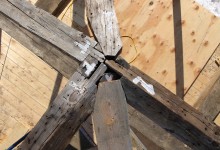
The tie beams cross over the plates using a partial half dovetail joint and overlap the plate to a depth of 3″. There are four full length tie beams in the main portion of the building and five full length ties in the ell. The ties closest to the gable are about nine feet from the end of the building. Two short tie beams cross the gable end plates and join the full length tie beam with a pinned mortise and tenon joint. A hip, or dragon, tie extends diagonally from the short tie and clasps the plate joint at the corner.
Hip tie clasps plate joint.
Each tie type is topped by a distinctive rafter. The full length tie is topped by a pair of principal rafters, which tenon into the end of the tie beam. The hip tie is topped by a hip rafter, and the short tie is topped by a jack rafter, which joins the hip rafter at a compound angle and full mortise and tenon joint. Zach had fun scribing one of these babies.
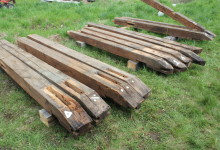
Masts in the Grass
A short four-foot mast supports the apex of the roof, receiving the end of the ridge, two principal rafters and two hip rafters. When we were inventorying the frame, the mast joinery looked rough, like it had been hacked with an axe. There was no consistency to the cuts, and no way to accurately model the joinery. When the frame was in parts, we weren’t crowing about the original builder.
Jake installs a jack rafter
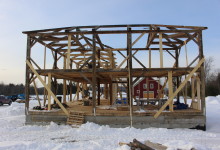
We assembled the frame using a lull, dead men and muscles. Considering the inconsistency of the bents, and the complications of the second floor, hiring a crane wasn’t efficient. Using a crane on-site for more than one day is a huge investment, and more than two days was beyond the scope or need for this project. So the raising was incremental, and slow.
Raising in progress. Photo by Timothy Sweeney
We waited to assemble the roof parts until after the rest of the frame was raised. There was no advantage to fitting the parts on the ground. We had almost all the original roof framing, and we were going to sheath the second floor as soon as it was raised, providing us with a contiguous deck on which to roll staging. When we finally placed the first roof timber, we were more than a year into the project.
Scott fits rafters to mast
Where assembling the house frame was frustrating, assembling the principal roof frame was gratifying. The original principals landed on the original masts like they were going home. The ugly axe cuts at the top of the mast were beautifully scribed to the undersides of the hip rafters. In modeling the roof frame, we could tell that the design was complex, but until we fit the pieces together, we had no idea that it was also beautifully crafted. It inspiring to witness, and to contribute our skills to its repair.
Two ridges, three rafters, one mast. Photo by Timothy Sweeney
This is the third post in a series about the Foley-French House. Check out more in progress photos, here, or by clicking on the slideshow below. If any of the photos look professional, but they don’t say “by Tim”, I forgot to credit Tim. Next up, scarf joints.
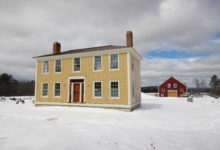
French House, c. 1804. Kingston, NH, Front Elevation. Photo by Charles Foley
If you are prone to feeling lazy, you’ll have to ignore the Foleys. In addition to their intense day jobs, they care for four horses, a flock of sheep, chickens, and a pack of wild dogs (it’s only two dogs, but they have a lot of energy). The French frame is the third frame we’ve raised on their farm and they finish the projects after sheathing. Sheila dug the footers for the solar array herself. At the outset of our most recent project, the couple was so involved in the design process that it wasn’t really a PTF design job at all. And that worked well for us. I’m happy as a draftsperson.
The French Frame, built in 1804, is L-shaped, two stories, hip-roofed, and always has been. It was also remarkably intact for two centuries of adaptation and use. The posts are tapered gunstocks and varied widely in dimension. Each leg of the L is 18′ wide; the front eave is 38′ long and left eave was 36′ long. The house was built with three full length plates – front (south) eave, rear (north) eave and left (west) eave – but the rear plate was damaged at the rear interior corner, and required a long scarf repair. Assembling the plates made us wonder at how they did it without a combustion engine. We added three bents off the rear (north) end of the ell, bringing its overall length to 68′. We also added an additional bent between the two original ell bents because 18′ is way too long a span for contemporary floor load requirements.
French House, Left Elevation. Photo by Charles Foley
PTF came aboard after the frame had been dismantled in Kingston, NH, transported, and stacked into temporary quonset huts in Poland, ME. I described our process for deciphering the frame here and a little bit here. Our first day back on site we inventoried and assessed the frame’s condition and I drew a 3D model using SketchUp. There are a number of other 3D modeling programs used by design professionals, but SketchUp has so far been best at meeting our timber framing needs. The next time I approach a project like this, I will model each timber to its exact specifications from the get-go. This will make it harder to establish the building’s overall dimensions initially, because hewn timbers vary and joints loosen, but it would negate the need to go back and make tedious changes to the model at cutting time.
Tie Level Hip framing
It’s not always a pleasure to work with a client who wants to share the work load. Scheduling can be a challenge. The arrangement requires both a clear delineation of tasks and flexibility to address problems as they arise. We have been lucky in our partnerships, but in this case, the design collaboration was ideal. Charley had a very specific vision and was able to convey it using an iPad floor plan app, in addition to teaching himself a little SketchUp. He has strong preservation aesthetic, and wanted to preserve the building’s original elevations and roof overhangs as close as possible within the bounds of modern building codes.
Simplified First Floor Plan
The Foleys retained a traditional floor plan within the original frame, and sequestered newer elements to the three bent extension off the ell. The building has a center stair layout with a chimney stack is built into either end of the main body of the building and a fireplace on each floor. In the ell, a third chimney mass is the focal point of the kitchen, with a traditional cooking hearth and beehive oven. George Libby of G.M.Libby and sons masonry designed the chimneys and provided guidance on their integration within the frame. The company specializes in traditional masonry and we have been very impressed with their work on previous jobs.
In contrast with a house museum, a house needs to meet contemporary building codes even if it is trying to maintain NPS-level standards. Balancing insulation requirements within a traditional frame is always a challenge. Usually, the client must decide between building out and building in. Building out means that an insulating exterior skin will be applied to frame like with SIPs or shop-made insulated panels. The advantage of building out is that the frame is visible to the interior. The disadvantage with a traditional frame is the exterior no longer resembles its original proportions. For our shop in Berwick, Arron chose to insulate to the outside, using a shop-made sandwich of pine shiplap and denim insulated batts. He achieved a fairly traditional look, but the walls are certainly thicker than the original barn wore. For this project, the Foleys wanted to insulate to the interior, and retain views of frame to the extent possible. This results in elevations that are much more true to the original building. At the first floor level, the clients will see the interior face of many of the posts and more timber in the second floor framing than the 2013 pop charts. On the second floor, the impressive tie and dragon beam configuration will be visible as well as most of the posts where they flare to meet the tie beams. Unfortunately, insulating to the inside will obscure the principal rafters. In most of Maine, code requires R-49 in the roof, resulting in 13.25″ of the preferred insulation, Roxul batts.
Y-stair section, simple-style
Fitting stairs is always the other big squeeze. In many buildings of this age, stair rise is taller than run is long. An 9″ rise and 8″ run is not uncommon. At my in-laws house from 1840, my size-tens ascend the stairs sideways, like a crab doing the grapevine. In order to approach the original layout of the French house, the front stair rises directly from the main entrance and doglegs to the left. The rear stair behind the beehive oven was my favorite design challenge. It was similarly limited by an overall 18′ run, with 3′ landings, minimum, on either end. Due to the second floor plan, the rear stair is Y-shaped, leading left to the master bedroom and right to a hallway that accesses the bath and music rooms. The master bedroom is private, being sequestered from the second floor family space, and accessible from the kitchen and frequently used rear entrance.
South Elevation, just the basics
For fenestration, we followed traditional lite divisions and window proportions. We selected the largest lite size commonly found in Federal-era windows in order to accommodate fire egress required for the bedrooms and to maintain a consistent window size throughout. The clients ultimately chose a wood window manufacturer to contain the cost over custom wooden sash. Although we didn’t use them here, there are a number of competitive sash manufacturers in New England if traditional sash is your priority.
Second Floor Framing, just the sticks
Once the floor plan and fenestration was established, we hired an engineer to review the framing plans. Due to the 17′ open span across the first floor and the spans between bents, this resulted in gargantuan floor girts, 10″x12″ and 12″x12″ in cross section. Big timbers can be fun to find in an original frame, but these seemed out of proportion with the rest of the frame. And then we didn’t even hear a peep from the code enforcement officer. It was both good fortune and a little disappointing that he wasn’t more concerned.
Jake and the Big Floor Girt. Photo by Timothy Sweeney
It’s been more than six years since fate matched up Charley and Arron at a decrepit barn in West Poland, ME. The teenager who chauffeured Arron that day, in preparation for his driver’s license, is graduating college in May. Since then, we’ve stabilized a dairy barn, moved a carpenter’s shop, and erected a horse barn just in time for Charley’s wedding. There is something specifically rewarding about collaborating on a home for such long-standing clients. We get to bask in the glow of our friends achieving a dream.
Foley Frame in February
Next up, scarf repairs and some exquisite hip joints.
Almost a year ago, we faced the year’s first pile of pick-up sticks: a neat but undifferentiated pile of timbers that formerly formed the French House of Kingston, NH. They were first assembled in 1804, around the time that the landmark Badger Tavern opened in Kingston, and the formerly enslaved overthrew their oppressors in the Haitian Revolution. More than two centuries later, the house was dismantled and transported to the Foley property in Poland, ME. It will soon become the home of two of our most steadfast clients, Charles and Sheila Foley.
Initially, at least, the project was like the Reverend Morrison House; we were charged with deciphering the frame and drawing a model, but the projects diverge dramatically from there. While the Morrison House will ultimately be interpreted for the public as a historic house museum, the French House will include four new bents off the back ell and indoor plumbing. The ultimate aesthetic will be historically accurate, but the home will be comfortable for a 21st century family.
Foley House Posts
Typically, PTF models the building and establishes tagging numbers before we dismantle. It is easier to determine the overall dimensions of a building while it is standing than when it is in parts. Tagging each member with an individual tagging number makes it easier to identify and inventory the pieces after they have been moved to the new site. The dismantlers of the French house used what is actually a more traditional method. They numbered the posts 1-10, and painted the associated numbers on the intersecting plates, tie beams and girts. The approach resembles trail systems that number the intersections of trails rather than naming the trails individually. Occasionally, we encounter old frames whose marriage marks have been numbered in this method, albeit with chisels and roman numerals rather than white paint. Ultimately, deciphering the members of the French House was easier than the process at Reverend Morrison, because the framing members were smaller, better organized, and more complete.
Foley House Rafters
The Foley house is L-shaped and always has been. Three of the plates are continuous, or were originally at least, and are almost 40′ long. It is unusual to find a two-story home from the Federal Period with an original two-story ell. The two 40′ plates, and two continuous ridge beams join one another, making it difficult to imagine how the building was originally assembled. The roof is an impressive feat of joinery, with three low-pitched hips. Given its distinctive roof structure, maybe the house is more accurately situated in the late Georgian period. Go ask Virginia McAlester.
Foley House Plates
The continuous plates were essential to deciphering the organization of the frame. Due to their length, they were stored separately in the loft of the horse barn, a project we’d reassembled one year prior. Post locations were labelled with the appropriate number in white paint. Each leg of the ell contained two additional tie beams, located in between bents. Each end of the extra tie beam and the associated half dovetail mortise in the plate was labelled with a symbol, rather than an alphanumeric. It was easy to identify the tie beams by their size, the half dovetail joinery on either end, and the long rafter mortise above the half dove. For more about identifying timbers based on joinery alone, see Salvage Detectives, part 2. Fortunately, the continuous plates in this frame provided us with the tie beam layout. If you ever find yourself facing a pile of frame with no map, find the plates and the tie beams. They provide the most accurate overall dimensions and a map of the bents, such as they exist.
Foley House Posts, gunstock profiles
From both aesthetic and historical perspectives, a fully scribed and hewn frame is desirable. In the case of the French House, it also means that the dimensions of the timbers are wildly divergent. There was no uniformity to the posts or eave girts. In older 18th century hewn frames, the girts will be oversized and the joists will be undersized, reflecting the size of the tree from which they were hewn. Hewing is labor-intensive, and frequently, the hewer would stop once he achieved flat and square faces. In this house, the scribing and fit of the joinery was remarkable, but the hewn surface and subsequent centuries of alterations left the timbers uneven. Initially, we documented the exact measurements of each of the pieces, in order to establish an average height from top of sill to tie beam. The length of post varied by nearly an inch. We modeled the frame using an ideal post size and established some uniformity to the girts. After the floor plan and window layout was established, I needed to go back to the framing members and adjust each post to its actual dimensions to achieve accurate girt lengths. If I could turn back time, I’d model each stick of the frame individually from the beginning, rather than revising the model later to achieve more accurate measurements needed during the cutting process. I’d also make cut drawings of each of the original timbers, regardless of whether there were significant alterations to the piece. It would allow the crew on site to double check actual measurements against the model.
Constructing the Foley house has been nearly a year-long journey. With the client, we designed a home to suit their needs and meet their historical standards. Upcoming posts will describe the design process, scarf repairs and the incredible hip roof joinery.