Tag: Meetinghouse

  • Sill Life with Woodpecker

    Sill Life with Woodpecker

    Frames rot from the bottom up. Water condenses on the foundation and rots the sill from below, or enters at the eaves and runs down the wall framing, rotting the sill from above. Some sills are sunk by splash back. In the dead of night, sill rot can haunt you; it seems catastrophic. But rotten sills are so common that their repair is our most standardized process, and can be buttoned up in a little over two weeks. We’ve repaired two church sills already this year. The jobs in Troy and Benton Falls ran smoothly and efficiently in the background, while we tossed and turned over pilaster this and custom-trim that. These sill jobs aren’t flashy, they’re basic (in the best way). They are also amongst the highest repair priorities, and essential to a building’s longevity.

    I. Troy, lifted. Photo by Tim Sweeney
    I. Troy, lifted. Photo by Tim Sweeney

    Troy Union Church

    We repaired Troy’s sill first, in January. A short section of sill was completely rotten. The building still has some of its original sill, but the rotted section had been replaced before, maybe 25 years ago, in hemlock. It had been damaged by splash-back off the propane tank and condensation resulting from drilling through the sill for the propane line. The sill was fairly low to the ground and drainage was poor (typical). There was no gutter, which is probably best for the building, but the ten inch overhang didn’t protect the sill from its fate. We connected the posts and studs with a tripled 2×10 ledger. On each post, we hung a stout metal L-bracket. We used hydraulic jacks, resting on short, angled dead men and cribbing, to take the weight of the wall off of the existing sill. The 20th century replacement was installed with a nice stop-splayed scarf, which we matched with our repair. The job took a little over two weeks.
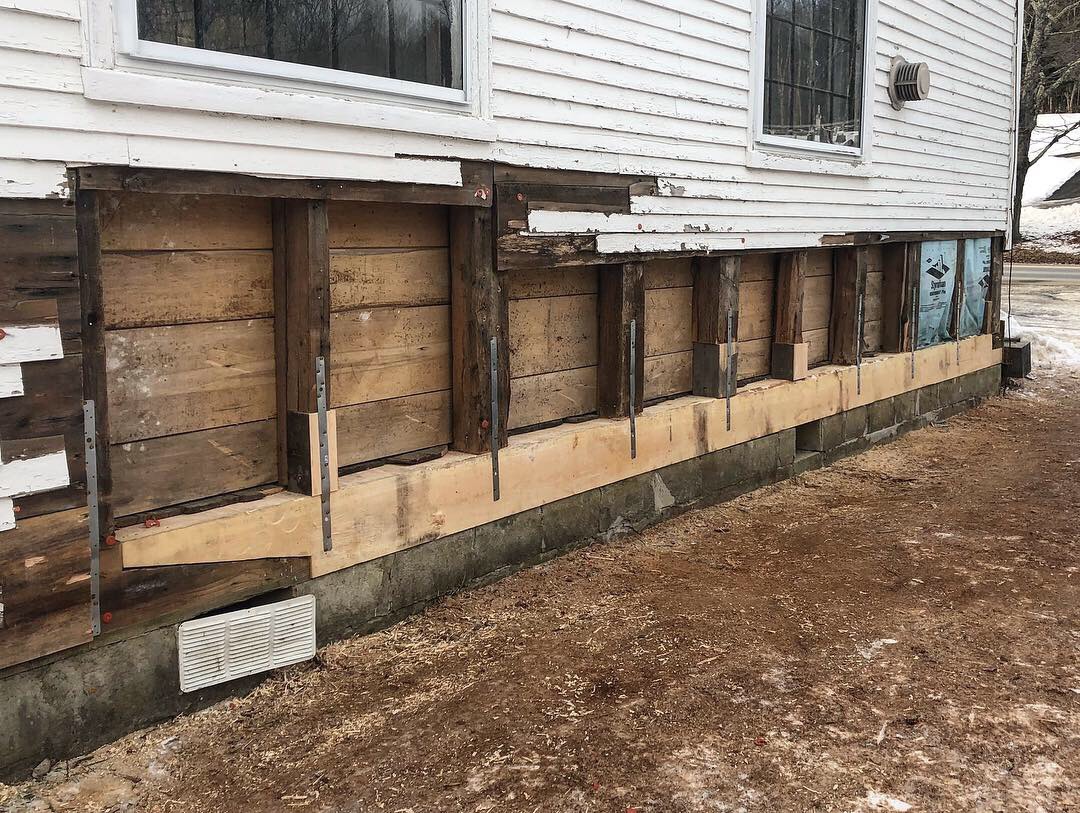
    II. Troy, repaired. Photo by Tim Sweeney
    II. Troy, repaired. Photo by Tim Sweeney
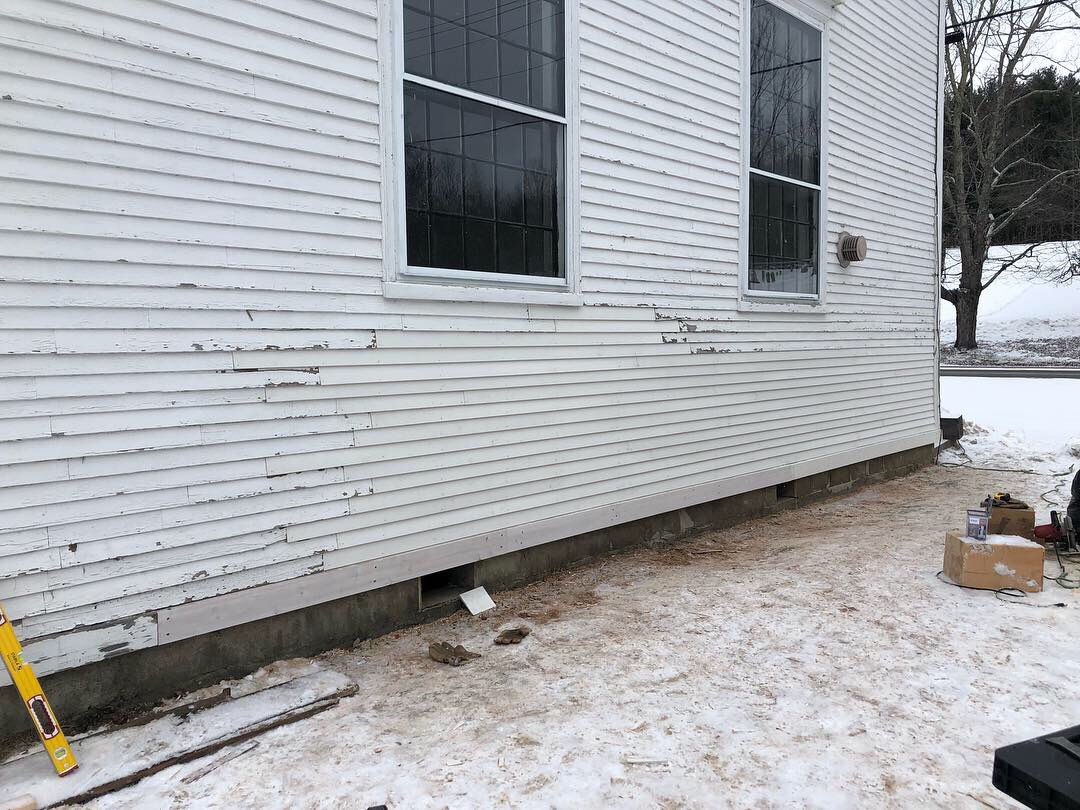
    III. Troy, buttoned. Photo by Tim Sweeney
    III. Troy, buttoned. Photo by Tim Sweeney

    Benton Falls Congregational Church

    The north eave sill at Benton Falls succumbed to years of organic matter built up along the eave wall, which made the sill nearly earth bound. Poor drainage and splash back didn’t help its cause. This building was different from Troy in that the sills were resting upon original granite capstones that had sunk and shifted over time. Using a laser level up in the attic and measuring the height of the plate at each post, we determined that the rear wall of the building had dropped three inches. During the repair, the crew gently lifted the rear of the building so that it was returned to within a half inch of level. The crew then replaced the entire 8″ x 8″ x 42′ sill. It was in three pieces connected by stop splayed scarfs, like those used at Troy. The building committee has contracted with a company to improve the drainage around the building, and, while they’re at it, pick up the rear cap-stones and install solid stone shims beneath them.
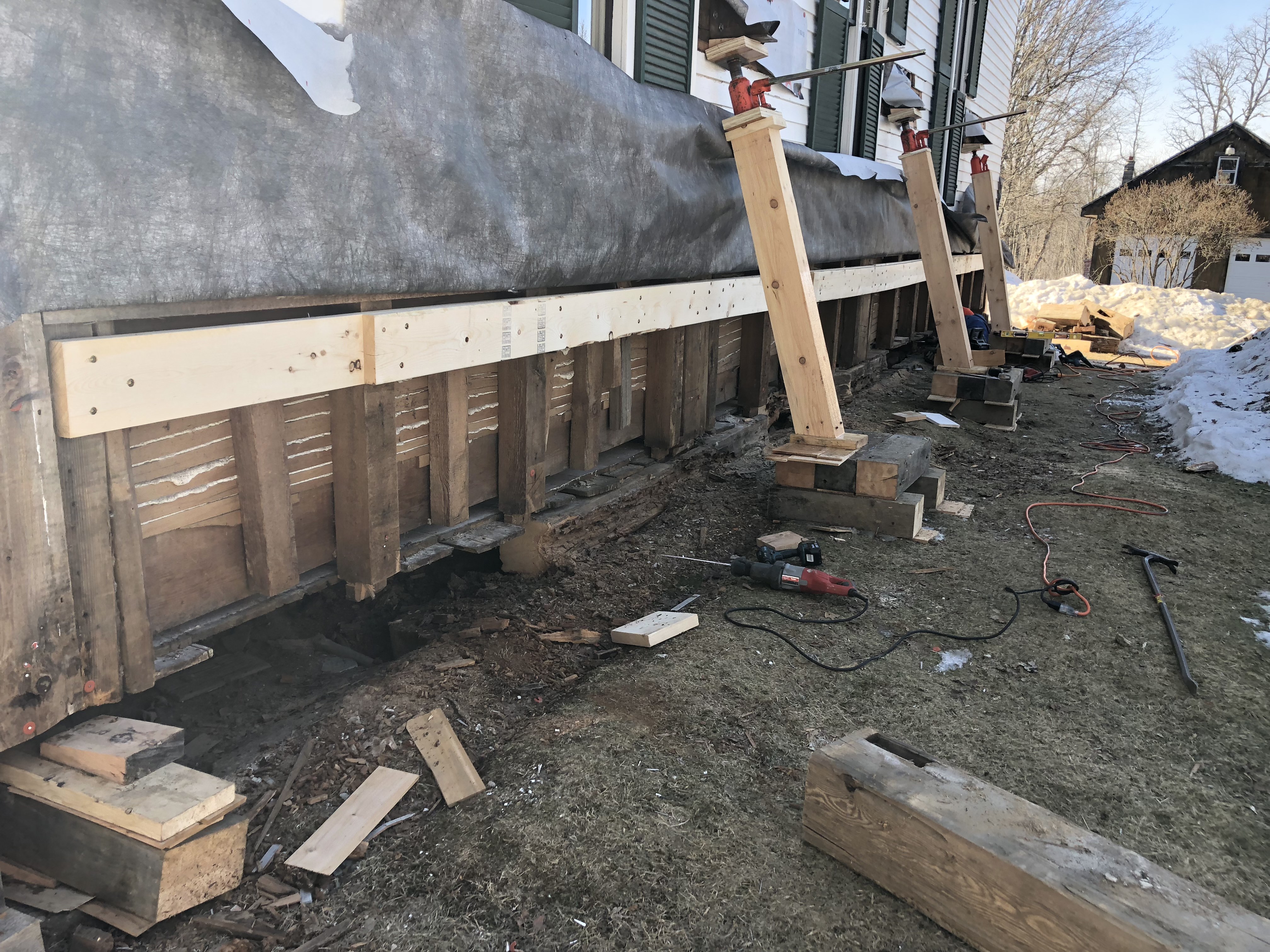
    Benton Falls, lifted (here we go again). Photo by Tim Sweeney
    Benton Falls, lifted (here we go again). Photo by Tim Sweeney

    You’d be forgiven for thinking I made a mistake and inserted the same lifting photo for Troy and Benton. Not so! The repair process was nearly identical. Don’t be afeared of sill rot. Just fix it, and sleep soundly.
  • “We’ve been watching that steeple slant backward for years”

    “We’ve been watching that steeple slant backward for years”

    The Troy Union Meetinghouse had a crane day last week. The long-leaning steeple was partially dismantled, leaving behind the two front posts to stand like wooden antennae. The entire replacement frame has been cut by a crew of local craftsmen, and will be resurrected before the end of the summer. Read more about the process here, and show your support. If you don’t see a video below, click on the link to watch the story.

    http://wabi.tv/2016/05/12/construction-underway-on-troy-union-church/

    Check out Troy Union’s facebook page for the most up-to-date information about the project.

  • Kitchen of the Community

    Kitchen of the Community

    New Hampshire Preservation Alliance recently released an inspiring video about the restoration of the Acworth Meetinghouse. Built by Elias Carter in 1821, the Acworth Meetinghouse, with its double lantern spire, is a masterful representation of historic building craft. In 2008, the steeple and undercarriage were repaired by local craftspeople trained and supervised by PTF in techniques unique to steeple repair, and timber framing. In 2011, the Acworth model won a Preservation Honor Award from the National Trust for Historic PreservationNHPA’s video is an inspiring glimpse into the effort invested to repair this “kitchen of the community.” Next year, we’ll be drawing upon lessons learned in Acworth to help the community of Troy restore the trusses of the Troy Union Church (fb). 

    Feature photo courtesy Acworth Meetinghouse Restoration Project


  • Abyssinian Meetinghouse listed as one of America’s 11 Most Endangered Properties

    Abyssinian Meetinghouse listed as one of America’s 11 Most Endangered Properties

    Abyssinian Meetinghouse, photo by Troy R. Bennet for the Bangor Daily News
    Abyssinian Meetinghouse, photo by Troy R. Bennet for the Bangor Daily News

    Last week, the National Trust for Historic Preservation announced it’s list of America’s 11 Most Endangered Properties.  The Abyssinian Meetinghouse had the dubious distinction of making it on the list.  Inclusion on the list indicates the importance of the third-oldest standing African-American meetinghouse in our nation’s history, but also sheds light upon the lack of funding to complete its restoration (you can make a donation, here).  The announcement was made on June 19, Juneteenth, a holiday commemorating the day in 1965 when slavery was finally abolished in Texas.  When I lived in Houston, Juneteenth was really celebrated, it couldn’t pass without one noticing as it does here in Maine.  Many people in Maine don’t recognize the holiday, and don’t realize that we have a significant African-American and abolitionist history.  Hopefully, this list will bring attention to the one of Maine’s most important artifacts of American history.  Preservation Timber Framing is honored to be a part of the restoration process.

    The press conference announcing the Abyssinian’s place on the list was rousing, and much more inspiring than other press conferences I’ve been to (and with a reporter dad, I’ve been to a few).  It was covered particularly well by the Bangor Daily News, and also by WMTW and WDSH.  The story made the cover of the Portland Daily Sun.

    The Portland Press Herald published a particularly well-researched editorial to help generate support for the building.  I learned about the 1898 shipwreck that drowned 19 congregants and ultimately led to the dissolution of the church.  Read the article here.

    And remember, the Committee to Restore the Abyssinian takes donations.

    Read more about the restoration of Abyssinian.

  • Our Biggest Fan

    Goodhue Sketch c. 1900
    Goodhue Sketch c. 1900

    In 1900, Charles Goodhue drew this sketch from the memory of an elderly parishioner.  This is one of the only remaining images that depict the building from this era.  Fortunately, evidence within the building has proven this sketch to be remarkably accurate.

    From the beginning of our involvement in the project, we have been looking forward to restoring the tripartite arched fan to the pediment.  We were unsure whether any evidence for it remained, and if the fan existed at all, whether we would be able to reproduce it accurately.  Much of the pediment had been changed, with three newer openings cut into the sheathing, and one window inserted directly into the space where the fan would have been.

    Arch Evidence
    Arch Evidence

    When stripping the pediment of its last remaining shingles, we found a series of tiny holes outlining a tripartite arch, with two sides flanking the central window, and a central arch likely to have had its apex somewhere in the top half of the window opening.  These holes had the pattern of flashing nails, small nails that were closely set in order to hold up heavy lead flashing.  It seems that the fan drawn in the Goodhue sketch was not a fully permeable louvered fan, but a decorative adornment that likely had a smaller central opening that vented the attic through the lower, central panel of the arch.  We will never know for sure, because the addition of a 20th century window obliterated the central section of sheathing.

    We used a cabinet and furniture maker in Sheepscot to reproduce the fan using a CNC machine.  Along with the Committee to Restore the Abyssinian, we decided to use a non-traditional method of construction because the fan will not be used to vent the attic, and traditionally arched louvers are notoriously difficult to flash and maintain.

    The new fan was flashed in a custom copper cap by The Heritage Company of Waterboro, Maine.  We work with Victor Wright, a fourth generation slate and copper roofing specialist, for virtually all our flashing needs; from soldering entire copper tile roofs, to custom trim flashing such as we needed for this project.

    When we went to pick up the fan, it took four of Victor’s employees to load it safely into the truck.  We were able to muckle the fan out of the truck and between the staging and the front of the church, and assumed that if two of us could carry it, surely we would be able to lift it into position using ropes and our body weight.  We secured two ropes to the ledger carrying the fan, and threaded them over staging ledgers at the top of the tower.  We pulled on the ropes and nothing happened.  Then we hung on each of our ropes and the fan still didn’t move.  Last we both hung on one rope, attached to one side of the fan, and not one corner would budge.  In the end, we needed a winch, attached to the back of Arron’s truck, to lift the fan into position, and we were happy for this safer solution.  Once we had the fan in position, we used timberlocks to secure the fan to the studs behind the pediment.  Click on the photos below for more information:

    Finished Facade, Finally
    Finished Facade, Finally

  • The Salvage Detectives, Part I

    The most interesting part of working on the Abyssinian has been the process of discovery.  When we first started working on the restoration, we encountered dank apartments and the absence of much of the original truss framing.  There was little architectural documentation of the building at the height of its use, except for a turn-of-the century sketch from an old member’s memory.  But as we’ve carefully removed the latest additions, we’ve discovered telling clues.  When we removed the 1920s plaster and lath, we found the original rough window openings, cut into the adjacent posts and studs.  Likewise, when we removed the vinyl and aluminum siding, and shingles from the front gable, we found evidence of the original trim elements.  The following is first part of a series about how we determined the trim details for the restored front facade.

    CROWN TOWN

    Crown Town
    Crown Town

    After we removed most of the aluminum siding that covered the trim, and found nothing, we lost hope that we would find evidence of the original crown.  We began researching similar buildings in Portland, like Mariner’s Church (1828) and the Fire Museum, in order to make an educated guess. We debated between profiles like a Cyma Recta, or an elongated Cavetto which would have made sense given the building’s Greek Revival silhouette.  But when we began the roofing phase, and finished removing the aluminum, we found the ten-foot long section of the crown pictured here.  It had typical Federal profile which is appropriate for 1828, at the transition between Federal and Greek Revival styles.

    The only remaining section of original crown was found along the rake, the sloped edge of the roof, and this generated a new mystery.  Traditionally, in order for eave crown and raking crown to have the same projection from the building, the molding profile of the raking crown will need be stretched, so that the raking and eave crowns will meet evenly at the corner of the building.  Two separate molding planes (or knives) were required to create these two separate profiles.  Using a slice of the original raking crown molding, and pitch of the roof, we calculated what the eave molding would have had to look like.  The resulting molding profile was squished, the convex portion looking like a crown roll of fat.

    Another solution to the eave/rake crown problem is to allow the raking crown to have a shallower projection, or stand up a little bit more, while the eave crown juts farther out.  Then, the crowns will match at the corners, but the carpenter only needs to cut different backing angles on the rake and eave crowns.   This allows a carpenter to use the same molding cutters, and many do this today.  Given the chubby eave profile calculated from the crown we found on the rake, we surmise that the original carpenters employed this second option.

    BED DOWN

    Bed-crown Clues
    Bed-crown Clues

    Is this just another boring photo of nail holes?  Oh no, it isn’t!  This photo was taken at the underside of the soffit, along the rake.  The ruler measures the distance of a line of nail holes that runs parallel to the rake.  The nail hole at 2 1/2 inches indicates how far beneath the soffit the bed molding was nailed.

    Revealing Paint Lines
    Revealing Paint Lines

    The second photo shows how we used paint lines to determine how far the bed molding projected from the face of the building, 3 1/8 inches.  Combined with the nail holes running beneath the soffit, we were able to guess the projections and angle of the bed molding.  The crown molding profile found on the rake fit these measurements and we guess that the original carpenters not only used the same molding profile for rake and eave crown, they also used it for the bed molding between the flush siding and soffit.  Absent evidence of some other molding profile, re-using the crown profile was our best guess.

    Coming up:  In The City of P, we discover flashing holes that outline a tripartite arch in the Tympanum.

  • !

    Abyssinian before:

    Abyssinian after:

  • Press on Preservation

    Last week, PTF was featured in two more articles, these ones about developments at the Abyssinian.  The DownEast article focuses on the social history of the building as well as the people responsible for its restoration.  It contains some of my favorite stories about the building, including its origin story, and how it was saved from the fire of 1866 by William Wilburforce Ruby, one of the founders’ sons.  Unfortunately, the online copy doesn’t include all the beautiful photos, so be sure to check it out on newsstands.

    The second article, in the Portland Daily Sun, covered a meeting in Boston between HUD, the Committee to Restore the Abyssinian, the Portland Freedom Trail and Boston’s African Meeting house.  HUD has been and is an important potential funding source for the restoration.  The Committee hopes that by completing the facade, they will attract attention and build momentum to fund the next phase.

  • Traditional Repair of the Abyssinian Meetinghouse

    Built in 1828, the Abyssinian Meetinghouse is the third oldest African American meetinghouse in the country.  PTF was fortunate to join the restoration project in 2005, removing the tenement apartments inside, and repairing the king post truss frame.  In 2010, we rebuilt the cornice, and completed the roof and basement phases.

    In October 2010, archaeologists dug around the site, looking for evidence of a former spring and well, while we completed the replacement of the front gable sill.  We cut and fit the scarf joinery first, before jacking up the building and replacing the sill section by section.  We knew the old sill needed to be replaced, but we were stunned by the extent of the rot.  When I see a building of this size resting on such a severely deteriorated framing member, I am reminded of the superior stability and longevity of timber-framed buildings, especially when combined with traditional sheathing and trim.

    Meetinghouse with a capital "M"
    Meetinghouse with a capital "M"

    The photo to the left was taken from the inside of the building after finishing the sill installation and roughing out the front windows.  I’ve shown it here because there are a number of uncovered architectural elements that identify this formerly forlorn structure as an historic New England Meetinghouse.  The king post truss, the triangle at the top, was the height of open-span engineering in 1828.  The king post, the vertical member in the middle, in combination with the struts, the diagonal members radiating from the center, helps to support the long and heavy rafters that make up the roof.  The king post also supports the center of the 36 foot tie beam, the long horizontal member, with an interesting joint called a wedged half dovetail.  The tie beam “ties” the eave walls together, and allows the timber-framed building to have an enormous open span, capable of holding the large audiences that came to listen to abolitionists like Frederick Douglass.

    At the front of the building, two enormous windows have been roughed out, architecturally identifying the building as a meetinghouse from the exterior.  It is unclear whether these windows were planned when the building was framed.  The studs adjacent to the outside edges of the windows were originally placed where the centers of the windows are today.  These studs were taken out of their original pockets and used as jack studs to support the original window frames.  Along the eaves of the building, posts and studs were notched out where the corners of the original window sat indicating that the builders assembled the frame, and added these large windows after.  The evidence we used to determine the size and location of the windows can still be seen today, contact the Committee to Restore the Abyssinian for a tour.

    In November, we began restoring the front facade.  The 8′ by 4′ plank frame windows framing the entrance were made with mahogany using mortise and tenon joinery. For more about plank frame windows, this article, from Newport, is pretty good.  We clad the original sheathing with rift-cut and skived clapboards.  David Paul, Treasurer of the Committee to Restore the Abyssinian, graciously allowed us to use his photos to document the process.  If you are interested in donating to the project, please visit abyme.org.

    Click on the photos below for a complete description of the process:

  • Sill Crazy After All These Years

    We’ve begun work on the Abyssinian Meetinghouse again.  Last week, archaeologists dug test pits in the basement and driveway, while we worked on cutting a new front sill.  After years of damage, no part of the original front sill could be saved.

    Click on the photos below for a complete description.

Think we can help? Get in touch.