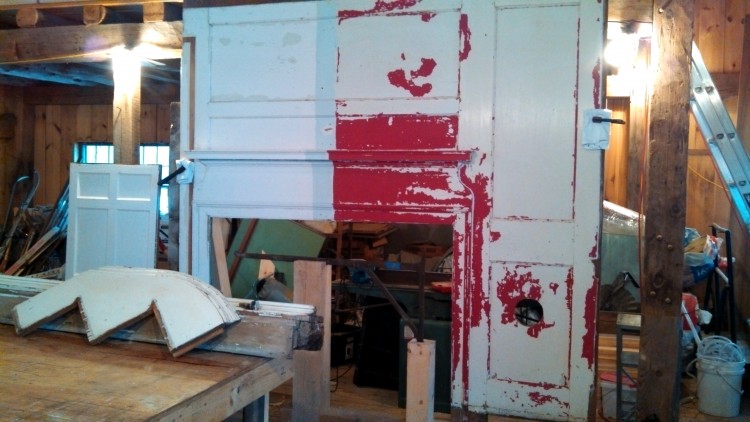
Less-Pink Parlor Surround, all cleaned up for the NHPA EXPO
This weekend, we’ll be sharing a few choice parts and pieces of the Israel Demeritt-O’Kane house with visitors to the NHPA Expo. We’ll be at the Radisson in Manchester, NH soaking up good talks ranging from “Old Home/New Technology: Explore Solar Energy for your Home!” to “The Masonry Detective: Exploring Chimneys, Bake Ovens and Fireplaces” (there’s a surprising amount of exploration in preservation). We are especially excited to be giving a talk on Sunday, at 1:00p; “Comprehensive Assessment of Your Barn and Home, Case Study: the Demeritt-O’Kane House.” We’ll be talking a little about assessments in general, and a lot about the specifics of the Demeritt-O’Kane house. If our series of journal entries about the complete dismantling of this Federal-era farmhouse piqued your interest, you won’t want to miss the talk. Our booth will showcase a few pieces of the house, including the fireplace surround from the “Pink Room.” We’ll be inviting folks to inspect examples of various intricate molding profiles, and see if they can identify the Asher Benjamin pattern from which they came. Hope to see you there.
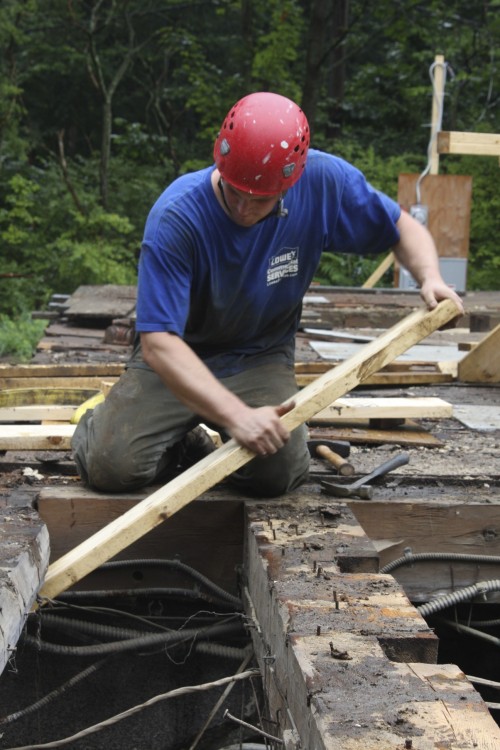
Dave, carefully removing sheathing from the Demeritt-O’Kane House
PTF’s own David Ewing will present his paper, “Moving Historic Properties: A Valid Method of Preservation” at the National Trust for Preservation’s 2013 Conference in Indianapolis, IN. Inspired by his experience dismantling the Demeritt-O’Kane house, the paper reviews the history of moving buildings and includes the example of a Boston apartment building which was moved at the rate of one inch per minute. The move took three months, and the apartments were inhabited continuously. He argues that the threat of demolition makes careful dis-assembly or intact movement a viable option for preservationists, as well as environmentalists. From the abstract:
The practice of Historic Preservation fundamentally involves the response to threatened historic places, buildings, or properties. Those involved in this professional field have the responsibility to use whatever means necessary to successfully thwart the deterioration or demolition of historic structures. For that reason preservationists must consider the merit of all potential methods. This paper investigates the evolution of building relocation as a method of protecting the resources found in the built environment. Furthermore, it explores the technological advances in the practice of relocation, the restrictive guidelines of National Registration Criteria and environmental implications in a thorough understanding of how relocation is a worthy option in the preservation of historic places.
Dave will participate in a panel discussion on “Re-Booting Preservation for New Audiences.” He is pursuing a Masters of Design Studies (MDS) in Historic Preservation at the Boston Architectural College, and his paper was selected competitively from a pool of preservationists from around the country. Dave joined PTF after a summer internship through Maine Preservation, which PTF supports as a way to give preservation professionals headed for the office some time in the field. We persuaded Dave to stay out in the field with us a little longer, and this paper is evidence that he’ll keep a boot in both environments.
Dave, removing floor joists at the end of a long day
FOR SALE – The Israel Demeritt House is a two-story, center-chimney, timber-frame dwelling, 40’ x 32’ with attached cape ell, 40’ x 21’. NH state historian, Jim Garvin, reports that it “is the best example so far identified in Durham of a two-story, center chimney house in the federal style.” Out of seven original fireplaces, three are incorporated within fully-joined raised panel walls. The remaining four mantels showcase the craftsmanship of Nathaniel Demeritt, the original builder, with reeded moldings derived from Asher Benjamin‘s A Country Builder’s Assistant (Demeritt’s own copy is housed at the New Hampshire Historical Society). Original crown moldings, chair-rail and casing are unique and have been preserved in nearly every room. The house also retains all original sash and corresponding “Indian” shutters. There are six bedrooms and room for two full bathrooms. The summer kitchen, 20’x 23’, is large enough to accommodate modern amenities with minimal retrofit of historic features. The house is dismantled, documented and preserved in its entirety. Please contact Arron Sturgis, (207) 698 1695, and peruse the articles below for more information.
View the architectural model of the building, in PDF form.
Read our series, “The O’Kane Notebook,” on dismantling the building, and the craftsmanship revealed in the process.
Read James Garvin’s report on the history of the building and its residents. You’ll never read a more well-written application for National Register status.
Peruse all of John Butler’s stunning photos of each interior and exterior wall, with trim carefully itemized and outlined, below:
While at the library, I asked Librarian Bill Copeley to see the 1798 second edition of Asher Benjamin’s The Country Builder’s Assistantcontaining the signature of Nathaniel Demeritt. There are two other signatures in the book, Samuel Furber, dated 1816, and Gorden Demeritt, dated 1826. We could tell that much of the trim in the house was derived from Benjamin’s designs, but it would seem that they were derived from this very book. I was especially interested in the penciled notes in the margins. On the back of a plate with an example of a front elevation, someone wrote, “A Fine House.” More photos, below:
When I embarked upon a career in wood, I wondered whether I should become a furniture-maker, and construct finely joined objects of beauty, or build houses, which provide a lot more utility to people. I soon found that it was a false dichotomy; working in preservation, I can work on buildings that are constructed like furniture. On the building we’ve been referring to as “The O’Kane House,” I’ve written previously on the finely-proportioned trim, and the stoutly-joined frame. Even the sheathing is weather-joined, creating a water-tight envelope, and the windowsills are grooved on the bottom to sit down tight over the sheathing. The carpentry employed at O’Kane isn’t ostentatious, but every day I am inspired by the craftsmanship employed at each phase of its building.
Given this gushing, we think that carpenter deserves some credit. “The O’Kane House” is a bit of a misnomer. For a long time, the building UNH now calls the O’Kane House was referred to as “The Demeritt House” in reference to the Demeritt family who built it, and lived on the land for more than 200 years.
In July of 2001, Jim Garvin*, the New Hampshire state historian, wrote an Individual Inventory for the NH Division of Historical Resources for the Demeritt House, one of the steps for applying for its placement on the National Register of Historic Places. In reading the report, I expected a bureaucratic list of dry historical attributes, but discovered instead a well-crafted narrative exploring the house’s former residents and their relationship to its architectural significance. I encourage anyone who has been interested in the O’Kane House to read the whole report, here.
The house was built for Israel Demeritt in 1808, on land that had been granted to his Great-grandfather, Eli Demeritt, before 1700. Israel inherited the land from his father, Captain Samuel Demeritt, and replaced his father’s two story house with the one we so recently dismantled. It was likely built by his brother Nathaniel Demeritt (1751-1827), a joiner who is known to have built a neighboring house with his son, the Rev. William Demeritt in 1819.
If Nathaniel was indeed the builder, there were architectural consequences. First of all, by 1808, Nathaniel would have been 57 years old, which explains why the house is so conservative in its layout and plan. The center chimney and first floor layout resembles other houses that began to appear in coastal Maine and New Hampshire shortly after 1700 (pg. 98 A Building History of Northern New England).
Floor Plan, two-room deep house, from A Building History…, by James Garvin
Conversely, the interior trim is far more contemporary and heavily influenced by Asher Benjamin. The casings in the front entry are elaborate, and Garvin’s report cites Plate 1 of The Country Builder’s Assistant and Plate 11 of The American Builder’s Companion as possible influences. I found a couple other possibilities in my copy of The American Builder’s Companion: in the top left corner of Plate 27 of is an example of a cornice that is very similar to the crown in the second floor front hall, and Plate 35 illustrates an example of reeding similar to that found in the Blue Chamber. I don’t own a copy of the Country Builder’s Assistant, but Nathaniel Demeritt did! His name is written in a second edition housed at the New Hampshire Historical Society in Concord. Concord readers (Hi, Mom and Dad!) go check it out.
First Floor, Demeritt-O'Kane House
Nathaniel Demeritt’s age and life experience determined the design of his brother’s house. His commitment to traditional techniques determined that the house was stoutly built, but his openness to Asher Benjamin’s new forms and proportions allowed him to trim it out in a style that was lasting. People often ask me to define “preservation carpentry” and my stock answer cites our use of traditional joinery and appropriate techniques. I mention that as Preservation Carpenters, we still get to work on houses (and barns, and steeples) that are built like furniture, which is something that can’t often be said of contemporary buildings. But one of the best parts of preservation, and something that I have tried to express through the O’Kane Notebook posts, is the connection to builders like Nathaniel Demeritt. He faced so many of the choices and challenges we still face today, and it is satisfying to uncover tangible examples of his decisions in the Demeritt House. Demeritt relied upon proven tradition to help him design a sturdy, lasting frame, and watertight sheathing, but he also made room for innovation, and style, and took inspiration from the pages of Asher Benjamin’s books. In rebuilding the Demeritt House, we will face a similar dilemma. We have committed ourselves to using traditional techniques to repair and rebuild the remaining 85% of original material, but we face choices with regard to those couple of rooms that contained no original material, and will be needed for modern conveniences. We can only hope that we will be as successful as Nathaniel Demeritt in building new rooms of lasting style.
Yesterday was the first day we had a crane on site to help dismantle the O’Kane house frame. I don’t think the day could have gone more smoothly, all thanks to a great crew, and crane operator Frank Donahue.
Rigging the raftersRafter pair, flying.
Thank you, Kendra, for all the pictures. Check back soon for more.
Brian Cox is managing the removal and inventory of the O’Kane windows, and he sends us the following report:
As the O’Kane house continues to be examined, documented, and carefully disassembled, the windows in the ell have begun to be removed. They were previously photographed, measured, and assigned an alpha-numeric designation consistent with other elements.
Window Disassembly sheet
There are thirteen windows in the one-story ell. Of these, ten are nine-over-six, double-hung sash. The rails and stiles are of a mortise-and-tenon joinery construction, with these joints being secured with pegs. The sash has and plain, or flush, meeting rail and the lower, moveable/operable sash has a lock on the stile. The muntin joinery varies, sometimes the vertical elements run long, from rail to rail, other times the horizontal muntins run long, from stile to stile. Each variation has been noted in a window disassembly sheet (above).
Wrought Nails in Jamb, photo by Brian Cox
The jambs of the windows are held together using half-lap joinery in conjunction with wrought nails. One detail worth noting is the construction of the jambs and sill.
Jamb and Sill Joinery, photo by Brian Cox
The sill and jamb create a “rabbet/cog”, where the jamb has a portion of the wood removed, allowing the sheathing to be captured by the jamb and sill. The sills measure 2”x3” at the long point. This supports a casing made of flat stock with an applied backband detail. This detail varies slightly in that on the “B” wall it is of one piece. On the “D” wall, the top profile of the backband is separate. On top of this element is a wooden flashing detail, shaped like an “L” in profile, which the clapboard overlaps.
Stud markings on sheathing, photo by Brian Cox
The windows were fastened through the casing only; there were no fasteners through the jambs going into the studs. Each window had approximately one dozen wrought nails holding it in place. The windows were removed by carefully using a pry bar to loosen the casing nails, tilting the entire window frame out of the rough opening and then lifting the frame off of the sheathing. The sheathing has a weather joint and the joints have less than a ¼” gap between adjoining sheathing boards; in many cases, the gap is much smaller. The sheathing has an etched marking where the vertical casing elements exist and a series of “x” marks are visible, noting the locations of the studs.
Dave, Jim, Scott and Andrew, dismantling rafters, with Pete represented by the lull forks
Over the past month, an injection of new blood has invigorated the dismantling process. Not only have we three new Maine Preservation interns; Dave Ewing, Andrew Cushing and Noah Kerr, but Jim and Kendra, two clutch workers, to boot. Brian Cox has been on site, managing the inventorying and dismantling of the windows (stay tuned for his upcoming window article) and Pete Dellea has been working his lull magic. The eager crew dismantled the entire cape ell one full week ahead of schedule. We can only hope that the rain stays away, and the house comes down as smoothly.
The Neat Stuff Update:
Dragon Spikes!
Dragon Spike
These spikes were used to pin the main house and ell frames together. There were seven spikes in all, one in a rafter, one in the front gable tie, and five distributed between a corner post and a beefy stud.
Scott and Dave, Vanquishing the Dragon Spike
Using levers, and some brute force, the rafter, post and stud were able to be pried, preserving master smithery. The spike that did need cutting was in the gable tie beam, which needed to be lifted straight up, and could not be pried out. It took six sawzall blades, ground to nubs, to cut through that unlucky nail.
Half Doves!
Tie Beam to Plate Joinery
For those non-timber-framers out there, a half dovetail is just like the first dovetail in a drawer, with one straight side, and one slanted one. The geometry that a drawer-dovetail employs in order to resist the outward pull of the drawer front is the same geometry that is used in buildings; the half dovetail in a tie beam is resisting the outward thrust created by rafters.
Half dovetailed tie beam (with trunnel hole) and two adjacent joists
In most English barns, only the tie beams have a half-dovetail joint on the end, and the attic joists half-lap over the plate.
Attic Joists, Upside Up and Upside Down, photo by Noah Kerr
In this building, every one of the attic joists had a half-dovetail joint, which helps to explain why these buildings stayed so square and straight for more than 200 years.
Teasel tenons!
Post hacked back, revealing mortise and pin that used to hold teasel tenon
In an English tie joint, the tie beam cogs over the plate with the aforementioned half dove. The tie beam is also connected to the post directly below it, by means of a teasel tenon. The confluence of so much joinery at the top of one post, i.e. tenon into plate AND tenon into tie beam, results in most posts flaring at the top, to as much as 11 1/2 inches in the case of the O’Kane house.
Two Mortises, One Plate, photo by Noah Kerr
One tenon runs parallel with the eave of the house, and inserts into a mortise in the plate, (pictured directly above), and the other tenon runs perpendicular to the plate, parallel to the tie beam, and extends from the interior plane of the flared post. This tenon inserts into a mortise on the underside of the tie beam. If that’s difficult to imagine, a few of the posts in the O’Kane ell were shaved back, revealing the innards of teasel tenon joinery (previous photo, above).
Interns!
Andrew and Kendra, preserving wrought nails
We are fortunate to have been blessed with so many terrific Maine Preservation interns, as well as interns from North Bennett Street School and other interns with an unaffiliated, but unabashed interest in preservation. They are always eager to learn and participate, as well as share their varied knowledge and experiences. Thanks to interns past and present for your indelible contributions.
Please peruse the slideshow below for more photos of our process:
Room 101 (The Pink Parlor), Wall D, Photo by John Butler
On Friday, Scott finished removing the trim from the Pink Parlor, pictured above. I had eagerly anticipated the joinery surrounding the fireplace, given our recent work on another fireplace surround. The displaced surround, turned upside-down, is below:
Pink Parlor Surround Turned Upside Down
When I think about the era in which this house was built, in a relatively new country, with newly earned independence, it can feel very foreign to me. I struggle to understand the mindset of these post-colonial carpenters. But when I see the joinery detail below, and a fireplace surround constructed nearly the same way I’d construct it today, I feel much closer and more connected with our region’s history. I realize that we are still a young country, and in the context of the rest of the world, this is a pretty young house. The importance of preservation is emphasized not simply because the house is “old,” but because so much hard work went into constructing it.
Mid Rail and Stile Joinery
Oh, and the stiles were buried deep, just like in the Blue Room.
Buried Stile
For more photos of last week’s progress, click on the slideshow, below:
On Tuesday, Dan was removing southern yellow pine flooring in a room we’ve dubbed “the Pink Parlor.” As an earlier layer of flooring was uncovered, he detected beneath the scrim of sand and dust a pattern in the mottled finish. A little washing revealed a fine stenciling.
Stenciling Detail
Scott had also been working on dismantling the Pink Parlor, and discovered some craftsmanship that has made me re-think a hasty declaration about the best way to field panels
Fielded Wall Panel
The crisp beveled edges of these raised panels are beautiful. It’s hard to believe that this was the back face, appreciated by the carpenter alone. Large panels need to have a certain amount of thickness for stability, but their edges must be narrow in order to fit into a groove that runs along the inner edges of the stiles and rails. At O’Kane, we have discovered a variety of techniques for relieving that edge, each one more impressive than the last.
Wall Panel Detail
When we were first assessing the room, and removing the plaster, many of us thought that the wall beneath the chair rail was finished in plaster, because the wall section was so wide, and smooth. In our day and age, it is hard to believe that a 24 inch, 17 foot wall section could be composed of a single, clear board, but in this building’s day and age, that was entirely possible.
Scott removing nails from wainscot panel
The wainscot that Scott removed was 24 1/2 inches wide, tightly grained, and completely free of knots and defects. Lain upon the horses, in the strafing light, the scallops left by the joiner’s plane were obvious.
Wainscot Panels
This is a limited selection of what we’ve revealed in the past week. For more, see the slideshow below: