Tag: Church preservation

  • Tie Your Spire Down

    Tie Your Spire Down

    Rigging Camden Spire
    Rigging Camden Spire

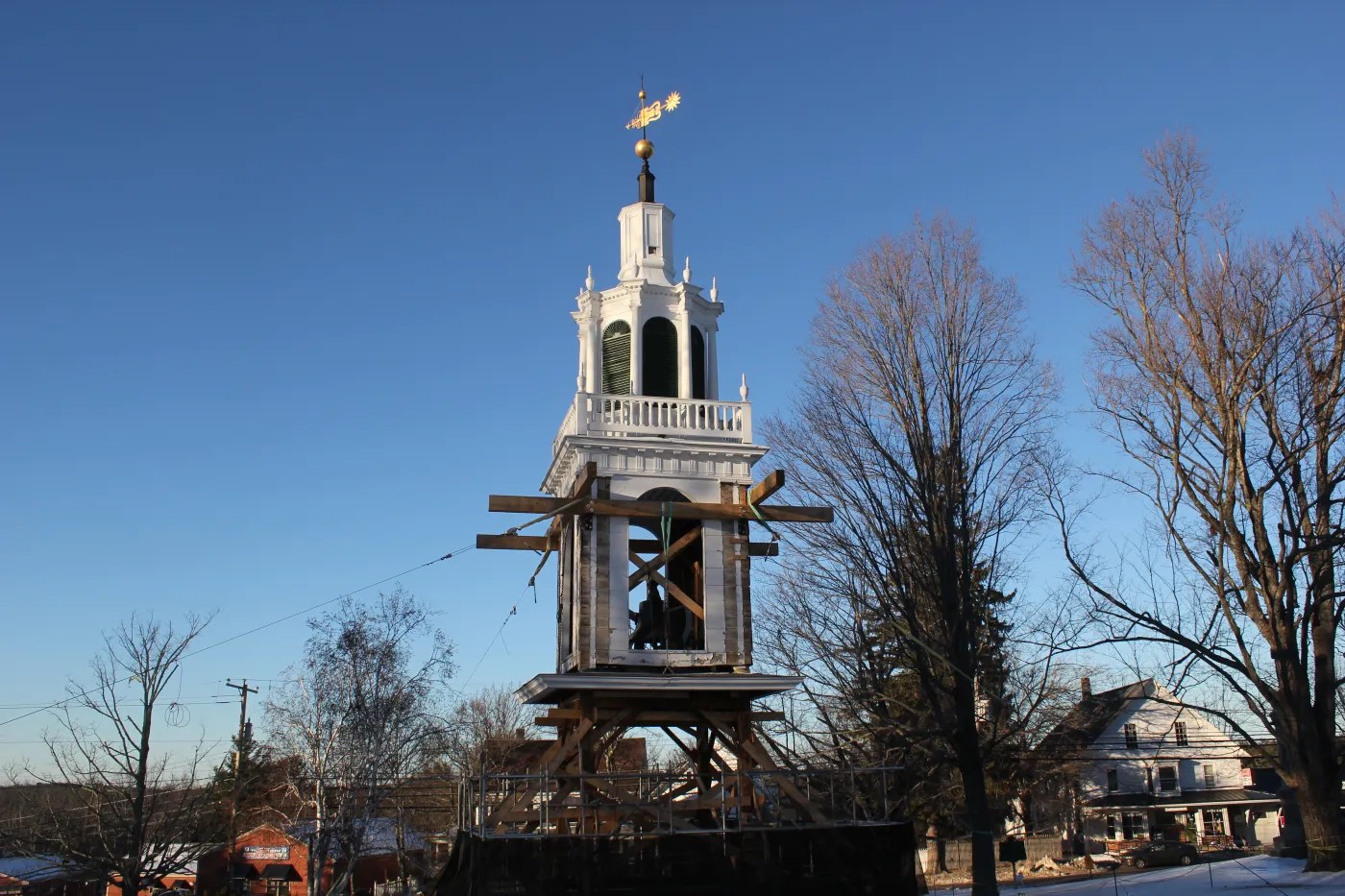
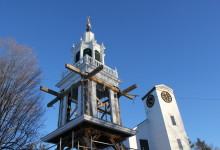
    Last Thursday, I popped out of bed at 4 am, like Sal on her way to Bucks Harbor. Scott informed me that if I wanted to help remove the Chestnut St Church spire in Camden, I needed to be there by 6:00. By the time I arrived, Scott and Arron had set the rigging. About a third of the way up the spire, eight laminated KD 2x10s poked through the spire like an avocado pit ready to sprout. PTF was hired to direct the spire removal and design a timber-framed transition from the old belfry frame to the new fiberglass spire. We’d worked with the G.C. before on True-Randall farm, Taylor-made Builders are good folks who do high-quality work; so even though fiberglass replacements are not our thing, we got over ourselves because Taylor and his crew are such a pleasure.

    IMG_7233

    This steeple is so tall that a 120′ man-lift couldn’t reach the weathervane on the day we went up there to remove the weathervane (oops). The main church is two full-height stories. Starting just below the main ridge-line, the belfry posts rise 30′ to a plate level just below the clock dials. The original spire rafters penetrate into the belfry, landing on a girt 5′ below the plates. The spire rafters pass through the dial level, behind four 6′ diameter glass dials.  Above the dials, the original spire rafters were severed and sistered with relatively light, laminated 2x4s. That repair was performed in the 1990s by a talented and eager Eagle Scout. This go-round, we designed a timber-framed “lantern” that crosses the belfry plates like a crab. Eight 8×8 posts rest upon the lower crab and support a maintenance floor behind the clock faces. The upper lantern plates, or upper crab, extends well into the fiberglass spire, 6′ above the horizon of the clock faces. Four new fiberglass dial hoods will protect the dials, and be structurally fused to the new fiberglass spire. The lantern frame we’re cutting reproduces the telescoped framing levels found in this building and other historic steeples.

    Lantern Iso, X-Ray
    Lantern Iso, X-Ray

    The model we’d created for the lantern design allowed us to accurately calculate the height at which the rigging would need to be placed in order for the spire to be slightly bottom-heavy as it flew. In fact, once prone in the driveway, the spire balanced like a seesaw on the fulcrum of its rigging. A top-heavy spire might flip mid-air, which would be just as dangerous and scary as it sounds.

    Chestnut St Church, Crane, and Rigging
    Chestnut St Church, Crane, and Rigging

    We hung a cage from the main ball of the frame to protect the weathervane from the rigging straps. We linked together the crane operators’ longest cables and our longest rigging straps, to connect the four corners of the metal frame to our rigging beams. The last strap was doubled over, resulting in an eight point pick.

    Spire cage
    Spire cage

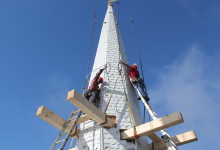
    The crane flew the rigging up to the crew on the top of the staging, and we pulled the rigging straps away from the spire as the operator located the ball directly over the weathervane. The rigging was accessed by ladders off the staging, which was less efficient than it was photogenic.

    Teamwork
    Teamwork

    Once the rigging was securely attached, we crawled inside the spire and used saw-zalls to cut first the spire sheathing, then the mast and then all eight rafters. In my experience, the penultimate step of severing the last connections is the most stressful and variable part of the entire crane day. As Arron warned the crew, a forgotten toe nail could prevent the spire from releasing safely and evenly. We were lucky to have a skillful crane operator from Keeley. We wanted the crane to take enough weight, and put enough tension on the rigging to prevent our sawzall blades from binding, but we did not want the spire to bounce or release with any energy.

    Witch's hat with a crown of thorns
    Witch’s hat with a crown of thorns

    Scott and Arron checked in with the operators. When we started cutting the sheathing, the crane had 1500 lbs of weight on the ball. For the mast, 2500 lbs. As the last of the rafters were cut, the crane was taking 3500 lbs. Unfortunately for the spectators on the ground, a safe spire removal looks slow and boring. Unfortunately for my story, the spire released without any hitches. The spire weighed about 8800lbs, which reflects its light framing.

    A Bittersweet Triumph
    A Bittersweet Triumph

    The crane operator lowered the spire safely to the street, and the crew cut the cone into sections small enough to carted away by a pulp truck. The Penobscot Bay Pilot got some beautifully boring drone footage of the removal, and covered the story, here. For more photos of our process, visit our Flickr album.

    Spire got the drop on you
    Spire got the drop on you
  • That Old Time Innovation

    That Old Time Innovation

    Central Congregational Church, Eastport, ME
    Central Congregational Church, Eastport, ME

    In 30 years of investigating New England’s historic churches, PTF has never encountered a better truss system than that of Eastport’s Central Congregational Church. Built in 1828, the roof system combines the traditional strength of a king post-prince post truss and principal rafter-principal purlin roof with innovative tying geometry that prevents the pitfalls of rafter slippage experienced by other churches we have investigated. The roof geometry has maintained its joinery even though the foundation appears to have suffered a landslide into the basement of the church, and most of the carrying timbers are being carried by their floorboards.

    Front Facade
    Front Facade

    The exterior façade stands out for the near complete preservation of its original composition and trim detailing. It serves as a prime example of how some Federal Era builders used relatively simple building methods and a small collection of hand tools to create arresting architecture by integrating detailing with overall composition of fenestration and major trim elements. The proportions of the pilasters are arresting, but the trim is not ornate. The pilasters are not fluted and the capitals have a simple, muted profile, devoid of carvings. The capitals are incorporated into the architrave and terminate at the full length gable return, which is deep, but has a short fascia. The pilasters terminate neither in an efflorescence like late Federal, nor in a broad stripe like Greek Revival. Instead, the return is a fine line. An eyebrow window, the width of the center third, punctuates the tympanum. The sash is decorated with three ovals drawn in tracery that repeat the rhythm established below. The building presents a façade that is both austere and elaborate. Austere in that the building is embellished exactly to the degree necessary to show reverence for the building’s purpose, and no more. Elaborate in that the design reflects a serious consideration for proportion and how every detail relates to the whole.

    Cantilevered carrying timber
    Cantilevered carrying timber

    The failure of the foundation can be seen from the outside of the building. In many places, the grade almost reaches the bottom course of clapboards.  In the rear northwest corner the foundation stones have caved in. A river runs through the right north bays of basement, where the clearance is 6’. The grade slopes upward to the south; the clearance in the southern joist bays is 1’ – 2’. Bulk moisture and lack of ventilation have deteriorated the timbers over time and the carrying beams bear the scars of inadequate repairs and forced-air heating ducts. The two rearmost carrying timbers are no longer connected to the sills, and the third is fractured. A replacement sill, under the narthex, is undersized, so that the adjacent joists don’t quite reach it. Fortunately, most of the joists are so oversized that they will function ably after the exterior ½” of slough is removed with a drawknife.

    Sweet daisy wheel
    Sweet daisy wheel

    In the process of undercarriage replacement, much of the foundation will also need to be rebuilt, and as much of the grade removed as possible to reveal pier footers and ensure good drainage and improved ventilation. Foundation and grading will comprise the bulk of repairs.

    King post - prince post truss system, looking rearward
    King post – prince post truss system, looking rearward

    The roof system has withstood the extreme deterioration of the foundation and undercarriage due to its exceptional design and level of craft. To the layperson, the Central Congo truss system is beautiful; the hewn surfaces of the timbers are shiny from the use of a sharp adze, and gently mottled, like hammered copper. At the center of the truss, the broad diamond-shaped head of the king post hangs from the apex of the rafters. Its long slender neck widens at two sloping shoulders from which two struts spring. Two wedged braces form an “X” connecting the trusses along the longitudinal axis. The struts each land in a undersquinted notch at the head of a prince post, from whose knees spring yet another pair of struts. There are two additional struts, or jack posts, just outside of the prince struts.

    King post - tie connection with stirrup strap and butterfly bolts
    King post – tie connection with stirrup strap and butterfly bolts

    To the timber framing professional, the roof system is sublime. The truss itself is at the peak of craft, from the detailed shaping of the king post to the undersquinted joinery at the prince posts. The bottom chord, or tie beam, 10” x 11”, appears to have forced camber so that its center is 2” higher than its ends. The king post/bottom chord joinery is reinforced with an iron stirrup, fastened with butterfly bolts. Not only is the truss exceptional, but they are tightly spaced, less than 10’ 6” on center. But it is the framing between the trusses that is truly innovative. The roof system is a principal rafter, principal purlin roof, with common rafters between the trusses. The principal rafter, or upper chord, is 9” wide, and tapers from 9” deep at its apex to 11” deep at its foot. It is connected to the next truss by a horizontal beam, called a principal purlin. The purlin is parallel with the eave, and about halfway down the roof pitch. Between the trusses, there are three common rafters. In a typical church roof, these commons land on a flying purlin that is joined into the ends of the adjacent tie beams. The problem with this design is that the tie beam is already missing a good chunk of material from the rafter mortise, and the rafter is actively pushing outward against the relish on the end of the tie. The flying purlin is often too undersized to really resist the thrust of the common rafters, and bows out and blows out the end of the tie beam, further compromising its joinery. Commonly, this results in the upper chord of the truss slipping out past the end of the tie.

    Truss Iso
    Truss Iso

    In the Central Congregational roof, there is no flying purlin. Instead, each common rafter lands on its own short tie beam, perpendicular to the eave, which runs over the top of the plate and ties back to a ceiling purlin connecting the trusses. The ceiling purlin is 9’ from the end of the tie so it doesn’t compromise the rafter joinery. The ceiling purlin and short tie are substantial. They are strong enough to actually resist the outward thrust of the common rafters. This means that the rafter mortise in the end of the tie is resisting a lot less thrust, and not a single one is blown out or even slipping. Additionally, the principal rafters are fastened to the bottom chord with an iron trunnel pin. The short tie solution is also found in the North Free Will Baptist Church, just up the road, and appears to be unique to Eastport. The truss system appears to be free of rot or any other damage.

    Spire rafter-belfry post connection
    20th century spire rafter-belfry post connection

    The tower was significantly rebuilt in the late 20th century, and while the repairs were not in-kind, they appear to be functioning. With the exception of one girt stabilization, all the tower needs is a good reaming and a coat of paint.

    The octagonal belfry and spire have clearly been through multiple generations of repair. The original spire was blown off the building in the Saxby Gale of 1869. This apparently does not include the belfry, much of which was also rebuilt in 1986 and 1994. Above the tower plates, the eight spire rafters join directly to their posts about 5′ from the belfry floor. There is no intermediate horizontal girt level for them to land on; the spire rafters join the tower posts at the center height of the louver openings. At the louver header, each spire rafter is further secured to a tower post by a 1 ½” iron stirrup that wraps around the rafter and is bolted to either side of the post. The belfry plates do not cross over the tops of the plates, they intersect the plate 6” below the top of the post. The tower posts terminate in a level cut. A belfry roof rafter connects the top of each post with a spire rafter.

    King and prince post truss, looking frontward
    King and prince post truss, looking frontward

    Access to the building has improved significantly since our first visit in summer of 2015. The removal of substantial pigeon detritus and installation of lighting is a testament to the high-quality stewardship of the Tides Institute and Museum of Art. The organization stands out for its initiative, community involvement, and generation of momentum. TIMA is clearly committed to the continued preservation of its historic structures.
    This blog post is a severely abridged version of the Central Congregational Church assessment that we performed for the Tides Institute this spring. TIMA has published a lot more about the building’s history, here.

  • Huge and Hollow

    Huge and Hollow

    Northwood BeforeDeep into the winter of 2014, a banner stretched like caution tape across the front of Northwood Congregational Church. It implored commuters from Portsmouth and Concord, “Don’t Judge a Church By It’s Outside. Look for Restoration Coming Soon!” The red text on white vinyl was the freshest trim on the front facade. The porch sagged, the paint was peeling, and the carved finials once crowning the belfry were many years gone. Still, any driver might have noticed the huge fluted columns more than 30″ in diameter. An unhurried driver might have recognized the church as one of the best examples of Greek Revival architecture in the state, even in its dilapidated state. The slight skew to the banner underscored the meaning in its message. No passerby could have guessed the depth of commitment within the building committee and dynamism of the congregation behind it. The PTF crew restored their church from 2015-2016.

    Early Photograph Northwood Congregational ChurchThe work was far-ranging, from repairing lightning damage in a king post to reproducing those finials from photographs. But the most impressive repairs were in the columns. The open portico is an important structural element, bringing half of the belfry weight to ground. But they are also an important decorative element, each stave carved with a tapered flute. When we first assessed the site, in winter of 2014, the deck supporting the columns sloped dramatically away from the building. The bottoms of the columns themselves were rotting, showing signs of decay, and the belfry leaned precipitously toward the road. Beneath the deck, we found a rubble stone foundation build on grade. There was no footer, no stone below grade, much less frost line. We supported the belfry on timber deadmen, staging, and steel I-beams while we removed the columns, replaced the foundation, rebuilt the deck, and repaired the columns. Arron documented the process in a series of photos, below.

    He described the tilt of the porch as “not quite 45 degrees.”

    Northwood porch foundation

    The crew transferred the belfry weight to structural staging, timber “deadmen”, and a steel I-Beams that picked up the corners diagonally. The rigging was accessed and adjusted by the crew using ringlock staging. Once confident that the belfry was adequately supported, the crew began to cut away the old, decaying deck, to prepare the columns for removal.

    Northwood porch, dismantling

    Using a chain fall, Tom lowered the columns safely to the ground. A custom carriage was used to transport the columns to our shop. At nearly 20′ long, one column claimed the entire trailer.

    Tom lowers the column safely to ground

    After the columns had been removed, we focused on foundation repair. The parish hall foundation had a granite cap stone foundation that was built at grade; there was no frost wall or footers beneath it. The parish hall was supported on cribbing and jacks, and the granite capstones were carefully removed. Using extreme care, Bob Cantwell excavated the soils below the parish hall. Chris McKinnon poured substantial footers. Then he used a one sided form to pour a frost wall up to and underneath the parish hall slab. The granite capstones were replaced, and new sills installed.

    The front wall of the church, under the columns, was similarly unsupported. The sagging deck was removed, and new footers, frost piers and frost wall were formed and poured. This foundation accepts the all of the weight from the front pediment, the portico, and half the tower loads.
    Front portico footerThe crew replaced the deck framing with white oak. The dimensions and layout of the timbers were identical to the original. They were tenoned into mortises on the front sill, and pitched slightly away from the building.

    Deck framing in white oak

    The new deck will support the portico and tower above. The structural columns were hollow. They were constructed out of individual staves toe-nailed to a series of round wooden forms.
    Hollow columnsWe assessed each individual stave for damage, trying to retain as much original material as possible. Where replacement was necessary, we cut tapered Eastern White Pine dutchmen and spliced them to the original flutes.
    Individual stave repairEach column capital was inspected, repaired and painted. They were constructed from rings of boards stacked, rotated, and laminated together. Each top was modified slightly to accept a structural post.
    Column capitalStructural timber posts were hidden inside the fluted columns. The posts were a necessary upgrade that will better transfer tower loads to the ground. The structural post was installed directly beneath the front exterior tie beam. The columns were not originally centered under the beam, and are not centered around the structural post.
    Structural post inside hollow columnOnce the front half of the columns is installed, the structural post is completely hidden. The front portico looks as it did originally, but is much more structurally sound.
    3 of 4 columns replacedOnce the columns were replaced, the crew could focus on structural repairs inside the belfry. The lower tower girts were replaced in-kind, along with the belfry bed timbers. All framing repairs were completed without dismantling the tower or removing the belfry. Once the structural repairs were completed, the exterior trim was restored. Balustrade elements were carved by hand, matching the few remnants of the original details, and early photographs. New louvers replaced poor reproductions. Bump outs were flashed with copper and new copper step flashing was installed at the base of the tower. The copper belfry roof was in good condition, and was modified slightly to accept the balustrade. George McKie, of Service Painting out of Lynn, MA, did a beautiful job of scraping, priming and finish painting. We are very proud of the result, but more than that, we are grateful to have been invited into this community. This project was so successful because the building committee recognized the importance of their landmark and committed themselves to appropriate preservation. They were one of the most responsive and knowledgeable groups with which we’ve ever had the pleasure to work.
    Northwood Belfry

  • Winter Street Center Ceiling, guest post by Jacob Imlay

    Winter Street Center Ceiling, guest post by Jacob Imlay

    Sanctuary, before
    The Winter Street Church Sanctuary, before remediation.

    (Hey readers, this was a cool job we completed over the summer, and Jake Imlay wrote up a nice blog post about it. Enjoy!)

    The Winter Street Center in Bath ME, home of Sagadahoc Preservation Inc., is striking at first glance. Sitting near the top of a hill, its gleaming white tower is outlined sharply against a blue sky. The tower is three tiered and ornamented in a Gothic revival style, with layers of pointed arches and slender spires topped with carved finials that look like spring onions. The building is flush board sided and bright white except for the window trim, which is red. The windows are triple hung and topped with a fourth fixed sash shaped into a pointed Gothic arch. On the whole, the simple strong lines of a New England church in white, and the more pronounced Gothic revival ornamentation work well together and the building manages to be eye-catching while fitting comfortably into its surroundings.

    Winter Street Center
    Winter Street Center, courtesy Sagadahoc Preservation, Inc.

    Inside, the main sanctuary space is defined by subtle curves. The balcony wall is curved, along with the narthex wall below it, and the ceiling has, or had, a deep cove. The narthex wall is the wall separating the front entrance, or narthex, from the sanctuary, and often offers structural support to a tower. This wall is where the curves originate. The sanctuary is close to 40 feet across and the curve starts at one wall and swings to the other catching the back center of the room at its deepest part. The pews mirror the curve as they move towards the altar as does the back portion of the balcony that wraps around three sides of the room. The last place the curve repeats is in the ceiling in an arch spreading from wall to wall. It was this ceiling and its spectacular failure that brought us onto the project.

    During a windstorm in August of last year, about a third of the plaster and lath detached itself in one huge sheet and came crashing down onto the pews below. The reasons for this are not entirely apparent, but the plaster ceiling is/was attached to a surprisingly slight structure of 1” thick pine boards suspended from the roof trusses. The one inch thick boards are widely spaced and the edges provide by a very small amount of fastening surface for the lath. It may also have had something to do with the family of raccoons living in the space above the ceiling. The combination of weather, light framing and furry squatters proved disastrous.

    Sagadahoc elevated timber deck, partially erected
    Sagadahoc elevated timber deck, partially erected

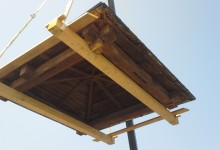
    We worked with EnviroVantage to clean the ceiling off the pews and erected a semi-permanent timber-framed platform from which they can demolish the remaining plaster and lath. The floor will pass over the balcony pews and land about 10 feet below the highest point of what remains of the arch. After the demo is completed, we’ll address structural issues in the roof trusses, and rethink the ceiling framing that defines the arch.

    Sanctuary interior iso
    Sanctuary interior iso

    The timber framed platform was conceived as a cost effective alternative to a more traditional staging setup due to the point loads in the basement, the nine foot cantilever over the balcony and and the amount of time it is going to have to be in place. Usually, it’s more economical and efficient to rent ringlock staging than to timber frame our own, but the timeframe for this repair is on the order of years not months. SPI was facing the rental of a lot of staging for several years or paying to erect and disassemble a lot of staging several times. The timber frame will result in fewer penetrations of the original sanctuary fabric, point load directly to ground and result in a work surface that is inherently stronger and easier to work off of than temporary scaffolding. The timber floor solution will allow the abatement crew to remove the remaining ceiling from rolling staging.

    Timber frame floor, from below
    Timber frame floor, from below

    The elevated floor is supported by four timber frame walls, consisting of seven posts, with paired braces and topped by a 60′ scarf-joined plate. The four plates are spanned by engineered I-joists, which pass over the balcony and rest on a knee wall adjacent the exterior eave walls. The biggest challenge in installing the timber frame floor was cutting the posts to the correct height. The tops of the posts needed to be level with one another for the joinery to fit, and the floor needed to be level in order to accommodate rolling baker’s staging. The main sanctuary floor rests on a series of six carrying timbers that run from eave to eave and the widely, unevenly spaced joists between them. The height of the sanctuary floor varies by more than two inches. We first mapped the carrying timbers in order to locate the posts directly over the carrying timbers, and to ensure the the carrying timber was supported by a pier directly beneath each post. We cut the joinery for the entire floor leaving the ends of the posts long. Once on site, we strung level lines across the sanctuary at the height of the elevated floor and parallel with the carrying timbers and measured down from the lines to the floor. The joinery was cut uniformly, but each post was custom cut to length. We were very pleased with how the joinery came together. If you want to see the plans, check out the Sagadahoc conceptual drawings. Sagadahoc Preservation Inc. is currently fundraising to restore their historic sanctuary, find out more or donate here.

    Timber floor, and arched ceiling
    Timber floor, and arched ceiling

  • Good Day, Bad Blog

    Good Day, Bad Blog


    Sub net pier from the top of the Wood Island staging
    Sub net pier from the top of the Wood Island staging

    This blog goes dark when it’s sunniest. Seems like every day this summer has been a good day to be working outside. We’re installing the last repairs to the undercarriage at East Derry First Parish Church, installing electricity for the clock at Hampton Town Clock Tower, waiting for the last of the ceiling to be removed at the Winter St Church in Bath and finally hanging exterior trim at Wood Island. They’re all big jobs, with little updates.

    ext-t1-wall-b-iso-w-church
    East Derry First Parish Church and steeple

    The First Parish Church is the biggest, heaviest building that we’ve ever lifted (thanks to Rick Geddes of Geddes Building Movers). The building was estimated at 188 tons, but actually weighs 288 tons. For the first time in PTF history, we bent a lifting bracket, as well as the shaft on a hydraulic jack (which is why we always use redundant rigging, and shim hard to ground).  “It’s been quite a challenge,” says job lead Brian Cox. A poorly conceived connecting ell was dumping water and moisture onto the historic meetinghouse, resulting in a nearly complete undercarriage replacement. Almost a year ago, we removed the steeple from the building and placed it on the front lawn to await repairs. In the early spring, the building was lifted, a new 4’ basement was excavated and concrete foundation poured. In May, the church was lowered onto its new foundation. Throughout the summer, Brian Cox, Dan Boyle, Seth Richard and Kirk Hennequin have been working diligently to replace any rotten girts and floor joists. Paul Lindemann on the restoration committee has kept a thorough blog to document their process and progress, and the building’s history. Read more here.

    Hampton Town Clock Tower
    Hampton Town Clock Tower

    The small Northern contingent of Lee, Jake, Scott, Seth and Jess built the Hampton Town Clock Tower this Spring and Summer. The standalone clock tower is building-sized display case for Hampton’s historic Howard round top tower clock. The 8-day clock, with dials that read “M E M O R I A L G I F T” instead of numerals, was given to the town in 1897 and ticking in the Odd Fellows Block until the building was destroyed by fire in 1990. The building is a design departure for PTF, as it references the Odd Fellows Tower, but does not replicate it. The four gable roof, topped with a “witch’s hat” spire, and four corner pent roofs was taken from the original building. Below, the body of the building is much simpler than the Odd Fellows tower. The 10’ arched windows reference the original arches, but the elaborate corner trim was eliminated, allowing the historic clockworks to take center stage. The clock will stand on a low lofted floor above the bell, making the clockworks accessible to its civic owners for the first time in history. Phil D’Avanza is completing repairs on the clock, and Skip Heal, of Northeast lantern, donated an enormous reproduction of the original weathervane. Read more about history of this clock, from installation, through destruction, disappearance and ultimate restoration.

    Sagadahoc elevated timber deck, partially erected
    Sagadahoc elevated timber deck, partially erected

    In August 2015, high winds shook loose nearly a third of the coved ceiling at the Winter Street Center in Bath, ME. Enormous swaths of plaster and lath crashed onto the pews, and hung loosely from the trusses. Remediating and repairing the 26’ high ceilings posed a unique challenge. The sanctuary needed to be cleaned of hazardous debris, and the rest of the dangling plaster needed to be removed. Following the removal, Sagadahoc Preservation will need to raise the funds to make necessary truss repairs and ultimately reinstall the ceiling. The process is expected to take years, and a lot of staging. Given the original timber framed floor framing, with large, widely spaced girts and joists, and the time-span of the project, it made more sense to build a timber-framed deck 13’ above the floor, and cantilevered over the balcony. The deck is perfectly flat, and allows EnviroVantage to safely remove the ceiling where it is 6’ above the deck at the eaves, and from rolling baker’s staging at the center of the room. The timber deck even allows Sagadahoc to continue to use and show the sanctuary as they fundraise for the next phase. Jake Imlay wrote a great post describing the building and our approach there. Coming soon.

    Wood Island Life Saving Station boathouse and tower
    Wood Island Life Saving Station boathouse and tower

    The restoration of the Wood Island Life Saving Station, in Kittery Harbor, has had Arron and his salty crew of Tom, Dave, Jake, Tim, Scott, Jess, Gail and Kendall up to their armpits in work. The life saving station was built in 1908 for the U.S. life saving service and became part of the coast guard in 1915. The U.S. Navy used the site to defend Portsmouth Naval Shipyard against U-Boats during World War II. Since the early 1950’s, the life saving station has been unused. Although the island is a popular destination for kayakers launching at Fort Foster, the building fell into dangerous disrepair, with radiators dropping through the floors. The Wood Island Life Saving Station Association applied for National Register status based on the building’s historic significance, and the integrity of the original interior trim and cabinetry. Over the summer, the intrepid crew rebuilt the boathouse, porches and dormers. As ever, sheathing repairs revealed more extensive rot than expected, but we’re finally finished with taking things away, and can focus on rebuilding. This week, we commenced with hanging reproduction trim milled right in our shop in Berwick. I’ve worked in wind like that on one other job-site: Mount Washington. We hope to have the building roofed by the end of September, which will mark the completion of phase one. And we’ve had some good press, from the Portland Press Herald to the Associated Press. Read more here.

    As much as we’ve enjoyed these projects, we’re looking forward to Fall, continuing repairs at the Abyssinian Meetinghouse and Troy Union Church and commencing work at the New Harbor Methodist Church, among others. When it rains, check back for more.

  • “We’ve been watching that steeple slant backward for years”

    “We’ve been watching that steeple slant backward for years”

    The Troy Union Meetinghouse had a crane day last week. The long-leaning steeple was partially dismantled, leaving behind the two front posts to stand like wooden antennae. The entire replacement frame has been cut by a crew of local craftsmen, and will be resurrected before the end of the summer. Read more about the process here, and show your support. If you don’t see a video below, click on the link to watch the story.

    http://wabi.tv/2016/05/12/construction-underway-on-troy-union-church/

    Check out Troy Union’s facebook page for the most up-to-date information about the project.

  • East Derry Derring-do

    East Derry Derring-do

    Steeple and Meetinghouse
    Steeple and Meetinghouse

    The First Parish Meetinghouse of East Derry, NH is preparing for a big anniversary, its tricentennial. What does one even get for a church on its 300th? Wood? Copper? Both, as it turns out. Beginning with a thorough assessment and rehabilitation plan in 2011, the congregation has been working steadily to repair extensive damage throughout the steeple and undercarriage. This past fall, we extracted the belfry and lanterns from the steeple stack. After the new year, we documented the upper sections from a woman-lift and dismantled them from finish to frame.

    Lower lantern roof, crowned with urns
    Lower lantern roof, crowned with urns

    As we surgically removed trim, we encountered earlier salvage efforts. Dan and Rod peeled back the gracefully curved roof between the upper and lower lanterns and revealed an oiled sailcloth roofing. The sheathing below was labeled November 1916.

    Lower Lantern Posts
    Lower Lantern Posts

    The frame was in far worse shape than we expected. Years of roof leaks and patchy repairs had finally overtaken the stout timbers. Once the lower lantern posts were exposed, we wondered how the structure was still standing and realized too late the bravery of dismantling it. Above, you can see that the six of the eight posts were hollow or non-existent at the top. An extensive repair campaign in the 1990s consisted of bolting channel steel and L-brackets to the crossing crab members (a “crab” is a horizontal web of timbers that spans the posts of a lower level and support inboard posts above). Looking at this picture, stiffening the crab fell far from the root of the problem.

    Lower lantern crab above belfry ceiling

    The crew struggled to free the timbers from their steel cages only to discover a corpse. It’s tragic that this rot wasn’t addressed when the church raised money for its repair two decades ago. A comprehensive, traditional approach at that time would have prevented the wholesale replacement necessary today.

    Truss spread

    In 1719, Scotch-Irish immigrants, fleeing religious persecution in Northern Ireland, settled the area that became East Derry. In 1722, they built their first meetinghouse on this site. The present structure was built in 1769. By its centennial, in 1822, the congregation had so grown that they cleaved the building in two and dragged one end 24 feet to the east. Above, you can see the first additional bay, indicated by the absent strainer beam and braces.

    East Derry Wall D
    East Derry Wall D

    In our assessment drawing above, the strainers and bracing between the trussses in bents 3 and 4 and bents 5 and 6 are non-typical. The strainers and bracing in bright green are non-existent; that is the bay in the photograph above. The yellow strainers and bracing between bents 5 and 6 do not quite reach bent 5, they are connected by a series of sisters and scabs. The evidence in the frame complies with the history: our hypothesis is that in 1822 the building was split between bents 3 and 6, (originally bents 3 and 4). Bents 6 through 9 were dragged to their current position, and bents 4 and 5 were built as exact reproductions of the originals. The strainer and braces that used to connect bent 6 (originally 4) to bent 3 were sistered to bent 5, and the strainer between bents 3 and 4 was deemed unnecessary. We are curious to uncover more of the eave wall framing, specifically the plates and the sill scarfs, to see whether there is more evidence to support our theory.

    Parallel rafter chord truss

    The East Derry First Parish truss is iconic. It has a king post in the center, with parallel rafter-chords and crossing pairs of ascending and descending struts. The king post is in tension, picking up the tie beam at the middle of its span, and the ascending struts rise from the king post and prevent the rafter from sagging. In the Timber Framing series, “Historic American Roof Trusses,” Jan Lewandowski explains:

    Outward pressure on the walls can be eliminated entirely by affixing the feet of each rafter couple to their own tie beam. The problem of sag can then be addressed by hanging a joggled vertical member, or kingpost, from these rafters and using it in tension to support the midspan of the tie beam… By a less obvious intuitive leap, it might be realized that the midspan of the long rafters can be kept from bending by struts rising from lower joggles on the suspended kingpost.

    East Derry Bents 1-4
    East Derry Bents 1-4

    The parallel rafter-chord is an innovation that protects the Achille’s heel of the king post truss. The casual observer often assumes that the joint between tie and king post is where we would most frequently see failure over time. I’ve seen many iron stirrups that attest to the builder’s concern for this joint. But most trusses fail at the rafter heel, where the upper rafter-chord intersects the tie beam. Of this foot joint, Lewandowski writes:

    Those we can inspect seem more prone to failure and impairment than most other connections in the truss, for a combination of reasons: the lack of relish beyond the mortise and the large forces involved, coupled with the low angle of attack of rafter to tie, all exacerbated by a high incidence of leaky eaves. The significance of the roof slope is that the geometry of low-pitch roofs channels more horizontal force against potential long-grain shear failure in the tie at the foot joint than it does comparable vertical breakout load on the kingpost at the peak (see TF 72, 19). The point: on both empirical and theoretical grounds, the principal rafter-to-tie beam joint is the likely weak sister in the mix.

    In Sedgwick, we saw the foot of the upper chord shear a 2″ x 12″ x 22″ block clear off the end of the tie beam (It was about the size of a hefty wedding-present-breadboard). With a parallel rafter-chord truss, the duties of principal rafter and upper chord are separated. The principal rafter, the top angled timber, carries the roof, while the upper chord, the inner angled timber, carries the compressive loads created by the truss. The upper chord intersects the tie beam farther from the end of the beam, thereby protecting the relish just past the joint from shear. We so liked this truss that we reproduced it in a building where it will be on grand display: the Lewis Conservation Center.

    Steeple extracted

    Paul Lindemann, East Derry historian and devoted parishioner, keeps a detailed website documenting the history of the church and their repair process. The Nutfield History blog is a fascinating read for anyone interested in New Hampshire history or building history in general. The blog also benefits from Lindemann’s web design skills, something that doesn’t always attend the dual callings of historian and parishioner.

    The vigor and ingenuity of the immigrants who built this Meetinghouse is evident in its frame. We honor their labor with our efforts to preserve it. In 300 years, what will historians write about the immigrants seeking refuge in the United States today?

  • Kung Fu Timber Framing

    Kung Fu Timber Framing

    Time to Lean
    Time to Lean

    Troy Union Church was built in 1840, in a vernacular style that combines elements of Greek and Gothic Revival. It is a modest building, 34′ x 42′, built to host the small town’s various Christian denominations, hence the “Union”. Caught up in that communal spirit, the bell tower is preparing to take a trust fall onto the back of the church. I’ve photographed a lot of buildings, and capturing a slumping wall, or humped roof can be challenging. This steeple has a model’s slouch. In fact, the center of the tie beam supporting the rear tower sags 7″ below eave height. The 10 x 10 tie beam is 34′ long, which means that there is a 7″ deflection over 17′.

    Bent 2, rear tower wall. Yellow string represents height of tie beam at eaves
    Bent 2, rear tower wall. Yellow string represents height of tie beam at eaves

    Typically, we also have trouble photographing center rot in a beam. The timber will be hollow, but look perfectly sound on its face, the only visible evidence seen through the pin’s hole in a mortise. At Troy, there is a crevass in the top of this tie beam, a 3″ x 12″ valley of rot. PTF stabilized the steeple in 2011; building a cross braced KD wall to support the failing truss. The fact that the timber was able to deteriorate that far, without dropping the entire tower, is a marvel.

    Rot Crevass
    Rot Crevass

    The design of most New England steeples is idiosyncratic. Vernacular church design is informed by regional tradition, availability of materials, individual ingenuity and a shared copy of an Asher Benjamin book. Entering a church attic can feel like entering the builder’s brain. Especially so at Troy Union Church. The main timbers are hand hewn, and the design is uncomplicated, braced wherever possible. The king post truss is without flourish, straight-sided, no flare at the head, or shoulder at the struts. The rear tower wall is a common adaptation of the queen post truss, where the tower posts take the place of the queens. Occasionally, such an adaptation can be successful, like the queen post truss in the United Church of Craftsbury Common, VT. Unfortunately, at Troy, the revised truss misses the mark. The large braces running from tie to tower post aren’t large enough to serve as upper chords, and the girt isn’t located properly to function as a strainer. That said, its hard to fault a design that supported the bell tower for more than 170 years.

    King Post Trusses Bents 3-5
    King Post Trusses Bents 3-5

    The restoration effort is led by Norma Rossel, one of 12 remaining members of the congregation. Soft-spoken, Rossel challenges one’s expectations of leadership. She is as determined as she is doe-eyed. In the Kennebec Journal, Rossel explained, “”The ladies of the church got together and said, ‘It’s up to us.’” With a population of 1000, Troy faces a challenge shared by many of Maine’s rural communities: they are in possession of a historically significant building but lack the resources to repair it. The Maine Steeples Project, of the Maine Communities Foundation, was established to address just this need. In 2011, the church was elected to the National Register of Historic Places, and received from the Steeples Project a $2,500 grant for assessment and stabilization. The church received an additional $15,000 grant from the Belvedere fund, in total raising nearly $40,000 to re-build the trusses.

    Still, it wasn’t feasible for the church to hire PTF outright. The congregation is tiny, the budget is tight, and the travel costs would be prohibitory. It will take double the funding they’ve raised already to place the trusses and complete the restoration. Fortunately, what the community lacks in local funding, it makes up for in skilled neighbor. Through connections made at a longstanding monthly potluck, Rossel found Marvin Daugherty, a caregiver and swordmaker, and Scott Pfeiffer, a farmer at the Garcelon House, a cottage industry incubator. Pfeiffer recruited Adam Joy, who raises goats at his farm and has some timber-framing experience with an uncle at Red Suspender Timber Frames, to join the restoration effort. Troy used to be called Joy, ME, and Adam descends from its founders.

    Pfeiffer and Joy sighting plumb for Daugherty, drilling pin holes
    Pfeiffer (left) and Joy (foreground) sighting plumb for Daugherty drilling pin holes

    Pfeiffer is a busy man, he and his partner sell eggs, produce wool, and maintain an organization that runs like a communal homestead. He says he is a farmer in every sense of the word, in that he farms himself out to the work that needs doing. He cannot afford to volunteer through the winter months, and neither can his fellow crewmembers. Following the model used to restore the Acworth Meetinghouse, Preservation Timber Framing will provide documentation, a repair plan, training and on-going guidance to the crew. The crew receives training and is paid a fair hourly rate that saves the church money, while spending fundraising dollars locally.

    Bent 2 frame elevation
    Bent 2 frame elevation

    In March, we visited the church to document existing conditions and develop construction drawings. Daugherty and Pfeiffer had already removed the sanctuary ceiling, allowing light into the attic space and making documentation much easier. We try to preserve the original design of a frame wherever possible, but the modified queen post truss at Bent 2 was under-engineered for its task: supporting half of the bell tower over an open span of 32′ (there is a 1′ overhang past either plate). We recommended rebuilding Bent 2 as originally arranged, with slightly larger timbers, and inserting a king post truss directly behind it. The new truss would be a replica of the king post trusses in Bents 3 and 4. Two bed timbers will run directly beneath the tower posts, and span from the front gable to the new truss, spreading the tower load over three tie beams (Bents 1, 2 and 3). We drew up detailed construction drawings of the repair plan, and assembled the crew in Troy.

    Fitting and Filming
    Fitting and Filming

    Timber Framing isn’t particularly complicated, but it is a rare skill, unlikely to be encountered on contemporary job sites. Working with large, un-dried timbers requires a completely different conception of layout, relying on reference faces to account for variation and shrinkage. It also requires a furniture-maker’s attention to detail, a basic understanding of the forces that put beams into tension or compression, and willingness to use hand tools. Scott Lewis and Lee Hoagland met the crew at the Garcelon House, in Troy, which Pfeiffer graciously offered as a cutting yard. The crew was accompanied by sheep, goats, pigs and geese in an adjacent barn, along with their spring lambs, kids and piglets. They spent a day organizing the yard, spreading out and labeling posts, rafters, struts, braces and tie beams. They showed the crew how to establish and use reference faces and arrises, how to lay out a line and carry it around the timber, and how to lay out joinery from cut drawings. Scott and Lee laid out mortises and tenons while the crew cut. They wielded 16″ circular saws and chainsaw mortisers fearlessly. It took the crew about two weeks to complete the cutting. As soon as the weather cooperated, Scott, Lee and I returned to Troy to fit the pieces together.

    Assembling the king post truss
    Assembling the king post truss

    We were met there by two local TV crews and the Kennebec Journal. Rossel will use the completed frame to raise the money needed for a crane to put it in place. WABI Channel 5’s coverage focused on the repair process and the timber framing itself, while ABC 7/Fox 22’s coverage shows more of the church. The Kennebec Journal wrote a great article detailing the history of the building, and Rossel’s efforts with the community to raise the restoration money.

    Scott Lewis checks the fit of the half dovetail joint
    Scott Lewis checks the fit of the half dovetail joint

    Marvin Daugherty speaks in the sort of aphorisms you’d expect from a practitioner of Kung Fu and maker of samurai swords. When asked how his skills working with metal transfer to working in wood, he responded, “skill is skill and either you have the touch or you don’t” and that “it’s just being sensitive to things.” He says, “If you can be good at one thing, you can be good at a lot of things.” Talking to Daugherty, I learned that a person can have Kung Fu in any craft that requires training over time, and that the singular association with martial arts is an American invention. I must not have a good appreciation of Kung Fu, because what impressed me, visiting the jobsite in Troy, was how quickly Daugherty and the rest of the crew had picked up timber framing. After training with Scott and Lee a handful of times, Pfeiffer, Joy and Daugherty had re-constructed the entire rear wall of the bell tower and a beautiful king post truss. If you are interested in the efforts to complete the restoration, please visit the Troy Union website.

    More photos, below:

  • After Fire, a Family Doubles Down on Preservation

    After Fire, a Family Doubles Down on Preservation

    Restoring an historic building takes a lot of stamina. The sense of warmth and meaning one feels within a restored structure comes from the labor invested by the craftspeople who built it and the experiences of the community that used it. Once complete, the Steiner-Truesdale residence in Newfields, N.H.,will reflect not only a century of life as a church, but also the owners’ dedication to restore it as a family home, twice. In April, a fire destroyed much of the interior, an 8-year long labor of love for owners Jack Steiner and Kimberly Truesdale. In November, PTF began its role in the home’s re-restoration.

    Ribs and Roof system
    Ribs and Roof system. Photos by Brian Cox

    Newfields’ Sacred Heart Church was built in the 1880’s — a transition frame, 40′ wide by 80′ long. Five interior timber bents were constructed from a pair of posts, a pair of steeply pitched rafters, two pairs of ribs and a collar tie. The lower ribs brace the posts to the rafters and the upper ribs brace the rafters to the collar tie. The ribs are let-in and bolted, rather than mortise-and-tenoned, reflecting the dominant technology of the period. A tie rod takes the place of a tie beam, tying the eave walls together. Had the church had been built in stone, in the original Gothic style, buttresses would have provided the support necessary to counter the outward thrust of the rafters. The roof system is substantial, consisting of the principal rafters let in with principal purlins and infilled with common rafters. The balloon studs run from sill to plate, and are spaced approximately 20 inches on center. The plate consists of doubled 2x stock, which is mortised and fit onto a tenon at the top of each of the posts.

    Stopped chamfer detail
    Stopped chamfer detail

    PTF was hired to rebuild a second floor that had been destroyed in the fire. The height of the floor was determined by the tie rods, so that the rods could be enclosed between the 10″ high floor joists. Two 8″ x 10″ x 60′ floor girts run parallel to the eaves, supporting the joists. Five pairs of posts, in line with the bents, support the girts. The posts rest on first-floor girts, or carrying timbers, parallel to the girts above. The carrying timbers rest on masonry piers set directly beneath the posts, point-loading the interior structure to ground. Ultimately, the entire frame will be exhibited within the living space. The timbers were planed, and the crew matched a chamfer detail from work that Jack completed: a 1″ chamfer on all posts and girts, a 5/8″ chamfer on joists and braces, stopped 1 1/2″ from joinery.

    Once onsite, Brian and the crew’s first step was to unload and organize the stock. In addition to the six 8″ x 10″ x 20+” stock required to create the second floor girts, there were more than seventy-five 4″ x 10″ x 12′ joists, ten posts, and sixteen white oak braces. The crew, Brian, Shawn and Seth, took half a day to lug lumber, moving the timbers along a pick through the window, and another day just to organize it all. Organizing timbers is like sharpening chisels –t ain’t romantic, but it’s necessary to a well-run job. A clean and well-organized job site makes a big difference in the efficiency and accuracy of the good stuff, such as cutting joinery.

    Shawn, girt timbers, and Shawn's breath
    Shawn, girt timbers, and Shawn’s breath

    All the joinery was cut and test-fit on sawhorses prior to installation. Each 60′ second floor girt was made up of three 20+’ sticks joined with two bladed scarf joints. Cutting a frame indoors in November sounds like a pretty cushy job, but because the floor girts and joists were so long and still green, the crew wanted to do everything possible to prevent them from corkscrewing, and this meant working without heat. With the heat off, the timbers would dry more slowly, ensuring their stability. Furniture makers will sometimes avoid kiln-dried wood, instead stacking freshly-cut boards evenly; plenty of air flow lets the boards dry naturally over the course of years.

    Thanks, Grandma! the scarf fits perfectly.
    Thanks, Grandma! the scarf fits perfectly.

    Each of the posts was connected to the floor girt by two braces. After cutting, all of the brace joinery, as well as the six scarves, were fit and laid out on sawhorses. In order to prevent the joinery from opening as the timbers dried, the crew decided to draw-bore all the joinery. Draw-boring is a joinery technique in which the pin hole in the tenon is placed 1/8″ closer to the shoulder of the joint than the pin hole in the mortised piece. A tapered pin is driven through the holes, squeezing the mortise and tenoned pieces closer together.

    Lee and Scott assist with assembly
    Lee and Scott assist with assembly

    After the pinholes were drilled, the crew erected two towers of staging along the center of the church. Using a chain fall, they lifted the three pieces of one girt into place, and re-assembled and pinned the girt on the staging. Next, they righted the posts and threaded their feet through holes in the first floor, maneuvering the posts into mortises on the carrying timbers below. Due to variation in floor depth, the posts were buried 9 1/2″ – 22″ below the surface of the first floor. The crew squared and plumbed the posts and temporarily braced them to the exterior walls with 2x lumber. Then the oak braces were fit into their mortises and pinned.

    Second floor girt in position, and blurry
    Second floor girt in position, and blurry

    Three one-ton chain hoists were needed to raise the assembled 50′ floor girt into position, 4 1/2″ above the post shoulders (and 1/2″ above the ends of the tenons). The girt just kissed the 1″ round tie rods, which ultimately run between the 10″ high floor joists. When the weight was released from the staging ledgers, those ledgers sprung up, and as the ledgers were removed, their wedges popped out with a “ping.” Coordinating efforts, the crew released the chain falls and slowly lowered the girt onto the five post and eight brace tenons. Then they pinned the joinery. For the second girt: rinse, and repeat.

    Floor framing, resurrected
    Floor framing, header visible near window, far left

    The second floor is supported by more than seventy-five 4″ x 10″ x 12′ joists, which were lifted into place using a winch. At each of the eight windows, the crew created a window well by inserting a 6″ x 10″ header between the joists adjacent to the window, so the top of the window and the arched trim can be seen from the first floor. The header fit into a pocket into the adjacent full-length joists, and the short joist sits in a pocket in the header.

    With the framing now complete, the Steiner-Truesdale family can finish their adaptive re-use of this Gothic Revival beauty. We were truly saddened to hear of the fire, and now we are honored to be part of this building’s journey.

    Completed framing, from below
    Floor framing, from below

  • Guest Post by Lee Hoagland: Castine’s First Parish Church, its History and Restoration

    Castine First Parish Church, photos by Lee Hoagland
    Castine First Parish Church, photos by Lee Hoagland

    On the northeastern side of Penobscot Bay in downeast Maine sits the town of Castine, an elegant town with a rich history. Our crew was called into town because some structural issues had been detected in its First Parish Unitarian Universalist Church. Having never visited before I was struck by the town’s wealth of early American architecture. I feel that a short note on the town’s early turbulent history goes a long way to support much of the building’s history. Castine was originally settled as a trading post in 1613 by the French. However, it spent the next century being taken back and forth between the Colonists, British and French, with even the Dutch having control for a bit. After the French and Indian War the Maine coast was opened up to the Massachusetts colonists, only to have it re-seized by the British in the Revolutionary War, which eventually led to the Penobscot Expedition, one of the greatest losses in American naval history. It then was briefly returned to the colonies, in which time Castine became a town (separating from neighboring Penobscot in 1796). Castine was then again re-seized by the British in the War of 1812, where they controlled it for the length of the war.

    In the years that followed Castine was able to prosper thanks to the booming fishing and timber industries that ran through the Penobscot River and Penobscot Bay, making Castine the perfect place for ship captains to build their dream homes

    The First Parish church that we are working on had originally started construction in 1790 and became a meeting house in 1796 with a steeple protruding out from the front gable. However, it did not have a minister until 1798. These dates are important because they correspond with the timeline of the town. The people of the town were most inspired during that time when they were rallying to be their own town. The need for a place to meet was essential in becoming a community, and not another military post.

    Shawn working in tower box
    Shawn working in tower box

    According to our research the original design had a steeple and tower box out front. The joinery layout supported the research because the bent that makes up the front gable wall is referenced to the inside of the building, in the same direction as the rest of the bents. Typically the reference face on the exterior southern bent is flipped around so that that all exterior walls are referenced to the outside of the building. Thus we can make the conclusion that there was a tower box bent in front of what now is the front gable, making it an interior bent at that time.

    Sweet dragon and cross in tower hip roof
    Sweet dragon and cross in tower hip roof

    The building stayed this way until the prosperous town was at yet another turning point. The First Parish Church represented more liberal Unitarian beliefs, and in 1828, a more conservative religious offshoot was created, calling themselves “The New Trinitarian Society,” and founding the Trinitarian Congregational Parish. By 1831, in an effort to stay with the times, the First Parish church took the steeple off the front, and installed a Greek Revival belfry on top of the front gable. In some readings it is described as a “joyful crown” and is thought to be a Bulfinch design. Inside the tower box, the joinery again supports this history. Each of the hewn posts are joined by scarf joints to sawn timbers that extend the box higher into a hipped roof.  The hipped roof was constructed with a truncated dragon and cross joint to carry the hipped rafter. Between the scarfed posts and the roof three new girts were installed. Two girts run perpendicular to the bents and one runs parallel to the front gable, off the second bent. All three girts are supported by ascending and descending 4×5” braces which run by each other to tie that level to the top plate.

    The fourth girt that makes up the tower box was once a tie girt in the bent adjacent the original tower box. This tie girt is located approximately two feet below from the additional three girts. Floor joists are cogged over these girts, running perpendicular to the bents. Four bed timbers rest on that floor. The bed timbers support the eight posts that create the belfry. These posts are 10×10” white pine from the level of the bed timbers to the roof frame, then turn into columns with ionic capping at the top. The bed timbers are in a concentric square inside of the girt level, their weight and the weight of the belfry posts supported by the floor joists, rather than directly over the girts. This caused the girts to roll in towards the interior.

    Rotten belfry post
    Rotten belfry post

    In the first half of 2012, Castine contacted PTF about a leaky roof. Since the posts penetrate the hipped roof, it creates eight holes in the roof that need to be flashed with the utmost care, so that water cannot run down the post and sit on the bed timbers, rotting out both the bed timber and the post foot. That is what happened in this church’s case. Thus we find our scope of work: to replace the rotted bed timbers and fix any post bottoms that might need it.

    Jack and bracket supporting belfry post while bed timber is replaced
    Jack and bracket supporting belfry post while bed timber is replaced

    One of the real challenges on this project was to lift all of the posts, and everything above the tower box, to access the old bed timbers while still being able to move our new timbers into position. We threaded 2x8s into the tower box and screwed them to the studs and braces of the tower box creating a laminated beam just outside the ring of belfry tower posts. Then we used other 2×8 beneath the laminated beam as jack studs, transferring the load directly to the tower girts. We lag-screwed an L-shaped steel bracket to each post, and used hydraulic jacks on top of the laminated beam to lift the bracket and the post it was attached to. This gave us the opportunity to lift all the posts while having the entire interior of the tower box to do our work.

    Only half of one bed timber looked original, sitting in same orientation as the others which looked like mid-20th century fixes. This led us to believe that flashing must have leaked at least once before. When we removed one of the newer bed timbers, we found a signature and date of 1936. This also matched up with church records.

    Tom, post fix, and bed timbers
    Tom, post fix, and bed timbers

    We decided that since we were replacing so much and needed to lift the entire belfry that we had an opportunity to change the design for the better and used a common historical design in which the bed timbers are run from the middle of connecting eave walls, picking up two of the posts. This transferring of the weight onto the girts spreads the load out onto the walls and off the floor joist. To do this, we needed a fourth girt in which would run coplanar with the three other girts. So we fabricated a girt that joined to the posts with free tenons inserted in the bottom of the girts, allowing it to take horizontal tension and vertical compression.

    Rolling bed timber into building
    Rolling bed timber into building

    Now that we had a coplanar box we were able to bring up our 9×12” white oak bed timbers. One of the big challenges of this project was getting the timbers up to the tower box while only having interior staircases to move through, but we were able to get them where needed them to go through a series of rigging. Fortunately all of the members were just small enough that they could fit.

    Inserting bed timber
    Inserting bed timber

    We had two chain falls that helped immensely and with that we fabricated slides out of dimensional lumber that saved all around wear and tear. We all really get our jollies off during this kind of rigging and by the time it was over we felt more connected than ever with the timber framers of the past in the ever present quest to lift heavy things up high.

    New girt inserted in front bent
    New girt installed in front bent

    After the bed timbers were in place we were able to connect them to the belfry posts using free tenons that engaged the bed timbers. Although we were confident in the soundness of the timber elements we installed threaded rod between the girts and the bed timbers and between bed timbers and posts creating a tension connection that would help hold the belfry to the tower box and the rest of the building. This gives the belfry additional stability, which is helpful in cases of extreme weather.

    Overall, we enjoyed the dynamic nature of the project and the rich history of Castine. We found the locals to be friendly and knowledgeable and the ocean views to be one of a kind. Although Castine doesn’t have the fame that some other early battleground areas do, it has a staggering significance in its role in the shaping of both the State of Maine and the United States.

    -Lee Hoagland

    Click on the slideshow below for more photos from the Castine project:

Think we can help? Get in touch.