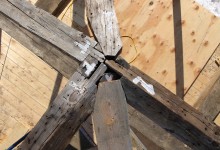
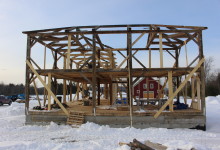
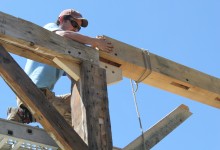
To the crew at least, the most impressive piece of the French frame is the roof system. The roof has a very low pitch: the apex of the ridge is little more than 4′ above the tie beams. There are two continuous ridges, each about 30′ in length, that meet on top of a short mast at the center of the crotch of the L. Each hip-roofed end also has mast resting on a mid-span tie beam, which catches the rugged hip rafters. Each full length tie beam is topped by a pair of principal rafters which tenon into the ridge beam.
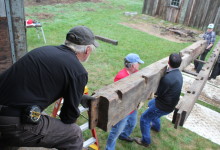
Plate installation with Jake and Scott. Photo by Timothy Sweeney
The tops of the posts are ringed by a set of co-planar plates, joined to one another by mortise and tenon. There is 38′ plate along the south eave and a 36′ plate along the west eave. There is another full-length plate along the north eave connecting the east gable to the west eave. At the inside corner, where the valley collected rainwater, and where an interior post was removed or missing, the north eave plate failed, and required a long double-scarf repair (being assembled, above). For this house, we used plate to refer to the gable end timber that tops the studs and connects the corner posts. To create hip construction, this beam itself is crossed by a set of tie beams.
Foley Roof Frame
The tie beams cross over the plates using a partial half dovetail joint and overlap the plate to a depth of 3″. There are four full length tie beams in the main portion of the building and five full length ties in the ell. The ties closest to the gable are about nine feet from the end of the building. Two short tie beams cross the gable end plates and join the full length tie beam with a pinned mortise and tenon joint. A hip, or dragon, tie extends diagonally from the short tie and clasps the plate joint at the corner.
Hip tie clasps plate joint.
Each tie type is topped by a distinctive rafter. The full length tie is topped by a pair of principal rafters, which tenon into the end of the tie beam. The hip tie is topped by a hip rafter, and the short tie is topped by a jack rafter, which joins the hip rafter at a compound angle and full mortise and tenon joint. Zach had fun scribing one of these babies.
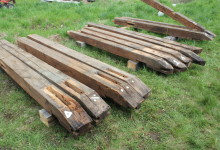
Masts in the Grass
A short four-foot mast supports the apex of the roof, receiving the end of the ridge, two principal rafters and two hip rafters. When we were inventorying the frame, the mast joinery looked rough, like it had been hacked with an axe. There was no consistency to the cuts, and no way to accurately model the joinery. When the frame was in parts, we weren’t crowing about the original builder.
Jake installs a jack rafter
We assembled the frame using a lull, dead men and muscles. Considering the inconsistency of the bents, and the complications of the second floor, hiring a crane wasn’t efficient. Using a crane on-site for more than one day is a huge investment, and more than two days was beyond the scope or need for this project. So the raising was incremental, and slow.
Raising in progress. Photo by Timothy Sweeney
We waited to assemble the roof parts until after the rest of the frame was raised. There was no advantage to fitting the parts on the ground. We had almost all the original roof framing, and we were going to sheath the second floor as soon as it was raised, providing us with a contiguous deck on which to roll staging. When we finally placed the first roof timber, we were more than a year into the project.
Scott fits rafters to mast
Where assembling the house frame was frustrating, assembling the principal roof frame was gratifying. The original principals landed on the original masts like they were going home. The ugly axe cuts at the top of the mast were beautifully scribed to the undersides of the hip rafters. In modeling the roof frame, we could tell that the design was complex, but until we fit the pieces together, we had no idea that it was also beautifully crafted. It inspiring to witness, and to contribute our skills to its repair.
Two ridges, three rafters, one mast. Photo by Timothy Sweeney
This is the third post in a series about the Foley-French House. Check out more in progress photos, here, or by clicking on the slideshow below. If any of the photos look professional, but they don’t say “by Tim”, I forgot to credit Tim. Next up, scarf joints.
French House, c. 1804. Kingston, NH, Front Elevation. Photo by Charles Foley
If you are prone to feeling lazy, you’ll have to ignore the Foleys. In addition to their intense day jobs, they care for four horses, a flock of sheep, chickens, and a pack of wild dogs (it’s only two dogs, but they have a lot of energy). The French frame is the third frame we’ve raised on their farm and they finish the projects after sheathing. Sheila dug the footers for the solar array herself. At the outset of our most recent project, the couple was so involved in the design process that it wasn’t really a PTF design job at all. And that worked well for us. I’m happy as a draftsperson.
The French Frame, built in 1804, is L-shaped, two stories, hip-roofed, and always has been. It was also remarkably intact for two centuries of adaptation and use. The posts are tapered gunstocks and varied widely in dimension. Each leg of the L is 18′ wide; the front eave is 38′ long and left eave was 36′ long. The house was built with three full length plates – front (south) eave, rear (north) eave and left (west) eave – but the rear plate was damaged at the rear interior corner, and required a long scarf repair. Assembling the plates made us wonder at how they did it without a combustion engine. We added three bents off the rear (north) end of the ell, bringing its overall length to 68′. We also added an additional bent between the two original ell bents because 18′ is way too long a span for contemporary floor load requirements.
French House, Left Elevation. Photo by Charles Foley
PTF came aboard after the frame had been dismantled in Kingston, NH, transported, and stacked into temporary quonset huts in Poland, ME. I described our process for deciphering the frame here and a little bit here. Our first day back on site we inventoried and assessed the frame’s condition and I drew a 3D model using SketchUp. There are a number of other 3D modeling programs used by design professionals, but SketchUp has so far been best at meeting our timber framing needs. The next time I approach a project like this, I will model each timber to its exact specifications from the get-go. This will make it harder to establish the building’s overall dimensions initially, because hewn timbers vary and joints loosen, but it would negate the need to go back and make tedious changes to the model at cutting time.
Tie Level Hip framing
It’s not always a pleasure to work with a client who wants to share the work load. Scheduling can be a challenge. The arrangement requires both a clear delineation of tasks and flexibility to address problems as they arise. We have been lucky in our partnerships, but in this case, the design collaboration was ideal. Charley had a very specific vision and was able to convey it using an iPad floor plan app, in addition to teaching himself a little SketchUp. He has strong preservation aesthetic, and wanted to preserve the building’s original elevations and roof overhangs as close as possible within the bounds of modern building codes.
Simplified First Floor Plan
The Foleys retained a traditional floor plan within the original frame, and sequestered newer elements to the three bent extension off the ell. The building has a center stair layout with a chimney stack is built into either end of the main body of the building and a fireplace on each floor. In the ell, a third chimney mass is the focal point of the kitchen, with a traditional cooking hearth and beehive oven. George Libby of G.M.Libby and sons masonry designed the chimneys and provided guidance on their integration within the frame. The company specializes in traditional masonry and we have been very impressed with their work on previous jobs.
In contrast with a house museum, a house needs to meet contemporary building codes even if it is trying to maintain NPS-level standards. Balancing insulation requirements within a traditional frame is always a challenge. Usually, the client must decide between building out and building in. Building out means that an insulating exterior skin will be applied to frame like with SIPs or shop-made insulated panels. The advantage of building out is that the frame is visible to the interior. The disadvantage with a traditional frame is the exterior no longer resembles its original proportions. For our shop in Berwick, Arron chose to insulate to the outside, using a shop-made sandwich of pine shiplap and denim insulated batts. He achieved a fairly traditional look, but the walls are certainly thicker than the original barn wore. For this project, the Foleys wanted to insulate to the interior, and retain views of frame to the extent possible. This results in elevations that are much more true to the original building. At the first floor level, the clients will see the interior face of many of the posts and more timber in the second floor framing than the 2013 pop charts. On the second floor, the impressive tie and dragon beam configuration will be visible as well as most of the posts where they flare to meet the tie beams. Unfortunately, insulating to the inside will obscure the principal rafters. In most of Maine, code requires R-49 in the roof, resulting in 13.25″ of the preferred insulation, Roxul batts.
Y-stair section, simple-style
Fitting stairs is always the other big squeeze. In many buildings of this age, stair rise is taller than run is long. An 9″ rise and 8″ run is not uncommon. At my in-laws house from 1840, my size-tens ascend the stairs sideways, like a crab doing the grapevine. In order to approach the original layout of the French house, the front stair rises directly from the main entrance and doglegs to the left. The rear stair behind the beehive oven was my favorite design challenge. It was similarly limited by an overall 18′ run, with 3′ landings, minimum, on either end. Due to the second floor plan, the rear stair is Y-shaped, leading left to the master bedroom and right to a hallway that accesses the bath and music rooms. The master bedroom is private, being sequestered from the second floor family space, and accessible from the kitchen and frequently used rear entrance.
South Elevation, just the basics
For fenestration, we followed traditional lite divisions and window proportions. We selected the largest lite size commonly found in Federal-era windows in order to accommodate fire egress required for the bedrooms and to maintain a consistent window size throughout. The clients ultimately chose a wood window manufacturer to contain the cost over custom wooden sash. Although we didn’t use them here, there are a number of competitive sash manufacturers in New England if traditional sash is your priority.
Second Floor Framing, just the sticks
Once the floor plan and fenestration was established, we hired an engineer to review the framing plans. Due to the 17′ open span across the first floor and the spans between bents, this resulted in gargantuan floor girts, 10″x12″ and 12″x12″ in cross section. Big timbers can be fun to find in an original frame, but these seemed out of proportion with the rest of the frame. And then we didn’t even hear a peep from the code enforcement officer. It was both good fortune and a little disappointing that he wasn’t more concerned.
Jake and the Big Floor Girt. Photo by Timothy Sweeney
It’s been more than six years since fate matched up Charley and Arron at a decrepit barn in West Poland, ME. The teenager who chauffeured Arron that day, in preparation for his driver’s license, is graduating college in May. Since then, we’ve stabilized a dairy barn, moved a carpenter’s shop, and erected a horse barn just in time for Charley’s wedding. There is something specifically rewarding about collaborating on a home for such long-standing clients. We get to bask in the glow of our friends achieving a dream.
Foley Frame in February
Next up, scarf repairs and some exquisite hip joints.
Almost a year ago, we faced the year’s first pile of pick-up sticks: a neat but undifferentiated pile of timbers that formerly formed the French House of Kingston, NH. They were first assembled in 1804, around the time that the landmark Badger Tavern opened in Kingston, and the formerly enslaved overthrew their oppressors in the Haitian Revolution. More than two centuries later, the house was dismantled and transported to the Foley property in Poland, ME. It will soon become the home of two of our most steadfast clients, Charles and Sheila Foley.
Initially, at least, the project was like the Reverend Morrison House; we were charged with deciphering the frame and drawing a model, but the projects diverge dramatically from there. While the Morrison House will ultimately be interpreted for the public as a historic house museum, the French House will include four new bents off the back ell and indoor plumbing. The ultimate aesthetic will be historically accurate, but the home will be comfortable for a 21st century family.
Foley House Posts
Typically, PTF models the building and establishes tagging numbers before we dismantle. It is easier to determine the overall dimensions of a building while it is standing than when it is in parts. Tagging each member with an individual tagging number makes it easier to identify and inventory the pieces after they have been moved to the new site. The dismantlers of the French house used what is actually a more traditional method. They numbered the posts 1-10, and painted the associated numbers on the intersecting plates, tie beams and girts. The approach resembles trail systems that number the intersections of trails rather than naming the trails individually. Occasionally, we encounter old frames whose marriage marks have been numbered in this method, albeit with chisels and roman numerals rather than white paint. Ultimately, deciphering the members of the French House was easier than the process at Reverend Morrison, because the framing members were smaller, better organized, and more complete.
Foley House Rafters
The Foley house is L-shaped and always has been. Three of the plates are continuous, or were originally at least, and are almost 40′ long. It is unusual to find a two-story home from the Federal Period with an original two-story ell. The two 40′ plates, and two continuous ridge beams join one another, making it difficult to imagine how the building was originally assembled. The roof is an impressive feat of joinery, with three low-pitched hips. Given its distinctive roof structure, maybe the house is more accurately situated in the late Georgian period. Go ask Virginia McAlester.
Foley House Plates
The continuous plates were essential to deciphering the organization of the frame. Due to their length, they were stored separately in the loft of the horse barn, a project we’d reassembled one year prior. Post locations were labelled with the appropriate number in white paint. Each leg of the ell contained two additional tie beams, located in between bents. Each end of the extra tie beam and the associated half dovetail mortise in the plate was labelled with a symbol, rather than an alphanumeric. It was easy to identify the tie beams by their size, the half dovetail joinery on either end, and the long rafter mortise above the half dove. For more about identifying timbers based on joinery alone, see Salvage Detectives, part 2. Fortunately, the continuous plates in this frame provided us with the tie beam layout. If you ever find yourself facing a pile of frame with no map, find the plates and the tie beams. They provide the most accurate overall dimensions and a map of the bents, such as they exist.
Foley House Posts, gunstock profiles
From both aesthetic and historical perspectives, a fully scribed and hewn frame is desirable. In the case of the French House, it also means that the dimensions of the timbers are wildly divergent. There was no uniformity to the posts or eave girts. In older 18th century hewn frames, the girts will be oversized and the joists will be undersized, reflecting the size of the tree from which they were hewn. Hewing is labor-intensive, and frequently, the hewer would stop once he achieved flat and square faces. In this house, the scribing and fit of the joinery was remarkable, but the hewn surface and subsequent centuries of alterations left the timbers uneven. Initially, we documented the exact measurements of each of the pieces, in order to establish an average height from top of sill to tie beam. The length of post varied by nearly an inch. We modeled the frame using an ideal post size and established some uniformity to the girts. After the floor plan and window layout was established, I needed to go back to the framing members and adjust each post to its actual dimensions to achieve accurate girt lengths. If I could turn back time, I’d model each stick of the frame individually from the beginning, rather than revising the model later to achieve more accurate measurements needed during the cutting process. I’d also make cut drawings of each of the original timbers, regardless of whether there were significant alterations to the piece. It would allow the crew on site to double check actual measurements against the model.
Constructing the Foley house has been nearly a year-long journey. With the client, we designed a home to suit their needs and meet their historical standards. Upcoming posts will describe the design process, scarf repairs and the incredible hip roof joinery.
An enduring feature of timber frames is that they can be dismantled and re-used. A traditional barn-raising, in which a community comes together to erect a frame in one day is preceded by weeks of joiners’ labor: cutting and fitting the posts, girts and braces, plates and tie beams. With the help of many hands, or a gin pole, or a crane, a frame can be raised or dismantled in a day. The relative ease of assembly, and more importantly, disassembly, is why we sometimes find 300 year old frames in 200 year old buildings. The act of preservation and adaptive re-use is a centuries-old tradition, regardless of the age of the frame itself.
This year, engaging in this tradition has been equal parts fun and maddening. We were hired to decipher two frames tagged and disassembled by other contractors. One was the Reverend Morrison House, c. 1726, which was considered to be the oldest house in Londonderry, NH, and is being restored by the Londonderry Historical Society. The other is the French House, c. 1804, a 2-story hip-roofed house that was slated for demolition in Kingston, NH. It’s being restored by Charley and Sheila Foley, who are becoming old hands at this. Both frames were tagged before dismantling, but neither is attended by a full set of tagging drawings. We use tagging drawings like the picture on the box of a jigsaw puzzle. While we try to follow consistent tagging patterns, tagging a frame is pretty idiosyncratic. It’s unlikely that any two PTF frames would have tagging consistent enough to decipher the tags without drawings. That’s what made deciphering these frames such a…fun-show.
SST7 and its old friend, Tom
The Rev. Morrison House was dismantled with tags similar to our own. Alphanumeric codes identified the location of the piece, the type of framing member, and its number in a sequence. We could tell, based on timber size, and the half dovetail at its end, that SST1-SST7 were tie beams. But was SST1 at the outside wall of the west ell, at the west gable, or at the east gable? And what did SS mean? That one remains a mystery.
South eave, prior to dismantling. Photo courtesy Londonderry Historical Society
Although a disassembled frame looks a little like a giant’s game of pickup sticks, it’s actually pretty easy to decipher how each timber was used. The joinery at either end of a timber communicates whether it was vertical or horizontal, and the joinery along its length tells us a lot about it’s location.
Knowing the English tying joint allows us to identify the timbers that establish the overall dimensions of the building. This joint is where the post, plate, tie beam and rafter intersect. The plate is a timber that runs parallel to the eave at the cornice and passes over the exterior half of the eave wall posts. The tie beam crosses the plate, directly over a post and directly beneath a principal rafter. Tie beams prevent the eave walls from spreading under the outward thrust of the rafters. The end of the tie beam is cut into a half dovetail, and performs a mechanical task that contemporary builders assign to metal fasteners. More about tying here, and here. The plate accepts the tie in a half-dovetail-shaped mortise. In order to secure all this framing, the post is joined to both plate and tie. It is flared at the top, sometimes in an iconic, stepped “Gunstock” shape. The interior half of the post extends vertically past the plate and terminates in a “teasel” tenon, which inserts into a mortise in the tie beam.
Tie beam end with half-dovetail and rafter mortise
We could identify tie beams by the half dovetails at either end, their size, 11″ x 11″ x 20′, and the long rafter mortise located right over the dovetail. The joinery in between will tell us whether the tie beam was located on either end of the building or across the middle. Tie Beams are located above the posts at the level of the attic floor. A tie beam from the gable end will have open cog mortises to receive attic joists along its top and interior faces. It will have closed stud mortises along its top and bottom faces towards its exterior, reference face. The reference face will most likely have a series of fastener holes left over from the sheathing. A tie beam from the middle of the building will look different. It will have cogs for attic joists along both sides. It will not have stud mortises on its top face, and it may or may not have stud mortises along the bottom, for partition walls. It was easy to tell the EPlate1 and WPlate1 were gable tie beams and the TS1 and TS2 were the interior ties. The carpenter who dismantled the building apparently considers all major beams that ring the post tops “plates” and, you know, that’s his prerogative. I guess he didn’t read this.
Tie beam end in plate pocket
Plates, as we define them, run along the eave across the tops of the posts. In older timber frames like the Rev. Morrison house, they are smaller than tie beams in section, 6″ x 11″, but longer: 30′. The Reverend Morrison House has a long shed off its north wall and a shed off its west wall, too. The north shed plate was much smaller, 5 1/2″ x 9″, but 46′ long. This little plate received the short ties SST1-SST6 in an evenly spaced series of dovetail mortises. A plate will have post mortises and stud mortises along its bottom face. In18th and early 19th century timber frames, “English” timber frames, the plates will be the longest continuous framing members.
Gunstock post tops. Plate tenon on top, teasel below
In an “English” frame, the post will be the easiest timber to identify. The Morrison house had beautifully stepped gunstock posts, 14′ 3′ long, 7 1/2″ x 9″ at the bottom and 8″ x 12 1/2″ at the top. The plate and teasel shoulders are offset from one another by two to four inches and the end tenons are oriented 90 degrees to one another. A corner post will have brace and girt mortises along two outside faces. Interior eave posts will have brace and girt mortises on opposite faces, and in a two-story building like Morrison, a second floor girt mortise on its interior face. The orientation of the stub tenon on the bottom of the corner posts will indicate how the original perimeter sills were arranged.
Perimeter girts will contain joist pockets that reveal joist orientation and joist layout. The Rev. Morrison house had an enormous chimney girt, 9″ x 14 1/2″ x 18′ 8 1/4″, and second story summer beam that connected the chimney girt and the east gable end girt, 10″ deep by 16″ across.
Saltbox west gable. Image courtesy Londonderry Historical Society
Once the timbers were identified, we were able to arrange the second and attic floors on the foundation that had been poured before the untimely death of one of the project coordinators. Just when the pieces were starting to fit together, the real mystery of this house was revealed. At the time of its dismantling, the building was a traditional saltbox shape. There were three bays, 12′, 8′ and 20′ wide, measured from reference to reference, west to east. We were told that the West bay (12′ wide) was a later addition, and the plates confirmed this.
West end of plate, upside-down
The ends of the plates were totally weird. They terminated in a sloped, stepped shoulder that we’d never before seen in so many years of investigating scarf joints. The end of the plate was long incline, that was sliced to half its width, as in a sloped, vertical lap joint. But the shape of the joinery wasn’t the weirdest thing about the plate. The weird thing was that it extended past the second bent, past the second pair of posts, by about sixteen inches. While the ends of some tie beams extend past the eave walls to create an overhang, that is a later style that was clearly not the case in this building. The overhang is not mirrored on the opposite gable end, and the ties do not overhang the eave walls. The building could not have originally ended at the current second bent, because there would have been two oddly shaped plate ends poking out of the west gable end of the building.
West end of plate, with extension in place
But the length of the plates remained a curiosity, why did they extend west, past the outside faces of the posts? Additionally, the west gable wall posts were not continuous like the posts in the rest of the building. Ultimately, we determined that there were a pair of short teaseled posts on the first floor, with their teasels facing east, towards the main building. Originally, these posts were topped with a tie beam at the second story level, running perpendicular to the gable. Later, the tie beam became a second floor girt. A second pair of posts were cut and stacked atop the first, their teasels facing one another and linked with a tie beam parallel to those in the rest of the building. A single story ell preceded the saltbox roof on the west bay. Photos from the dismantling revealed that the chimney, located in the center, 8′ bay, was built with three fireplace openings, facing East, North and West. The fireplace opening and plate length indicate that a west-end, shed-roofed ell was original to the structure. The weird sloped shoulder cut into the end of the plate originally received shed rafters.
Tie beams, early and late. Later tie beam “WPlate” is up top
Investigating the tie beams confirmed our suspicions. When the building was dismantled, the tie beam on the west gable end was labelled “WPlate.” The next tie beam in was labelled TB1. TB1 served as the west gable tie beam when the building was built around 1726. Above, WPlate and TB2, a mid-span tie beam, lay next to one another. You can see attic joist pockets in TB2, and that they are laid out evenly until they get to the chimney mass, where there is a gap in the sequence. Both tie beams are hewn, but the hewing in the upper timber is more crude, and consistent with the quality of hewing on the plate extensions. The hewing in the rest of the frame was consistent with the fine hewing of the lower timber. The later timber is still quite early, and contains a number of wrought nails. This indicates that the west bay was converted from shed roof to salt box in the first quarter of the 19th century, at the latest.
Morrison House Isos
It took us nearly a week to extract the timbers from the trailers, decipher their use and document their dimensions. We used that information, along with dismantling photographs, to create a scale 3D model in SketchUp. Using this information, the Londonderry Historical Society can restore the building, and decide the time period to which they will interpret. Ultimately, deciphering a dismantled frame is like a Times crossword puzzle, the degree of difficulty is matched by the feeling of pride and satisfaction in the solution.
Joe McAllister, fitting Bent 6. Welcome back, Joe!
On Monday, the Pennell crew erected the ell by hand. They had a roustabout on-site, which is like a more portable, telescoping gin pole, but the bents were light enough to raise with a crew of four. The ell, a drop-tie frame built in the mid-1800s, was dismantled earlier this spring during the first phase of Pennell House repair. The frame parts were transported back to the shop in Berwick, repaired, and test fit. Our most recent North Bennet Street School intern, and newest employee, Joe McAllister devoted his final school project to the cutting and joining of two additional bents to prepare the frame for re-use as a contemporary kitchen.
East gable, dismantled
Following the ell, repairs to the house were extensive. The frame was lifted on steel I-beams in order to replace the foundation and completely rebuild the undercarriage. Seven of the eight house posts needed repairs, two of which required full replacement. The first floor studs of the north, south and east walls all required lap repair or replacement. Along the north eave, all three second floor girts and eight of their associated braces were replaced. Ultimately, the entire east gable bent was completely dismantled, repaired, and rebuilt, while the rest of the building was left standing. See “before” picture, above, and “after”, below.
East gable attic, reassembled
Revisiting the job-site this week, I realized that the diversity of joinery matched the broad scope of repairs. The decision to use a particular scarf, spline or lap joint is dependent on a number of factors including location, level of deterioration, difficulty of installation, historic significance, and whether or not the joint will be in tension, compression, or subject to twisting. For joinery enthusiasts, I’ve recommended Historic American Timber Joinery, by Jack Sobon, and I’ll recommend it again; it is the definitive reference manual for those pursuing traditional repair of historic timber framed buildings (I’ve linked to a PDF, if you want a hard copy, it’s worth ordering one from the Timber Framer’s Guild). On a hybrid job like this one, combining preservation, energy retrofitting and adaptive re-use, we used both traditional scarf techniques like those in Sobon’s book, and contemporary approaches, like splines and free tenons. Paradoxically, sometimes the newer repair techniques are able to preserve the most original material.
Bladed scarf, you old so-n-so
If you visited our site before, job or web, you’ll know that our bladed scarf is an old standby. It works well for post fixes, because the keys prevent the joint from slipping or twisting under outward pressure. The outward thrust of the rafters from above, in combination with the possibility of a rolled sill, and the inward tension of the tie beams and tie girts, means that a post scarf should have some means of “locking” to prevent slippage. This could also take the form of an under-squint (see below) but in this instance, we prefer the square-bottomed keys of the bladed scarf. These multi-directional forces are what make a simple lap joint inappropriate for post repairs. We expect our repairs to last for as long as the building has already been standing. Over the course of 150 or 200 years, there may be shifting in the foundation, or deterioration in a sill, that would complicate the pressures acting on our post fix. A bladed scarf joint is designed to withstand those forces, so that in 100 years, if a sill needs to be replaced, the post foot and associated repair can remain intact. (I hope Athena, protector of woodworkers, notices that we strive only to double the lifespan of a building, we don’t expect to triple it.)
Halved and bladed scarf in the undercarriage
A bladed scarf is also used to repair an unsupported section of sill. When a sill, summer beam or floor girt is supported on posts or piers, rather than a full foundation wall, it needs a repair that can support itself and prevent sagging without introducing metal brackets or plates. The introduction of big plates of metal, especially in potentially moist environments, like a basement, risks the danger of condensation and its dreaded associate, rot. While a lap joint may be sufficient for many sills, on stable, continuous foundations, the keys in a bladed scarf give it compressive strength perpendicular to the joint.
True-Randall Tie Beams
In a timber under considerable tension, such as a tie beam, a bladed scarf joint may not be appropriate. The joint has considerable resistance to compression and twisting, but relies on pins and friction to prevent spreading. We’ve long used a tabled, wedged joint to prevent spreading in tie beam repairs, but at the True-Randall Farm in Montville, we encountered a stop-splayed, under-squinted and wedged scarf that had been used to extend the length of tie beams by more than ten feet. The barn was moved over a hundred years ago, and the joints had loosened, but held up considerably well under the strain of a crumbling mid-century concrete block foundation. The biggest threat to a barn’s frame is water infiltration. When tying joints fail, allowing plates and rafters to spread, roof leaks can result, leading to water infiltration that will accumulate on any available horizontal surface: plates, girts and, often, all the way to the bottom of the frame, at the sill.
Stop-splayed, undersquinted and wedged scarf in the east gable tie girt
We used this stop-splayed, under-squinted, and wedged scarf joint to repair the east gable tie girt. The east gable bent contained two tying timbers: a tie beam above, which runs from plate to plate and required full replacement, and this tie girt, which supports the second floor joists, and is fully supported by studs from below. The under-squinting is the little angled cut two inches from the top and bottom faces of the timber; this angled cut also helps to mechanically “lock” the joint, and prevent twisting.
Slope-shouldered and under-squinted bolster. Note free tenon in second story girt, above.
Elsewhere in the house, we found another instance of under-squinting, in a slope-shouldered bolster used to repair a post. This was a really cool fix that was probably installed sometime after a renovation that involved hacking out the interior faces of the posts, so that they wouldn’t intrude on the interior wall plane (how dowdy and old-fashioned!).
Mortises: Exposed!
This assault on the frame resulted in some posts being sliced in half, immodestly revealing their joinery. Unfortunately, this hackery also removed the bearing shoulder of the post which formerly supported the ends of the second story floor girts. The bolster above was installed around 100 years ago to support the end of one of these girts.
North eave, center girt, before.
Three second-story girts along the north eave were rotted and needed full replacement. The second floor joists fit into cogs cut into the interior faces of the girts, and stayed put during installation of the repairs. Likewise, the four north eave posts could not be moved (the east gable post was replaced in full, but needed to be installed before we replaced the girts). The conditions created by a standing frame required that we use a free tenon or spline connection to repair these elements. We cut the girt to length, shoulder to shoulder, and cut a slot in the underside of the timber the full length of the free tenon.
Free tenon repair between girt and post. Extended mortise in post is plugged.
We install the girt between the standing posts, and then insert a free tenon into the slot. Then we slide, or pry, the tenon laterally so that in engages with the accompanying mortise in the post. Lastly, we plug the gap that is left in the girt. In those instances where the posts are in better condition, the post mortise can be extended. The free tenon is inserted below the girt and slid up into the slot. Then the extended mortise in the post receives a plug (see above).
Half lap, and partial bladed scarf joint
Seven of the house’s eight posts required repair or replacement. In each case, we preserved as much original post material as possible, resulting in some fairly idiosyncratic fixes. In the one pictured above, an interior corner of the post had been removed in the previous “renovation” and required a slightly more complicated version of the bladed scarf joint.
Halved and bridled scarf repair in south plate
The twin threats of squirrels and rot wreaked havoc on the east ends of the north and south plates, requiring a scarf repair for each of them. Plates endure considerable torque, created by the outward thrust of the rafters and inward tension of the tie beams. Lee used a halved and bridled scarf on the ends of these timbers in order to retain the most material, and prevent twisting or rolling.
Splining the ell plates
The original ell plate was full length, and in good condition. The plans required an extension of the ell by two bents to accommodate a contemporary kitchen, but we didn’t want to remove any more original material from the plate than was necessary. The plate had its own interesting joinery, worth preserving, in the form of a rabbet along the top interior edge, that caught the birdsmouth on the rafter tails. A traditional scarf joint would have required the plate to be cut back as much as two feet. Instead, Ed designed a spline-joint, that connected the original plate, the new plate extension, and the post, all in one (above).
South eave stud repairs
Three quarters of the first story studs required repair or replacement. Where feasible, we used a simple half-lap repair on the athlete’s feet of rotten studs. The half lap, instead of a full length stud replacement, allowed us to replace studs with tenons on either end, even when the stick was captured by a sill below and second-story girt above.
Rafter foot and tie connection. This one wins worst.
Often, we encounter bolts and L-brackets employed to little effect. Sometimes, these metal band-aids do more harm than good, due to the introduction of large plates of metal, against which water can condense and be held against the timber, or by creating a tensive or compressive force where it does not belong. There are instances, however, where a metal bolt or bracket is the best solution. The tie beam ends at the Pennell House were one such case. Each of the 5 remaining tie beams showed various levels of rot at either end, outside of the plate and the rafters’ birdsmouth. Other than the east gable tie, none of ties were rotted enough to require a scarf repair. However, the joinery on the end of the tie, the angled cog capturing the rafter’s birdsmouth, needs to resist considerable force, especially from the rafters that carry the cupola.
Rafter tie connection, repaired with bracket and bolt
We wanted to ensure that the tie beams would continue to prevent the bottoms of the rafters from spreading. Ultimately, we used a combination of 3/4″ threaded rod, and Simpson-brand L-brackets to create an economical solution to this pervasive, but relatively minor, problem.
Preservation work can be frustrating, because every building is unique, and every problem is interconnected with others. The lack of a universal solution makes preservation work almost as difficult to estimate as it is to execute. Fortunately, it is the very same combination of variety, unpredictability and creative problem-solving that makes this work so much fun.
Teamwork! Look at what fun Joe, Lee and Scott are having!
For more photos of our process at Pennell; please visit our Flickr page.
Less-Pink Parlor Surround, all cleaned up for the NHPA EXPO
This weekend, we’ll be sharing a few choice parts and pieces of the Israel Demeritt-O’Kane house with visitors to the NHPA Expo. We’ll be at the Radisson in Manchester, NH soaking up good talks ranging from “Old Home/New Technology: Explore Solar Energy for your Home!” to “The Masonry Detective: Exploring Chimneys, Bake Ovens and Fireplaces” (there’s a surprising amount of exploration in preservation). We are especially excited to be giving a talk on Sunday, at 1:00p; “Comprehensive Assessment of Your Barn and Home, Case Study: the Demeritt-O’Kane House.” We’ll be talking a little about assessments in general, and a lot about the specifics of the Demeritt-O’Kane house. If our series of journal entries about the complete dismantling of this Federal-era farmhouse piqued your interest, you won’t want to miss the talk. Our booth will showcase a few pieces of the house, including the fireplace surround from the “Pink Room.” We’ll be inviting folks to inspect examples of various intricate molding profiles, and see if they can identify the Asher Benjamin pattern from which they came. Hope to see you there.
FOR SALE – The Israel Demeritt House is a two-story, center-chimney, timber-frame dwelling, 40’ x 32’ with attached cape ell, 40’ x 21’. NH state historian, Jim Garvin, reports that it “is the best example so far identified in Durham of a two-story, center chimney house in the federal style.” Out of seven original fireplaces, three are incorporated within fully-joined raised panel walls. The remaining four mantels showcase the craftsmanship of Nathaniel Demeritt, the original builder, with reeded moldings derived from Asher Benjamin‘s A Country Builder’s Assistant (Demeritt’s own copy is housed at the New Hampshire Historical Society). Original crown moldings, chair-rail and casing are unique and have been preserved in nearly every room. The house also retains all original sash and corresponding “Indian” shutters. There are six bedrooms and room for two full bathrooms. The summer kitchen, 20’x 23’, is large enough to accommodate modern amenities with minimal retrofit of historic features. The house is dismantled, documented and preserved in its entirety. Please contact Arron Sturgis, (207) 698 1695, and peruse the articles below for more information.
View the architectural model of the building, in PDF form.
Read our series, “The O’Kane Notebook,” on dismantling the building, and the craftsmanship revealed in the process.
Read James Garvin’s report on the history of the building and its residents. You’ll never read a more well-written application for National Register status.
Peruse all of John Butler’s stunning photos of each interior and exterior wall, with trim carefully itemized and outlined, below:
Yesterday was the first day we had a crane on site to help dismantle the O’Kane house frame. I don’t think the day could have gone more smoothly, all thanks to a great crew, and crane operator Frank Donahue.
Rigging the rafters
Rafter pair, flying.
Thank you, Kendra, for all the pictures. Check back soon for more.
Dave, Jim, Scott and Andrew, dismantling rafters, with Pete represented by the lull forks
Over the past month, an injection of new blood has invigorated the dismantling process. Not only have we three new Maine Preservation interns; Dave Ewing, Andrew Cushing and Noah Kerr, but Jim and Kendra, two clutch workers, to boot. Brian Cox has been on site, managing the inventorying and dismantling of the windows (stay tuned for his upcoming window article) and Pete Dellea has been working his lull magic. The eager crew dismantled the entire cape ell one full week ahead of schedule. We can only hope that the rain stays away, and the house comes down as smoothly.
The Neat Stuff Update:
Dragon Spikes!
Dragon Spike
These spikes were used to pin the main house and ell frames together. There were seven spikes in all, one in a rafter, one in the front gable tie, and five distributed between a corner post and a beefy stud.
Scott and Dave, Vanquishing the Dragon Spike
Using levers, and some brute force, the rafter, post and stud were able to be pried, preserving master smithery. The spike that did need cutting was in the gable tie beam, which needed to be lifted straight up, and could not be pried out. It took six sawzall blades, ground to nubs, to cut through that unlucky nail.
Half Doves!
Tie Beam to Plate Joinery
For those non-timber-framers out there, a half dovetail is just like the first dovetail in a drawer, with one straight side, and one slanted one. The geometry that a drawer-dovetail employs in order to resist the outward pull of the drawer front is the same geometry that is used in buildings; the half dovetail in a tie beam is resisting the outward thrust created by rafters.
Half dovetailed tie beam (with trunnel hole) and two adjacent joists
In most English barns, only the tie beams have a half-dovetail joint on the end, and the attic joists half-lap over the plate.
Attic Joists, Upside Up and Upside Down, photo by Noah Kerr
In this building, every one of the attic joists had a half-dovetail joint, which helps to explain why these buildings stayed so square and straight for more than 200 years.
Teasel tenons!
Post hacked back, revealing mortise and pin that used to hold teasel tenon
In an English tie joint, the tie beam cogs over the plate with the aforementioned half dove. The tie beam is also connected to the post directly below it, by means of a teasel tenon. The confluence of so much joinery at the top of one post, i.e. tenon into plate AND tenon into tie beam, results in most posts flaring at the top, to as much as 11 1/2 inches in the case of the O’Kane house.
Two Mortises, One Plate, photo by Noah Kerr
One tenon runs parallel with the eave of the house, and inserts into a mortise in the plate, (pictured directly above), and the other tenon runs perpendicular to the plate, parallel to the tie beam, and extends from the interior plane of the flared post. This tenon inserts into a mortise on the underside of the tie beam. If that’s difficult to imagine, a few of the posts in the O’Kane ell were shaved back, revealing the innards of teasel tenon joinery (previous photo, above).
Interns!
Andrew and Kendra, preserving wrought nails
We are fortunate to have been blessed with so many terrific Maine Preservation interns, as well as interns from North Bennett Street School and other interns with an unaffiliated, but unabashed interest in preservation. They are always eager to learn and participate, as well as share their varied knowledge and experiences. Thanks to interns past and present for your indelible contributions.
Please peruse the slideshow below for more photos of our process:
Before it was dismantled, the fireplace in O’Kane’s Blue Parlor got a lot of attention. It is a simple-looking surround, with a single large panel above and an applied mantle, but it’s a good representation of the vernacular style from its era. Aside from a little bit of backband added in a Greek Revival-era renovation, the surround was intact, and allowed a visitor to feel transported in time. While I found the piece pleasing aesthetically, I didn’t fully appreciate the workmanship until it was dismantled, revealing another chapter in the story of this building.
After Scott removed the adjacent paneling, and had cut or pulled the wrought nails attaching it to the wooden lintels, we realized that removing the surround wouldn’t be so easy. The stiles on either side of the panel and fireplace opening extended past the first layer of brick, but we could never have guessed just how deeply. After removing a piece of subfloor and digging into crumbled clay mortar, we found that the stiles extended below the surface of the subfloor by 8 inches. Eight Inches!
We haven’t found anything like this elsewhere in the building, and, based on the adjacent wall paneling, which went no deeper than the first layer of flooring, there is no reason to think that the original floor was eight inches lower. My theory is this: while the frame was being fit, joiners were cutting this and the other frame & panel walls (joinery shots, below). As soon as the frame was erected and sheathed, joiners installed this surround first so that this hearth could warm and feed the carpenters as they finished the rest of the house.
After digging out the stiles, we carefully laid the surround onto a specialized piece of preservation equipment called a Trash Can, and then we discovered something AWESOME.
A Pulvinated Panel! I have a thing for pulvinated, or “breasted” panels (would an analyst draw some connection between my interest and being a woman in a male-dominated field?) I have loved them ever since I first encountered them at Hancock Shaker Village on a NBSS class trip. At Hancock, the technique is seen on the front of the panel, and elsewhere, it seems to refer largely to friezes. I just think it is The Number One Most Elegant Way to field a panel, and ought to be used more often, and visibly. It is appealing to me how present the crafts-person is in this method of shaping a panel. The curve is shaped by his eye and hand, rather than a combination square. To me, the process is nearer to the construction of a chair than that of the austere wall panel.
Pulvinated Panel at Hancock Shaker Village
Given that the back of the panel we found was mostly rough, and totally invisible, the gently curved backside was not really where this crafts-person showed his stuff. That was in the triple stub tenon we found in the wide bottom rail, and the double tenon up top. The joinery involved is partly what leads us to believe that the surround may have been made ahead of time, off-site.
To see more photos of our process click on the slideshow, below